







Village Board Considers the Establishment of Special Tax Districts to Fund Stormwater Remediation Work
- Category: On Our Radar
- Published: Saturday, 30 May 2026 15:09
- Joanne Wallenstein
 Matching grant funds for up to 50% of long-awaited stormwater remediation projects in Scarsdale is now available from Westchester County. Will the Village use these funds to finance four projects?
In September the Village of Scarsdale submitted applications for three projects and has now added a fourth. Together the proposals for Brite Avenue, Cushman Road, George Field and Griffen Avenue are estimated to cost $19.9mm, and the county would therefore fund almost $10mm of the work.
In order to receive the funds, the Village Board of Trustees needs to demonstrate their commitment to doing the work to reduce flooding and damage by approving debt authorization of the Village’s share of the projects by June 19, and therefore would need to vote on it at the June 9 meeting of the Scarsdale Board of Trustees.
According to a memo from the Village Manager, the Village had anticipated funding these projects. It says,
“The County was informed that the Village of Scarsdale had earmarked debt for stormwater improvements as well as identified fund balance to be potentially allocated towards these projects including:
-Assigned fund balance in the amount of $1,800,000 for FY27
-Debt issuance in the amount of $4,140,000 for FY27
-Debt issuance in the amount of $4,140,000 for FY28"
At a work session on the proposal held on May 28, 2026, Village Engineer David Goessl reviewed the proposals for four areas, studied by consultants from H2M Architects and Mott McDonald.
You can see the proposals here:
Here’s a review of the proposed work:
George Field: Though the Village built a 7-acre retention pond at George Field and downstream drainage in 2012-13, the pond, outlet and downstream piping continue to overflow during big rainstorms. In order to address the flooding on Greendale Road, Oxford, Rugby and Cambridge Roads, engineers propose a combination of elevating Greendale Road, the installation of new retaining walls and installing a new control structure that will allow the for adequate storage in a ten-year storm event.
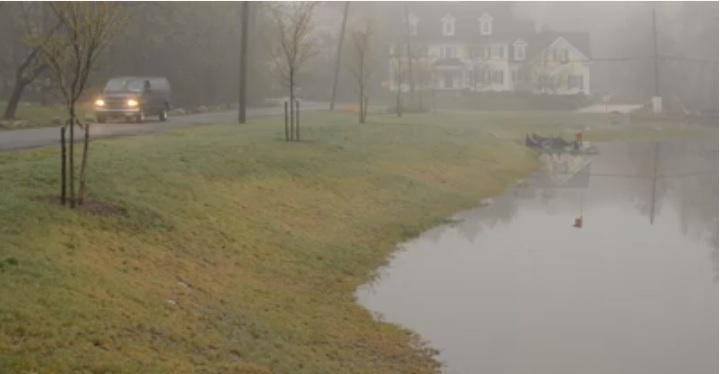
On Cushman, Willow and Sheldrake Roads residents have experienced significant flooding of their homes and yards for years. According to H2M, the existing drainage system does not have sufficient capacity to even convey a 2-year storm event. There is a watershed at the junction of these three streets which collects runoff from 118 acres, including parts of White Plains. So the benefit is not just to homeowners but for surrounding communities as well.
To address this, the proposal calls for 2,040 feet of new drainage infrastructure along Cushman Road, the replacement of seven existing catch basins and the addition of eight more.
At the intersection of Cushman, Willow and Sheldrake Road, the proposal includes the replacement of an 18” drainage pipe with a 24” pipe to increase flow, stormwater back up and reduce ponding and flooding during heavy rain events.
In addition, they recommend replacing damaged piping along Cushman and Garden Roads and Varian Lane and the installation of new catch basins.
Additional work includes:
-Increase the existing 35” pipe capacity from the intersection of Garden Road and Cushman Road to the intersection of Earlwoode Drive and Cushman Road to 54”, approximately 515’.
- Increase the existing 35”-42” pipe capacity from the intersection of Earlwoode Drive to the existing sedimentation chamber to 60”, approximately 800’.
- Increase the existing 12” capacity within Garden Road to 24”, approximately 620’.
- Increase the existing 12” capacity within Varian Lane to 24”, approximately 440’.
Commenting on the proposal, Goessl said, “The pipes on Cushman Road are already antiquated – they need to be replaced.”
At Brite Avenue and Fox Meadow Road, the existing drainage system has less than a 2-year storm capacity and there is often flooding in the streets, homes and yards.
Here engineers recommend the construction of a new supplemental drainage system along Fox Meadow Road, Chersterfield Road and Brite Avenue, consisting of pipes ranging in size from 42 to 60 inches in diameter. The new system will have a 100-year storm capacity.
However, Goessl cautioned that the installation of such a large line could impact the utility lines buried underneath the street and there are concerns about increased flow rates into the Bronx River and a backflow preventor on Brite Avenue near the tennis courts.
On Griffin Avenue, the $747,500 project cost would be split with the town of Mamaroneck. To alleviate flooding on the road, they are proposing to install a larger culvert and piping. With the county’s matching funds, Scarsdale’s share would be $175,000.
In a discussion of the proposals, Trustee Kofman asked Goessl how many homeowners would be affected by the work for each project. Goessl said he could get him that information. Goessl asked if Kofman wanted the number of homes or their lot coverage area.
After some discussion Mayor Arest raised another proposal about how to fund the work. He suggested that the residents in these areas pay for the infrastructure repairs themselves. He proposed that the Village create special taxing districts and require the residents in these areas to underwrite the cost of the infrastructure repairs and improvements. The creation of special taxing districts requires the approval of the NYS Comptroller if the tax would exceed a cost threshold of $1,010. Arest appeared to have done some research on the idea and cited two examples:
Arest mentioned a precedent involving pond work in Crane Berkeley as an example -- where a special taxing district was created and the neighborhood association paid half the cost to dredge the pond. (In this case it should be noted that the neighborhood owns the pond and is responsible for it.) Here is an account of the structuring of that debt.
He also said that something similar was done in Ithaca, New York. However, in Ithaca, there is a stormwater user fee that applies to all properties and is based on the runoff created by the property. Here are the details: “The stormwater user fee allows the City to bill each property (including those owned by tax-exempt entities) based on the amount of runoff it creates. By including more properties in the funding, the amount paid for stormwater infrastructure and services by the average residential property owner is being cut roughly in half in 2015, to under $50 per year. The fee also encourages property owners to reduce the amount of impervious surface area on their properties, which reduces the amount of stormwater runoff. Finally, because the user fees are placed into a separate account, the fee provides a dedicated funding source for these costs that is not affected by the overall economy.”
Trustee Schulhof asked that if the Village paid for these improvements, could they also impose restrictions on development and stormwater runoff that is the cause of some of the flooding. He says that residents are pumping water into the stormwater system without paying fees. He said, “not everyone can have everything they want in those areas.”
At the conclusion of the meeting, the Village Manager said she would ask the Village Attorney if accepting the matching grant funds would preclude the Village from setting up special taxing districts. If it would not, Arest favored passing the bond resolutions.
However, what if accepting the grant funds did prevent the establishment of special taxing districts? In that case, Arest did not indicate whether he supported moving forward with the bond resolutions to receive the matching funds.
There is no precedent in Scarsdale for asking individual residents to underwrite the cost of Village infrastructure, which up until now has been the responsibility of the municipality.
It raises many questions:
Is it the role of Village government to maintain the stormwater infrastructure system?
In the case of Cushman Road, is it feasible for as few as 20-30 homeowners to underwrite $7mm in work, even if some of the water flowing into their area is from White Plains and points north?
Why is the county offering matching funds to the Village if, in turn, the Village is going to pass the costs along to residents?
How would the Village determine who falls within these districts and which properties contribute to the flooding or would benefit from the improvements? The watershed is wide and drainage patterns often shift.
Is it fair to long time property owners to require them to foot the bill from issues created in part by new construction?
Arest concluded by saying, “We have a responsibility to help residents. This is clearly a priority for us overall. I can’t imagine I won’t support moving these projects forward in the best way we can.”
The Village Board will need to make a decision in just nine days about whether or not to benefit from this generous matching grant funding from the county.
Commenting on the concept of special taxing districts, Village Manager Alex Marshall said, "This was one of several ideas raised during the work session discussion. As I mentioned, I will be speaking with counsel to learn more about this process. However, it would be premature to suggest that there is consensus among the Village Board on this proposal or any of the other concepts discussed.Flood mitigation has been, and remains, a priority for the Board. As we evaluate potential approaches, it is important that the Village continue to do what it can to assist impacted residents while also considering the interests and needs of the community as a whole."
See the presentation here and watch the work session here.