






District Presents Comprehensive Capital Plan Covering School Renovations, Cost Estimates, and Athletic Field Upgrades
- Category: Schools
- Published: Wednesday, 19 November 2025 13:04
- Wendy MacMillan
 The Scarsdale School District continued shaping its long-range capital plan this week, unveiling detailed updates on elementary school renovations, districtwide cost estimates, and revised athletic field proposals. Together, the presentations, given by Kevin Walsh and Ken Schupner from BBS and Paul Tozzi and Jonathan Federico from Arris, offered a clear picture of the scope, priorities, and financial structure behind a potential bond that officials aim to keep near or under $100 million.
Edgewood and Fox Meadow: Additions, Learning Spaces, and Reconfigured Programs
The architects presented revised plans for major upgrades at Edgewood and Fox Meadow, emphasizing improved classroom environments, more flexible program spaces, and construction sequencing designed to minimize disruptions.
At Edgewood, the proposed addition, sited within the existing courtyard, preserves open space while creating new, modern kindergarten classrooms with enhanced visibility, restrooms, and dedicated learning zones. Existing classrooms marked for renovation will receive new flooring, lighting, electrical capacity, and updated infrastructure modeled on the flexible learning environments built during the 2018 Greenacres project.
Program rooms would shift to improve functionality: music and art would form a cohesive arts wing, while OT/PT, reading, and speech services would move into purpose-designed spaces. A 3D model highlighted how the addition aligns with current grade-level clusters without obstructing the courtyard.
At Fox Meadow, architects outlined an addition that would house a new first-floor Learning Commons and a new library above it. The existing library and multipurpose spaces would convert into additional classrooms, creating a net gain of four instructional rooms needed to accommodate projected enrollment.
Because the campus sits on a sloped site, architects showed how the three-story structure steps with the terrain and how play areas may be regraded or expanded. A small addition to the multipurpose room would add storage and a restroom for kindergarten classes.
Board members asked about construction logistics. Consultants said temporary classrooms should not be needed, as newly built additions will be used as swing space during interior renovations. Costs for staging, temporary access, and safety measures have been included in project estimates.
You can see all of the architectural plans in the slideshow they presented at the BOE meeting on Monday, November 17th.
Cost Estimators Detail Financial Framework, Rising AC Costs, and “Model Room” Budgeting
The next part of the presentation provided a technical breakdown of how the capital plan is being priced. All budgets begin with “today’s dollars,” based on current market rates for construction, labor, and materials. Additional layers include:
Hazardous materials abatement
Inflation across the seven-year project timeline
Construction contingencies for incomplete design elements
Soft costs, architectural, engineering, construction management, fiscal advising, and bonding, totaling approximately 18%
A major point of discussion was air-conditioning. Earlier community conversations had cited a $12 million figure, but updated calculations place districtwide AC needs at $15.7 million. The increase stems from higher equipment costs due to tariffs, upgraded systems needed for large spaces, and significant electrical work at Heathcote. Some AC expenses are embedded within larger renovation budgets, and estimators reorganized categories to avoid double-counting.
The district’s classroom renovation budget, developed using detailed “model room” pricing for every room type, now stands at just under $60 million. These models include flooring, ceilings, lighting, asbestos removal, casework, technology, and new flexible furniture, informed by building-wide 3D scans.
Board members questioned how costs were allocated in spaces undergoing major reconfiguration. Estimators said line items were structured to reflect the most realistic installation pathways and to maintain transparency as the design evolves.
Revised Athletic Field Plans Reduce Conflicts, Support Softball Relocation
The meeting also included a comprehensive update on proposed athletic field planning. After earlier field layouts were deemed unworkable, consultants introduced a redesigned plan for the Scarsdale Middle School campus.
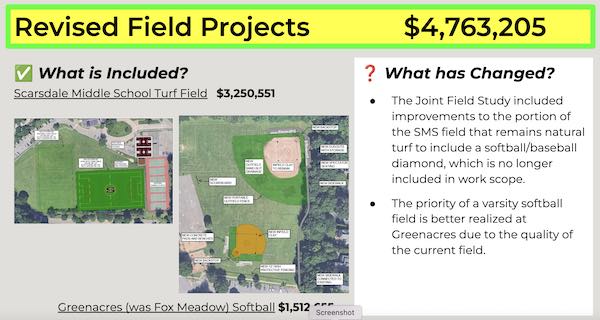
The new concept removes the previous baseball/softball configuration and instead creates two regulation-size multipurpose fields, one turf and one natural grass, each measuring 180 by 330 feet for soccer and boys’ and girls’ lacrosse. Two basketball courts will be repaved and restriped.
The presentation made clear that the revised layout eliminates conflicts between field lines and maximizes the site’s limited space. Though slightly smaller than high school fields, both meet athletic requirements. No permanent bleachers are planned, but families may use portable seating. Protective fencing and netting will be added, and required stormwater-retention features are included in current cost estimates.
Board members raised concerns about past flooding at district facilities and about pellet migration from older turf fields. The consultants related that the middle school site does not have significant drainage problems and that the new turf would use a modern stone-base system with updated infill materials, not the rubber pellets used at Butler Field.
Potential plans for Greenacres, which would house both varsity and JV softball, were also shared during the presentation. The varsity field would receive new dugouts with storage, a backstop, portable bleachers on concrete pads, a scoreboard, outfield drainage improvements, and a portable fence. The lower field would be upgraded with a new infield, simpler dugouts, and fencing to protect cars on Montrose Avenue.
Athletic Director Cindy Parrot emphasized that the softball move is driven by equity. Softball currently plays at Supply Field, off school grounds, with limited weekday access and no Saturdays. The village does not open its fields until April 1, despite the season starting March 9, forcing softball indoors while the baseball teams practice outdoors. Relocating the program to Greenacres resolves those constraints.
The changes to the athletic scope, largely the removal of overlapping baseball/softball elements at the middle school, generate an estimated $913,000 in savings.
Next Steps Toward a Bond Proposal
The district will present updated infrastructure and Building Conditions Survey data on December 15. Administrators will then outline a full recommended scope for the Board to review.
A second community survey will run from late December through early January to gauge support for the refined plan. Board trustees reiterated their intention to keep any future referendum close to the $100 million range, responding to earlier community feedback.
As design work deepens in the coming months, officials said estimates will continue to be refined before the Board finalizes the bond proposal. The links for the presentations supporting documents can be found in the meetings agenda under Capital Projects Bond Update.