








Paperwhites for the Holidays: The Easiest Bulb You'll Ever Force
- Details
- Written by: Marichal Gupta
- Hits: 386
 Paperwhites (Narcissus papyraceus) are a holiday classic: slim green stems crowned with clusters of small white, fragrant flowers. If you'd like them blooming on your windowsill or dining table by Christmastime, now is the time to get them planted. Paperwhites usually flower four to six weeks after planting, so a mid-November start lands them right on time. Timing is really the only trick. They need no chilling, no special equipment and no green thumb, just bulbs, a container and a few minutes.
Choosing your bulbs
Most garden centers carry a few varieties, and the main differences are height and scent. You can find them at Home Depot, a local nursery, Amazon, or White Flower Farm.
Ziva: The classic, and the easiest to find. It grows tall (12 to 20 inches), flowers quickly and has a strong, musky perfume that some people love and others find overpowering.
Inbal: The pick if you're sensitive to scent. Its creamy blooms are larger and only lightly fragrant, and its sturdy 12- to 16-inch stems are less prone to flopping.
Nir: A compact choice at 6 to 12 inches, good for a mantel or side table, with generous flowers and a gentler fragrance than Ziva.
Whichever you choose, look for bulbs that are firm and plump.
What you'll need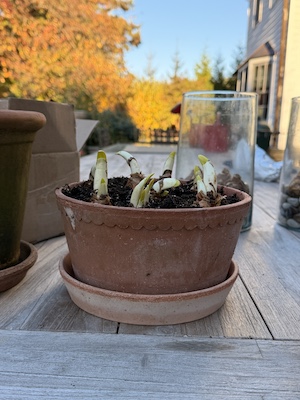
-Paperwhite bulbs, as many as will fit snugly in your container
-A container: a terracotta pot, a glass hurricane or a low bowl
-Potting soil, or pebbles, gravel or glass beads
-Sheet moss for finishing (optional)
-Water
Option one: a pot with soil
Fill a pot about two-thirds full with potting soil. Set the bulbs on top, pointed ends up, packed in so they nearly touch. Crowded bulbs lean on one another and help hold each other up as they grow. Add soil around them, leaving the top third of each bulb exposed. Water well, then keep the soil lightly moist. This is the classic method, and it gives the plants the steadiest footing.
Option two: a glass hurricane or low bowl with stones
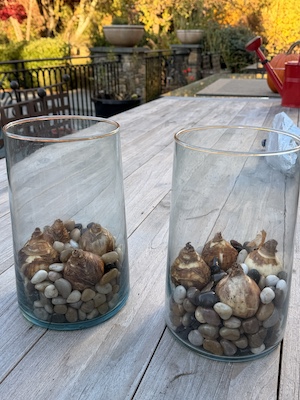
This is where paperwhites really shine. Spread about two inches of pebbles, gravel or glass beads in the bottom of a glass hurricane or shallow bowl. Nestle the bulbs in, pointed ends up, and tuck more stones around them to hold them steady. Add water until it just touches the base of the bulbs. Do not submerge them in water, or they may rot. In glass, you'll see the white roots wind down through the stones; whether that's a feature or a distraction is up to you. A tall hurricane has a practical advantage, too: its sides help hold the stems up as they stretch.
 Finishing touches
You can tuck a layer of sheet moss over the soil or stones, such as this one, for a professional look. You can also plant several small containers to give as hostess gifts throughout the season.
Care tips
-Keep the containers somewhere cool and bright. Too much warmth makes the stems leggy.
-Check the water every few days and top it up so it reaches the roots.
-A handy trick: once the shoots are a couple of inches tall, swap the water for a mix of about one part vodka or gin to seven parts water. Research at Cornell found this stunts stem growth a little, giving shorter, sturdier plants that are less likely to flop.
-Once the stems reach 8 to 10 inches, give them some support. A bulb ring works, or simply push a few bamboo or wooden stakes discreetly around the edge of the container and loosely corral the stems with twine or a festive ribbon.
-For blooms through the holidays and into winter, plant a new batch every two weeks through January.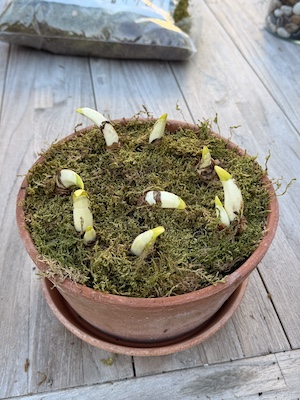
That's it!  Plant this week or weekend and you'll have a burst of white flowers in time for your holiday gatherings. It takes about ten minutes, and it's hard to get wrong.
Contributor Marichal grew up in the Berkshires and now lives in Scarsdale with her husband, two kids, and adorable mini Aussie. A former baker, she loves cardamom buns, sungold tomatoes straight off the vine, and hunting for vintage Swedish ceramics.
Scarsdale Foundation Bowl Committee To Select 2027 Honorees
- Details
- Written by: Joanne Wallenstein
- Hits: 531
 The 2027 Scarsdale Foundation Bowl Committee invites nominations for both the 2027 Bowl Award recipient and 2027 Spotlight Award recipient. Nominations for both awards are due by December 4, 2026.
The Scarsdale Bowl is the highest honor bestowed on a Scarsdale resident in recognition of their volunteer public service in the community. Under the auspices of the Scarsdale Foundation, the Scarsdale Bowl has been awarded annually since 1944 to an individual or, in exceptional cases, to a married couple or domestic partners who have given “unselfishly of their time, energy and effort to the civic welfare of the community.”
The founding donors of the Bowl believed that “many who serve generously and voluntarily, without office, honor, or publicity, are those deserving of having their names permanently inscribed on the Scarsdale Bowl.” The Bowl itself, engraved with the names of the honorees, is permanently displayed at the Scarsdale Public Library.
Scarsdale Bowl candidates must be Scarsdale residents who do not currently hold elective office. To access the Bowl Award nomination form, please visit this URL:
The Spotlight Award, first presented by the Scarsdale Foundation in 2023, is a newer tradition that honors an individual or organization that has made a significant impact and brought about positive change in one targeted sphere of community engagement.
Spotlight Award candidates must be Scarsdale residents or institutions, and individuals may not currently hold elective office. To access the Spotlight Award nomination form, please visit this URL:
This year, the Scarsdale Foundation Bowl Dinner will be held on April 15th at Mamaroneck Beach and Yacht Club. The event will pay tribute to the honorees while celebrating the spirit and culture of volunteerism in Scarsdale. Funds raised at the dinner will enable the Foundation to continue its mission of quietly but effectively helping local individuals and community organizations through student scholarships and project grants. Most significantly, the Scarsdale Foundation has awarded more than $1.5 million in scholarships during the past ten years to Scarsdale’s high school graduates in their sophomore, junior and senior years of college.
Dr. Michael and Jennifer Rosen of Eye Gallery of Scarsdale are returning as Champion Sponsors, continuing their generous support of the Scarsdale Bowl celebration.
The 2027 Scarsdale Foundation Bowl Committee members are: Lisa Copeland, May Cowan, Kathy Gray, Warren Haber, Sharon Higgins (Treasurer), Meredith Love Kent, Linda Kermanshahchi, Ken Mazer, Laura Miller, Bill Natbony (Secretary), Nadine Pepin, Rob Tepper, and Elaine Wang. Pam Fuehrer is serving as Chair. Isabel Finegold and Toby Milstein Schulman, Scarsdale Foundation Trustees, will also serve on the committee as liaisons, along with Seema Jaggi, President of the Scarsdale Foundation Board.
We look forward to gathering on April 15th to recognize all that makes Scarsdale a special place to live, and to raise funds for the benefit of generations to come.
Questions? Please reach out to Pam Fuehrer, Bowl Chair at pfuehrer3@gmail.com, or scarbowl@gmail.com. More information about the Scarsdale Foundation can be found at www.scarsdalefoundation.org.
Sportswriter S.L. Price Discusses America's Oldest Game: Lacrosse - At Scarsdale Public Library
- Details
- Written by: Brian T. Brown
- Hits: 1187
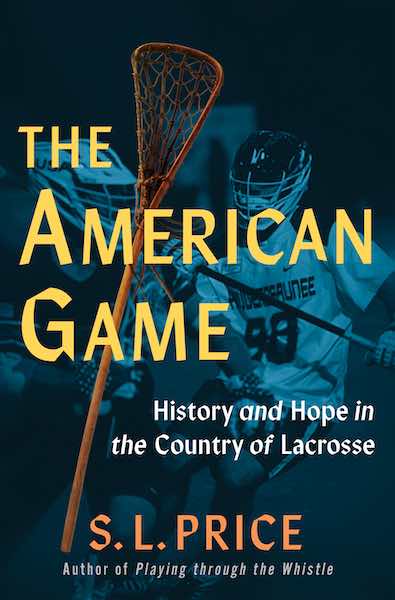 On Wednesday, November 4, at 6 p.m., S.L. Price will be appearing at Scarsdale Library to talk about his latest book, The American Game: History and Hope in the Country of Lacrosse.
One of America’s most acclaimed sportswriters, Price’s new book addresses the winding, epic story of our country’s oldest game – created a millennium ago by Indigenous people and perfected by the Haudenosaunee nation in upstate New York.
Many will know Price for his heralded and often gripping pieces at Sports Illustrated, where he authored 47 cover stories.
His award-winning books, classics of journalism and language, have dissected the culture of a Western Pennsylvania football stronghold, uncovered the roots of Cuba’s astonishing sports dynasty, and chronicled the often merciless world of minor league baseball.
The American Game – winner of the 2026 Jenkins Medal for Excellence in Sportswriting and based on seven years of research – is perhaps the most definitive work ever written about lacrosse culture, and explores how the game, perhaps more than any other, describes America’s long fitful attempt to bend the arc of the moral universe toward justice.
Price provided this exclusive interview to Scarsdale 10583 …
You were raised in Stamford, Connecticut. What elements of that upbringing played a role in becoming a writer?
My Dad was a real devotee of American history, and he and I used to quiz each other on American history. He was a member of your classic, reserved World War II, Korean War generation. Men who didn't speak a lot about their feelings. So the way we spoke to each other, the language we spoke to each other, a lot of it was based on our mutual love of American history. So there was that. And then my Mom was incredibly good at sitting down and talking to people. And I didn't realize it at the time, but she taught me curiosity and taking an interest in people and how to talk to them and interview them. And my best friend from high school, Bruce Schoenfeld, was a year ahead of me, and he went off to Harvard and was on the newspaper and he opened up to me this whole world of sports journalism, which I just really had no idea of.
What was your first experience writing sports journalism?
I joined the school newspaper at the University of North Carolina to get a lot of reps and become better as a writer because I knew I needed a lot of reps to get better, and there's no better place than a school newspaper, especially because sports are often the most important and the most interesting subject to students.
You worked for several newspapers and became a celebrated writer at Sports Illustrated. Is there a consistent theme in the stories you’ve written through the years? Author S.L. Price
I began my career at the Sacramento Bee, and I was the beat writer for the NBA’s Sacramento Kings when they moved from Kansas City to Sacramento. Very quickly, I understood the idea of sports as a mirror of a culture – and the enthusiasms of it beyond competition were fascinating to me. Sacramento thought, “If we get a Major League team, that makes us a Major League city.” And so that sort of planted a seed, which is like, “Wow, sports is not just bats and balls.” And, so, many of stories I've done that have resonated most with people are usually not just about sports, but in some way how sports sort of either mirrors or channels, the hopes, dreams, desires, passions, hatreds, prejudices of a school, town, city, country.
You have said that there is also something incredibly honest about sports. Can you elaborate?
When sports are part of the picture, people can't help but tell you who they are. Our games reveal us. You look at the field, and these athletes are playing at the height of their powers, under the most pressure, and they can't fake it. They can't fake who they are under that kind of pressure. You'll see them cry and laugh and scream and yell and swear, and you get a pretty good sense of who that person is. And, then, you turn around and look in the stands, you see people of all kinds of different backgrounds, races, income levels, all screaming or crying or laughing or whatever it is, seeing themselves in what they're watching on the field in a way that they don't really express any other way, and coming together as one and expressing together who they are. And those moments of deep passion happen because they love their team, they love their city, they love their region.
And because of that, you can write about any topic in sports. As long as there's somebody in that story bouncing a ball and shooting it or competing against somebody, people will pick up that story and read it. And you can sneak in all these other issues and talk about issues that are much larger and much broader. And you can maybe touch people in a place, in a way, that they didn't expect. And tell a story that they otherwise wouldn't be interested in, or a trend, or an issue that's important and bears scrutiny. I played one-on-one with Obama. I've met Clinton. I met George W. Bush when he was the owner of the Texas Rangers. So I was able to do all that all under the guise of being a sportswriter and to indulge my love of history, my love of the culture, my interest in the changing face of America. Sports has allowed me to do it, and it's given me a platform that otherwise I probably never would have had.
The American Game is your fifth book. What drew you to what is a sweeping story about lacrosse?
Lacrosse inspires a very cultish following and an intense devotion. And I can't tell you how many times I was told across the board – people old, young, black, white, Latino, male, female – how they were bitten by the stick, bitten by the game. They picked up the stick, they couldn't put it down. They were into other sports, more popular sports, but something about lacrosse got to them and, over and over, someone would say to me, “Well, I gotta confess something. I actually, for like two years, slept with my stick." So there are people who really think this game is great. And they don’t understand why this sport isn’t more popular. It's got everything. It's got hand-eye coordination, and a little bit of violence, and speed and dynamism and magical stick handling – behind-the-head shots, and so on and so forth. Lacrosse people believe the game is important and they don't understand why the world doesn't understand it. But I think it's more important than even the lacrosse people understand it to be.
Lacrosse is America’s oldest game. For those who may not know, how old is lacrosse, and who is credited with inventing the game?
So lacrosse was created about a thousand years ago, and no one knows exactly when or specifically where. The Indigenous people of this continent – from all over, North, South, and West – played a variation of the stick and ball game. But the field game – which has realized its highest expression at American Division I colleges – traces back to the Haudenosaunee Confederacy, previously known as the Iroquois Confederacy, which is basically located on either side of the St. Lawrence River, in northern New York and, on the other side, southern Ontario, Canada.
How many nations are part of the Confederacy?
The Haudenosaunee Confederacy is comprised of six nations. The most recognizable to a lay audience would be the Seneca and the Mohawk, but also the Onondaga, Tuscarora, Oneida and Cayuga. And the capital of the Haudenosaunee Confederacy is basically Onondaga, which is located near Syracuse, New York. The great faith keeper of the Onondaga, Oren Lyons, who is 96 and still living and one of the great Indigenous activists of the last fifty years, insists to me that Onondaga was where lacrosse was invented, but, essentially, no one knows for sure.
Did Oren Lyons play lacrosse?
Yes, Oren Lyons is also a notable figure because he was a teammate of Jim Brown. For most people, the most famous name that comes up whenever lacrosse is mentioned is still Jim Brown, perhaps the greatest running back in NFL history – and some people believe he's the greatest player overall. Many people in lacrosse feel that Jim Brown, who played at Syracuse, was the greatest lacrosse player of all time. There have been many great players since, and it's very hard to compare eras, but Jim Brown's All-American teammate and goalie at Syracuse was Oren Lyons. And Oren Lyons and two partners – Wes Patterson, a Tuscarora stick maker, being one of them – co-founded the Iroquois Nationals. Now they're called the Haudenosaunee Nationals. The team was founded in the 1980s as a vehicle for sovereignty for the Haudenosaunee, and they have an extremely small talent pool compared to the United States and Canada, and yet they're the third-best team in the world.
Many people grew up using Iroquois to describe this group. Why was it decided to change the name to Haudenosaunee?
Well, the Haudenosaunee have always called themselves Haudenosaunee, which translates as “People of the Longhouse.” Iroquois was a name dubbed by the French. But because of common usage, it’s obviously what everyone called them for 500 years. Oren Lyons is as fierce a nationalist as there is, but he didn't really take offense at the word “Iroquois.” It was simply the most recognizable name for the program to use at the time it was founded. As a wave of ethnic activism sort of swept the country in the early 2020s, I think the Haudenosaunee began rethinking how they were regarded and they felt, “You know what? We need to make sure people understand who we are.” And so no one really blinks if you call them Iroquois, but they appreciate if you actually follow what they've now decided, since 2021, officially calling themselves the Haudenosaunee Nationals – not to mention the Haudenosaunee Confederacy.
Isn’t lacrosse a French word?
Yes. French missionaries in the 17th century came across Native Americans in northern New York playing lacrosse as a medicine game for healing the community. It's a spiritual practice to this day. The suspicion is that it was called lacrosse because the stick resembled a bishop's crozier – the curved staff used in the Catholic religion.
Can you explain more about why the Haudenosaunee thought it necessary to form their own national team?
To start, keep in mind that when it comes to Native Americans, and certainly the Haudenosaunee specifically, the one phrase you're gonna hear over and over whenever speaking to anyone about Native American life is, “We are still here. People forget about us, but we need for them to understand that we're still here, we're still a vibrant part of this country. We're not a piece out of history or old cowboy movies with John Wayne.”
When the Haudenosaunee lacrosse team travels to international competitions, they use their own passports – not a U.S. passport. Isn’t this part of a long history of fighting for recognition as a sovereign state?
In 1794, the Treaty of Canandaigua was signed, stipulating that the United States would annually pay the Iroquois Confederacy $4,500 worth of implements and goods – such as farm implements. Over time, that morphed into muslin. And that treaty is still honored to this day by the United States government. The Obama White House actually had a ceremony where they officially refreshed the treaty. But every year, unceremoniously, a FedEx truck pulls up to the capitals of each nation and drops off a certain amount of muslin, to be divided up between all the people. And, depending on the market value, it could be a yard, two yards, a few inches. One of the general managers for the Haudenosaunee team got married in a shirt made out of the treaty muslin. There's a piece of artwork at the Smithsonian made out of the treaty cloth. The point is, the treaty is a living document. And back in the 1950s, the U.S. said, “Can we stop doing this? Give you a bulk of money, and stop doing this muslin thing?” And the Haudenosaunee said, "No, no, no, no, no. This is a treaty, which, by very definition, is between two nations. You recognize us as a nation. You're gonna keep paying us." They've insisted on that ever since.
But, as you write in The American Game, when the Haudanesaunne decide to form a national lacrosse team, they had a big problem. They didn’t really play the field game anymore.
Not institutionally, though their Medicine Games never ended. By the 1930s, lacrosse had become a white man's game in Canada and the owners of the NHL teams – the Toronto Maple Leafs and the Montreal Canadiens – thought, “We've got these empty arenas. Let's do something to fill them.” And they created indoor lacrosse – box lacrosse. Which became an instant sensation in Canada, and almost immediately rendered field lacrosse there irrelevant. The Native Americans were also allowed to play it and so that became, in many ways, the main Haudenosaunee game – box lacrosse.
Meanwhile, the Americans picked up field lacrosse, and over the next 50 years, raised it to a level at U.S. colleges that had never been seen before. The U.S. remains the number one team, and have won by far the most world championships. And though, over the decades, a trickle of great Haudenosaunee had played collegiate field, too, mostly at Syracuse – box reigned as the supreme Haudenosaunee variation, and there had been a disengagement from field developments and strategies.
However, as we learn from your book, winning world championships wasn’t the primary goal, anyway.
So when the Haudenosaunee Nationals, then-named Iroquois Nationals, were started in the 1980s, it was first of all seen as a reclamation of their original Creator's game. But, very quickly, within two or three cycles, the Haudenosaunee passed England and Australia and became one of the premier field powers. But the quest for sovereignty and the use of lacrosse as an expression of identity has always trumped what is, basically, the cardinal mission of all sports, which is. “We want to win.”
And, as you detail, the Haudenausonee won’t even step on the field if official recognition is denied.
In 2010, when their passports weren't gonna be recognized by England, the men's team pulled out of the championships. The U-19 women pulled out of another in 2015. And then in 2018, going to Israel, it came down to the last flight. The Haudenausonee were stuck at Toronto Airport, and there were all kinds of machinations because Israel is maybe supreme among nations in terms of border security, and were very wary of the Haudenosaunee coming, and there were all these negotiations going on, and the Haudenosaunee were willing, yet again, to not compete for the world championship if their passports were not recognized. But in 2018, their passports were recognized by Israel, and that is considered a great victory for the mission of the team.
Can you address the effort by the Haudenosaunee to participate in the 2028 Los Angeles Olympics as a separate nation?
The International Olympic Committee, the IOC, does not recognize the Haudenosaunee as a nation. If you're recognized by the United Nations, the IOC will recognize you as a nation. Also, you have to have a National Olympic Committee. The Haudenosaunee don't have that United Nations recognition, nor do they have a National Olympic Committee. For the latter, you need at least five sports recognized by the sporting federations. The Haudenosaunee have one – men's and women's lacrosse.
But they desperately want, as a form of recognition and of their sovereignty and identity, to play in the 2028 Olympic Games in Los Angeles, where lacrosse, for the first time in 80 years, will be contested. So they would like desperately to compete under their own flag and they’ve been campaigning for this. And the Biden Administration came out in support of the Haudenosaunee competing under their own flag in Los Angeles. But the IOC has repeatedly replied in the exact same way, which is that the Haudenosaunee are not recognized, and they're more than welcome to try out for the U.S. or Canadian teams.
In general, what has been lacrosse’s response to the IOC position?
The Haudenosaunee are still campaigning and World Lacrosse, who is in favor of the Haudenosaunee playing in the Olympics, has made it clear the Haudenosaunee are part of the qualifying process. And even though, right now, the Haudenosaunee are officially not allowed to play at the 2028 Los Angeles Olympics, they are involved in the qualifying process for the 2028 Games, which means that it's quite possible that a year from now, the Haudenosaunee, because they are the third-best team in the world, could qualify, and it's quite possible then that the IOC will continue its stance and suddenly you have not just an identity or sovereignty issue, but a competitive one, which is just that your basic sports fan is going to say, “Wait a minute, how is this competition in any way legitimate if the third-best team in the world is not allowed to play?” And in the meantime, you're gonna have people saying, “Wait a minute, the creators of the game, who are also great at the game, are not being allowed to play.” And it just so happens that these Olympics are being fielded and contested on what was once Native American land. And so you can see that the situation is rife for controversy, and it's a shame because the IOC doesn't seem to recognize that it's an absolute public relations boon if they allow the Haudenosaunee to play – and a disaster if they don't.
For readers in general – and specifically for Scarsdale lacrosse players, coaches, and parents – what might you hope they’d find of value in reading your book?
I’d hope they’d gain an appreciation for the depth of the game, and the spiritual depth of it, which is unlike any other game. And the historical depth of lacrosse, which in many ways serves as a metaphor for literally 500-plus years of the history and the collision of white and Indigenous cultures on this continent. And understand that this sport mirrors so much of American culture – from Wall Street finance, to the expanding and changing role of women, to racism and drug use, to this incredible bond with the military that's unlike any other sport. The layers of the game go so far beyond the caricature of the game. I think the sport has incredible layers, incredible dimensions, and it's worth everybody's time and everybody's passion … and it's a wonderful pastime. And, frankly, I think in many ways it’s the most American game there is.
Shop the Village. Read the World. The team at Scarsdale’s Bronx River Books – established by the truly engaging bibliophiles Jessica Kaplan and Mark Fowler – will be at S.L. Price’s November 4 Scarsdale event selling copies of The American Game. For more about Bronx River Books, check out their website: bronxriverbooks.com.
All Aboard for the Scarsdale Historical Society Trolley Tour
- Details
- Written by: Joanne Wallenstein
- Hits: 815
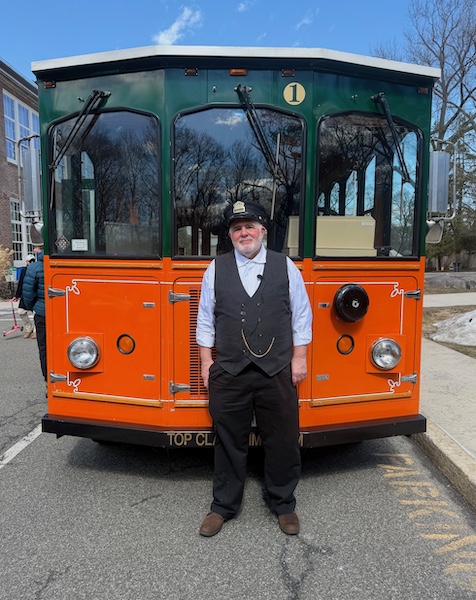
 Scarsdale Trolley Tour
November 1, 2026
Departures at 10:00 AM, 12:30 PM & 3:00 PM
Members: $30 | Non-members: $45
Climb aboard for a journey through Scarsdale’s past as we celebrate the Village’s 325th anniversary (and America’s 250th)! This family-friendly 90-minute guided trolley tour will explore the people, places, and stories that shaped early Scarsdale.
Along the way, we’ll uncover remnants of an earlier Scarsdale that are still all around us—historic homes, former estates, and places where Revolutionary War events unfolded - all hiding in plain sight if you know where to look.
Tickets are very limited. Scarsdale Historical Society members enjoy special ticket pricing, so it’s a great time to join!
Capretta Hits the Ground Running in Scarsdale
- Details
- Written by: Joanne Wallenstein
- Hits: 2488
 The managers of Scarsdale’s newest Italian restaurant, Capretta, have hit the ground running. The opening was long anticipated, and shoppers watched for months as the space formerly occupied by Japanese restaurant Akai underwent its transformation.
When Capretta finally opened in late September, diners were greeted by a colorful tile floor, a long bar, a large wood-burning oven, and a façade of windows that open onto the Spencer Place sidewalk. Even better, the proprietors, Z Hospitality Group, are experienced restaurateurs who operate well-known spots such as Terra and Mediterraneo in Greenwich and Aurora in Rye. They have the know-how to bring first-class food and hospitality to Scarsdale’s discerning but welcoming clientele. Capretta has been an instant hit.
We were invited to dine on a Monday, and the restaurant was already packed and lively. If this was what Monday night looked like, we could only imagine the scene on a Saturday!
Despite the crowd, we had plenty of space and could easily hear our companions over the buzz of conversation.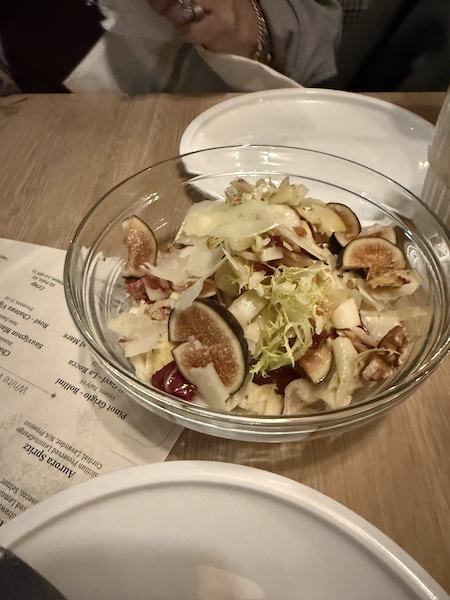
A look at the menu revealed so many appealing options that choosing was no easy task. Fortunately, we were attending a tasting and had the opportunity to sample a wide range of dishes.
First, the libations. Recognizing that some diners prefer lower-alcohol or alcohol-free options, the drink menu is divided into several categories. There are proprietary cocktails featuring creative combinations, classic cocktails, and four fruity spritzes made with nonalcoholic prosecco. A collection of aptly named “Placebo” drinks offers alcohol-free alternatives that look just as enticing as their spirited counterparts. There is also a pleasing selection of red and white wines, along with beers to suit a variety of tastes.
The food menu has something for everyone, including vegetarians, pizza aficionados, pasta lovers, and those seeking a satisfying main course. Choices range from chicken and fish to steak, pork chops, and even braised short ribs. With so many tempting dishes, it was difficult to know how much to eat—or how to save room for what was coming next!
We began with an endive and chicory salad tossed with Black Mission figs, walnuts, and cheese in a white balsamic dressing. It earned rave reviews around the table. Other starters included veal meatballs in tomato butter and zucchini flowers stuffed with shrimp and mascarpone, served with a tomato marinade.
Needless to say, I was already feeling full before two irresistible pizzas emerged from the wood-burning oven.
The first was topped with San Marzano tomatoes, wild oregano, and pecorino cheese. Its crust was crisp, with just the slightest char, and the pizza was delicious enough to stand on its own as a meal. Next came “The Detroit,” a deep-dish pie topped with pepperoni, cherry peppers, and garlic, then finished with spicy honey.
Need I say more?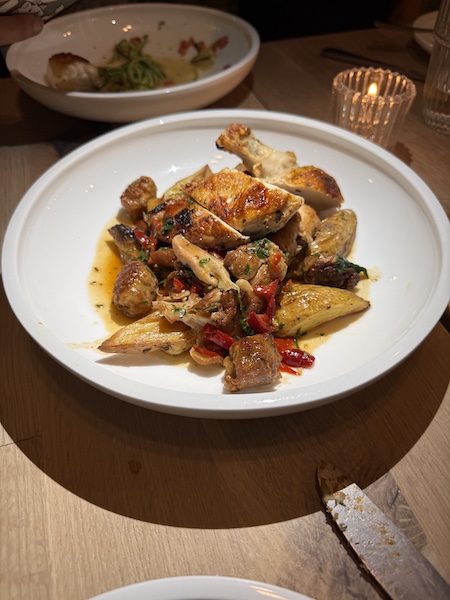
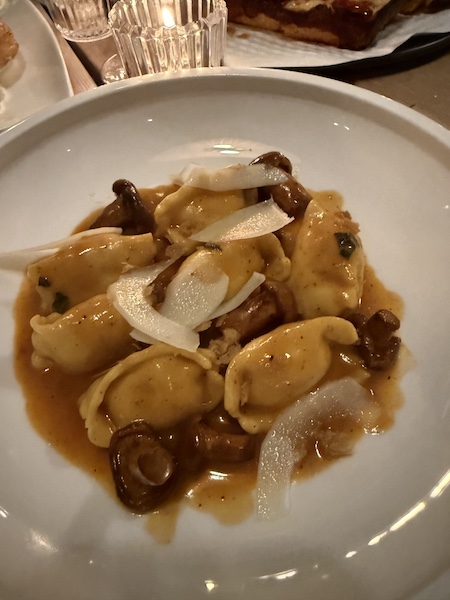
Another standout came from the pasta menu. The agnolotti—half-moon-shaped stuffed pasta pockets—were filled with roasted chicken and served with chanterelle mushrooms in a rich brown sauce. Delicious!
Next time, I’ll pace myself, skip a few appetizers, and save room for the main courses. The Parmesan-crusted halibut, served with zucchini noodles in a beurre blanc sauce, was voted the group’s favorite. The Chicken Scarpariello, accompanied by sweet sausage, roasted potatoes, and cherry peppers, was another hit. We rounded out the savory courses with rich, braised short ribs served with potato pavé and a mascarpone-horseradish sauce.
My companions ordered dessert, and everything looked delicious. Sadly, by that point, I simply couldn’t manage another bite!
It was truly a feast, and Capretta delivered on every level: an appealing setting, a lively atmosphere, and a menu that offers something for every taste. I’ll be returning to 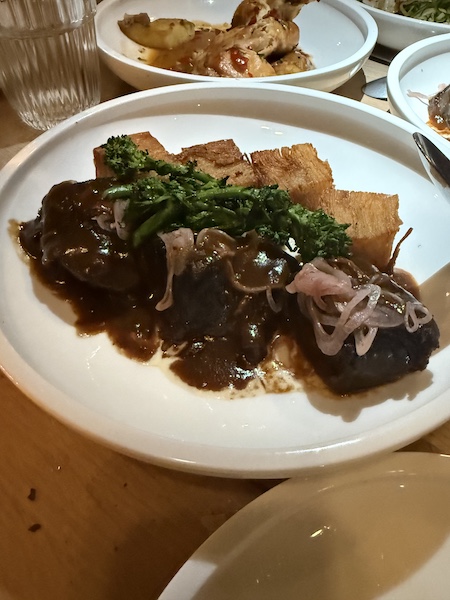 this happening spot as soon as I can reserve on Open Table.
Buon appetito, Scarsdale!
Capretta
57 Spencer Place
Scarsdale
(914) 202 6900