







Scarsdale Students Post Strong Results as District Expands Performance-Based Assessments
- Wednesday, 19 November 2025 15:45
- Last Updated: Wednesday, 19 November 2025 16:23
- Published: Wednesday, 19 November 2025 15:45
- Wendy MacMillan
- Hits: 2069
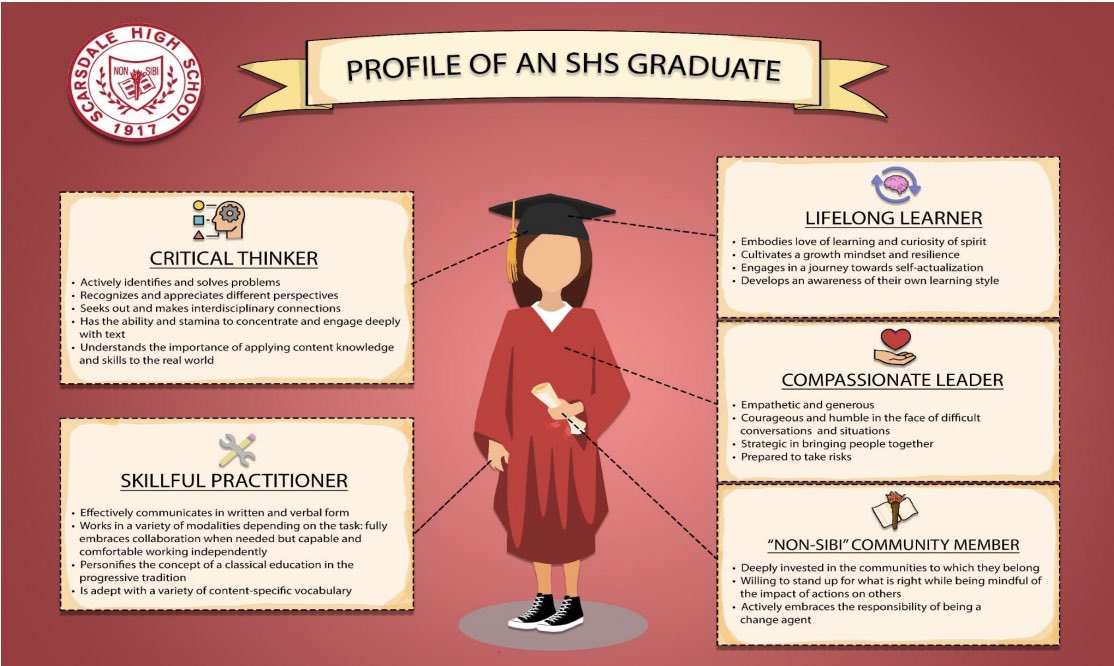 Scarsdale students continue to demonstrate high academic achievement across standardized measures, according to an annual assessment report presented to the Board of Education on Monday November 18th. In his three-part report, Assistant Superintendent of Curriculum, Dr. Edgar MacIntosh also outlined findings from a recent Tri-State Consortium review that praised the district’s instructional practices and recommended further expansion of performance-based assessments.
College Readiness Indicators Remain Strong
Dr. MacIntosh reported near-universal college enrollment among Scarsdale High School graduates, consistent with previous years. For tracking admissions trends, the district now uses the U.S. News & World Report lists of top universities and liberal arts colleges after the Barron’s “Most Competitive Colleges” index ceased regular publication. A slide shared during the presentation showed that in 2025, 69% of Scarsdale graduates went on to attend one of U.S News designated top 50 colleges or universities. MacIntosh includes a complete list of these colleges in his presentation’s supporting documents.
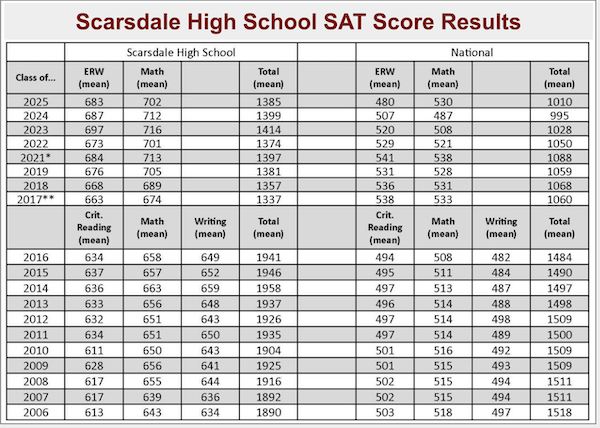
Also consistent with previous years, Scarsdale students recorded high mean scores on both the SAT and ACT. Furthermore, these results showed that an overwhelming percentage of students meet College Readiness Benchmarks, indicating readiness for first-year college coursework. Comparisons with other high-performing local districts show Scarsdale students maintaining a leading position.
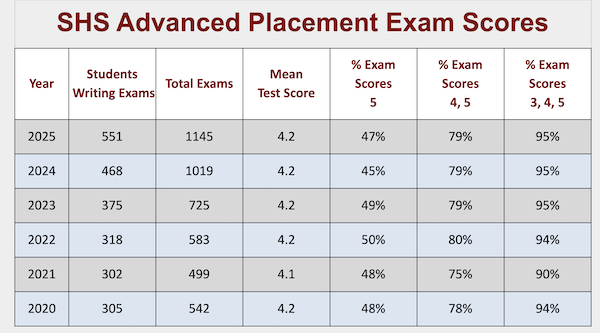
MacIntosh went on to describe that AP exam participation by Scarsdale students continues to rise, including among younger students. Administrators have suggested that some families may believe AP testing strengthens college applications, though college admissions officers have not indicated that AP scores provide an advantage. Board members asked for additional data on test-taking patterns and potential implications for college credit or placement.
State Testing Results Show Consistent Performance
Scarsdale elementary and middle school students continued to outperform statewide, regional, and other high performing-peer districts averages on New York State assessments in English language arts, mathematics, and science. MacIntosh cautioned that year-to-year variation between Scarsdale’s elementary schools is typical and influenced by cohort size and student needs. He also noted that a statewide increase in ELA scores this year was attributed to changes in the exam, not to the shift toward computer-based testing.
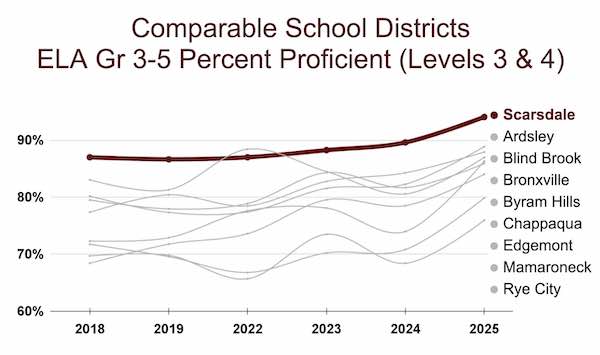
Regents exam results at the high school level also reflected incredibly strong proficiency across core subjects.
You can see all the data presented in the slideshow here.
While the district acknowledged the role of standardized exams in providing broad measures of student achievement, MacIntosh made sure to emphasize that these assessments offer only a “small portion” of the district’s overall approach to evaluating student learning. He added that internal benchmark assessments, progress monitoring, formative tools, and performance-based tasks offer a more detailed and actionable picture.
Tri-State Review Affirms District Practices
The Tri-State Consortium, a collaborative of high-performing districts, conducted an in-depth review of Scarsdale’s assessment system. After observing classrooms, interviewing stakeholders, and reviewing more than 300 teacher-created assessments, the team concluded that Scarsdale’s instructional practices align with the district’s strategic priorities.
Commendations included strong student engagement, widespread use of inquiry-based instruction, and extensive opportunities for student choice and authentic learning. Programs such as the Middle School Choice Program, STEAM pathways, and elementary science performance units were cited as aligned with district goals.
The consortium recommended that the district adopt a clear, shared definition of performance assessments; expand professional development on assessment design; address student stress related to grading and workload; and communicate more frequently with families about assessment practices.
Shift Toward Performance Tasks Gains Momentum
In his report, MacIntosh highlighted the growing use of performance-based assessments, which allow students to demonstrate understanding through open-ended, real-world tasks. A video shown during the meeting featured students and teachers describing project-based math problems, engineering design challenges, and interdisciplinary tasks that require collaboration, reasoning, and reflection.
Board members praised the student perspectives and asked how assessment practices intersect with the district’s ongoing facilities planning. MacIntosh related that flexible classroom spaces are increasingly important to support collaborative learning.
Next Steps
The district plans to incorporate the Tri-State recommendations into ongoing work around curriculum, assessment, and teacher professional learning. MacIntosh stated that the district’s goal is to maintain strong performance on standardized measures while expanding assessment practices that more accurately capture student thinking and real-world problem-solving. “Standardized tests give us one snapshot,” he said. “Our performance tasks show much more about how students learn.”