







Reflections on the 25th Anniversary of 9/11
- Tuesday, 15 September 2026 15:24
- Last Updated: Tuesday, 15 September 2026 15:32
- Published: Tuesday, 15 September 2026 15:24
- Joanne Wallenstein
- Hits: 614
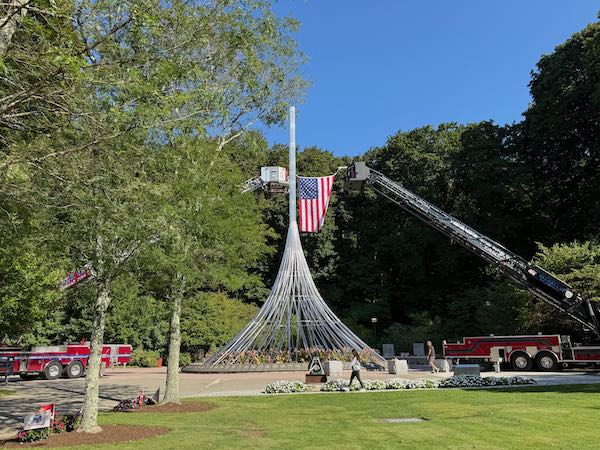 Though it’s been 25 years since the September 11 attacks, many of us can remember where we were as it was yesterday. It’s surprising how vividly people can recount what happened to them on that fateful day.
Here are a few reflections from Scarsdalians:
Jeannie Rosenthal – President Scarsdale Rotary
I was in midtown on 9/11/2001. While on a Metro North train from Scarsdale, we learned that a plane had hit the WTC and the subway was closed. Everyone groaned at the inconvenience. As I headed on foot across town toward my office I saw the gaping hole through the second tower and floated towards it, transfixed. I rushed into a camera shop so I might buy a camera to get a photo. While inside, a crash outside shook the ground and when I ran out, the second tower was gone. Through streets of people covered in dust and blood, I ran east to the East River where I intended to jump and swim to the Bronx, a logical move if Manhattan was under siege, as it seemed to be. A boatman ushered me aboard a ferry which took me to somewhere in New Jersey. Aboard, I met a girl my age who invited me back to her house. We ate Greek food on her porch overlooking the Hudson River and watched the tower rubble smoking all afternoon until my dad picked me up. I had a proper emotional breakdown after that. I quit my job and moved far from New York.
I am back among my people now and understand how those planes tore holes through so many families and lives. Families, bodies, health, well-being, mangled that day and in all the time since, scars physical and emotional aching Every. Single. Day.
I want those who have experienced the massive losses of 9/11 personally to feel some comfort of community.
Andrea Seiden, Greenacres Avenue
After the fall of the Twin Towers, Grand Central Terminal became a makeshift memorial to the missing victims of 9/11. Gone were the hurried commuters hopscotching across the giant marble slabs, weaving around one another with cups of coffee in one hand and folded newspapers in the other. Seemingly out of respect for the missing, no one sprinted for the downtown subway or rushed to grab a toasted bagel at Zaro's. The frenetic rhythm of the city had been replaced by a profound stillness. An eerie quiet settled over Manhattan.
People moved softly, speaking in hushed voices, each trying to process the unimaginable.
For weeks after the unspeakable tragedy, every morning as I stepped off my train and walked through the great hall, shafts of sunlight streamed through the towering windows, giving the terminal the hazy quality of a steam bath. As my eyes adjusted to the morning light, I felt a haunting energy emanating from the makeshift exhibition of missing-person flyers that families and friends had begun hanging on every available surface.
Each one asked the same heartbreaking question:
Have you seen...?
What began as a handful of posters quickly grew into a dizzying gallery of ordinary people who had never made it home on that impossibly bright September morning.
As I emerged from Grand Central and looked downtown, I could still see enormous plumes of smoke rising from the place where the Twin Towers had once stood. The skyline looked wounded, as if part of the city itself had been erased. The air carried the unmistakable smell of smoke and ash. A fine gray dust drifted through the streets, settling on windowsills, parked cars, and the shoulders of pedestrians. Sometimes I could taste it.
I couldn't help but wonder what the ash contained. I imagined it held the remnants of ordinary lives—countless documents people had painstakingly prepared, family photographs tucked into desk drawers, handwritten notes, children's drawings, appointment calendars, letters never mailed, favorite books, framed diplomas, and the thousands of everyday objects that had quietly filled offices only days before. Those fragments had been swept into the sky and scattered across the city. Even the air seemed to carry the weight of unimaginable loss.
My walk from the train to my office forced me to pass the same faces every day. Over time, I began to feel as though I knew them. After all, they looked like the very people I had passed on sidewalks, trains, and elevators every morning before the attacks. Inevitably, I began inventing stories about the lives behind those photographs.
There was a young woman sitting on her dorm room bed, smiling up at the camera in a Fordham University T-shirt. She radiated hope and promise. I imagined she had just started her first job in Tower One, excited for the future that now would never come.
Near the side entrance to the terminal was the smooth face of a man in his thirties, dressed in a crisp suit and tie. His confident smile seemed to embody optimism and ambition, as though he had come to New York to build a life filled with possibility.
Then there was a woman about my age, walking arm in arm with two close friends. I imagined the photograph had been taken during a weekend hike in the Berkshires. She wore a red bandana and carried a small daypack slung over one shoulder. I found myself wondering what she had packed that morning for the hike—and then wondering whether she had carried that same backpack with her to work on that fateful Tuesday.
I was struck by how young so many of them were. Their lives appeared to be just beginning.
Day after day, I passed those same faces. Gradually, they became more familiar to me than many of the people rushing past on the sidewalks. Their smiles, frozen forever in moments of celebration and ordinary happiness, began to feel more alive than the living.
The rest of us moved through the city like ghosts.
We went to work because we didn't know what else to do. We sat at our desks, stared blankly at computer screens, answered telephones, and attended meetings, but our minds were elsewhere. We were frightened, exhausted, and still in shock, unable to concentrate on anything beyond the collective tragedy we had experienced. Every conversation eventually circled back to September 11. Every glance toward lower Manhattan reminded us of what had been lost. Every siren made us stop and look.
The faces on those posters seemed to possess a vitality that the rest of us had misplaced. They smiled from birthday parties, weddings, graduations, vacations, and family gatherings, forever suspended in lives interrupted. We wandered through our days in a haze of grief and disbelief, carrying an unspoken question that none of us could answer: How could the world continue when so many lives had stopped?
Everywhere you went in New York City, there were posters asking if anyone had seen a missing husband, wife, son, daughter, brother, sister, or friend. Makeshift memorials sprang up on street corners, in parks, outside firehouses, and along neighborhood sidewalks. Flowers wilted beneath flickering candles. Teddy bears, rosaries, handwritten prayers, and American flags accumulated in quiet shrines across the city. Perhaps the saddest reconning was walking past a midtown fire station each day. Many fire stations lost the majority of their brothers while trying to rescue people crying for at the top of the towers. The grief was palpable.
Strangers stopped beside one another without speaking. They cried together. They embraced without introductions. For the first time in my life, I witnessed a city of millions sharing the same heartbreak. In those first weeks after September 11, grief belonged to everyone. We were one family doing what we could to help each other heal.
Pete Jones – Hitchcock Church
Beloved friends,
It's hard to believe it has been 25 years since that gorgeous September morning when the world was changed by hate. God wept with us.
Some of you were far too close and will never forget what you experienced that day or the people you lost. You are in my prayers today.
Others, like myself, were far away from New York or DC or a field in PA, but will still never forget the feeling that everything changed in the blink of an eye...that everything was suddenly vulnerable. Our daughter, Gracey, was 3 weeks old, and suddenly the world felt far too dangerous for her.
The weeks that followed that horrific day brought some of the most beautiful and some of the ugliest national moments of my lifetime: petty differences crumbled, hardened New Yorkers hugged in the streets, generosity became the norm, and our international partners stepped up in miraculous ways. That lasted for a while. Simultaneously, Muslim Americans were targeted for their faith or the color of their skin; friends and neighbors were sent off to war, and lessons of unity were too quickly forgotten. Sadly, today, we see far too many people using this day for division rather than remembrance and hope.
On this 25th anniversary, I hope we will all stop:
To pray for the families of those lost on September 11th, in the decades of war that followed, and due to the health risks of Ground Zero.
To give thanks for first responders who were heroes in those days and weeks, and for military personnel.
To find a way to spread love again as we did in the immediate aftermath, and to speak up for the marginalized.
To remember that love will always be stronger than hate, and that God loves people of all faiths.
Hate (usually better defined as fear) is a cancer upon the world, causing unspeakable pain and suffering, hunger and thirst, violence and division. Love is the cure. Know that you are loved this day, as are ALL of our neighbors around the world.
"The ultimate weakness of violence is that it is a descending spiral, begetting the very thing it seeks to destroy. Instead of diminishing evil, it multiplies it." -MLK
"Love does no wrong to a neighbor; therefore, love is the fulfilling of the law." -Romans 13:10
May today remind us that no calling is higher than to love.
With Hope, Pete
Send your memories to scarsdalecomments@gmail.com and we will add them to the article above.