






Scarsdale School Board Approves Stop-Loss Insurance Renewal After Sharp Premium Increase
- Category: Schools
- Published: Wednesday, 26 August 2026 13:38
- Shilpa Spencer
 The Scarsdale Board of Education approved the district’s 2026-27 stop-loss insurance renewal Monday night after a difficult insurance market left the district with only one viable carrier and a nearly 50 percent premium increase.
Stop-loss insurance protects Scarsdale’s self-funded employee health plan against unusually expensive medical claims. Under the policy, the district pays claims up to a set threshold for an individual covered member, after which the stop-loss carrier reimburses additional eligible costs.
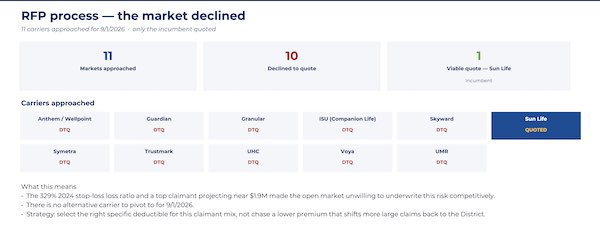
The district sought proposals from 11 A-rated stop-loss carriers, requesting prices at individual claim thresholds of $300,000, $325,000 and $350,000. Ten carriers declined to submit competitive proposals because of Scarsdale’s recent claims experience, leaving incumbent insurer Sun Life as the sole option.
S
un Life proposed increasing the district’s annual premium from approximately $1.93 million to $2.90 million, a 49.3% increase. The administration recommended retaining the existing $300,000 individual deductible rather than assuming additional risk in exchange for a lower premium.
Dustin Kuehn, a senior benefits consultant and vice president from Gehring Group, advising the district, told the Board that Scarsdale’s recent experience with large medical claims had made it difficult to attract insurers.
“We approached all markets, so 11 markets, and unfortunately, 10 of those declined a quote due to being uncompetitive,” Kuehn said.
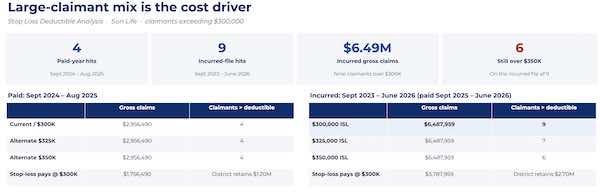
Kuehn said the number of large claimants exceeding the district’s $300,000 threshold increased from four in the prior plan year to nine in the current year.
The district’s stop-loss loss ratio reached 329% last year, meaning reimbursements for covered claims substantially exceeded the premium paid. The current plan year’s ratio stood at approximately 94 percent at the time of the meeting and was projected to exceed 100 percent, according to Kuehn.
“So two years combined, you’re at 200%,” he said. “Hence the reason why most of the market declined to quote.”
Scarsdale did have the option of increasing its individual deductible. Sun Life’s quoted premium increase would fall to approximately 41% with a $325,000 threshold and 31% at $350,000.
But a higher deductible would also mean the district assumes more of each expensive medical claim before insurance begins reimbursing costs.
Based on current large claims, Kuehn estimated that moving to $325,000 would leave the district about $30,000 worse off than remaining at $300,000. The $350,000 option was estimated to cost roughly $6,600 more overall than maintaining the existing threshold.
“With all of that being said, the current $300,000 threshold at the 49% [increase], we feel that this provides the district with the optimal risk profile,” Kuehn said. “Claims unfortunately aren’t getting any better.”
Board members questioned whether repeated large premium increases could eventually force Scarsdale to assume more risk.
Board member Kevin Ziegler asked whether the current arrangement was sustainable if the district continued receiving maximum-level increases. “If we’re seeing these max-level premium increases, are we getting to a point where we have to accept a different risk profile?” Ziegler asked.
District officials said predicting future costs is difficult because a relatively small number of people can account for a large portion of health claims, and the individuals generating high costs can change from year to year.
Andrew Lennon, the Assistant Superintendent for Business, said the district can forecast some recurring high-cost conditions but that other cases remain inherently unpredictable. “What’s concerning is it can change on a dime,” Lennon said, noting that earlier optimistic health-claims projections had ultimately not held.
Gehring Group’s Kuehn said the district and its consultants are looking at ways to control future costs, including a possible carve-out for specialty pharmacy medications and a broader analysis of plan design and claims utilization. The consultants plan to compare Scarsdale’s experience with other entities and industry benchmarks before making recommendations.
The discussion comes after another challenging year for the district’s health plan. A district official said Scarsdale finished the year just under $795,000 over budget across the overall health plan. Stop-loss recoveries were approximately $4.7 million, helping offset claims costs that were about $4.8 million above expectations.
Later in the meeting, the Board unanimously approved the renewal at the $300,000 specific deductible, effective Sept. 1, 2026. The motion was made by Kevin Ziegler and seconded by Omer Wiczyk, with all seven Board members voting in favor.
The decision keeps Scarsdale’s existing level of protection against catastrophic individual claims for another year, but the discussion made clear that rising medical costs and a limited insurance market will remain significant financial issues for the district.