







Declining Reserves Should Be a Wake Up Call to the Board of Education
- Wednesday, 19 November 2025 10:53
- Last Updated: Monday, 22 December 2025 20:39
- Published: Wednesday, 19 November 2025 10:53
- Joanne Wallenstein
- Hits: 4272
 (This is the opinion of Scarsdale10583 Publisher Joanne Wallenstein)
Is the school district budget heading toward a financial cliff?
That was the question parents asked Assistant School Superintendent for Business Andrew Lennon, but when they got the answer, no one seemed to know how to respond.
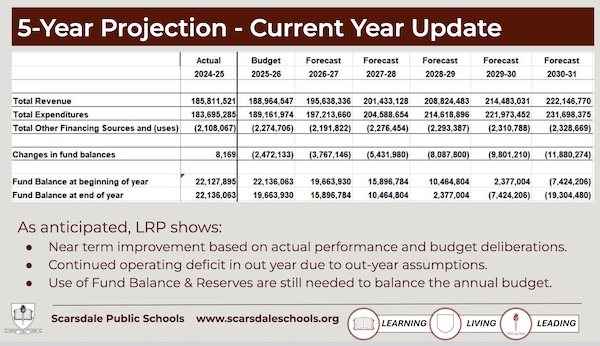
Late into the School Board meeting on Monday night November 17, 2025, Lennon presented a long awaited 5-Year Financial Plan for the Scarsdale Schools. It showed that the district has been using fund balances and reserves to balance the school budget and bring it in below the tax cap. In fact, $2.472 mm in reserves will be used to balance the 2025/26 school budget.
But draining reserves is not a long-term solution. When we continue to spend more than we take in, we use up our reserves and will eventually head into negative territory. And if Lennon’s projection is accurate, the $22.1 million fund balance as of June, 2025, will be down to just $2.3mm in June 2029.
By June 2030, the district will be $7.2mm in the red, and by June 2031, that deficit will fall to $19mm. See the chart below.
These projections were offered at the same meeting where the administration presented a $113 mm bond proposal that includes additions to Fox Meadow and Edgewood Schools along with a $15 mm air conditioning proposal and wide scale infrastructure improvements.
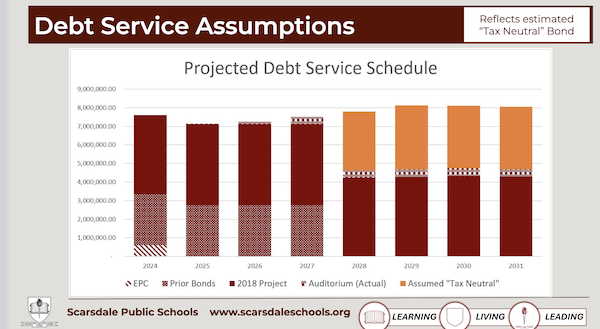
The catch is that Lennon’s dire financial proposal only included debt service payments on a tax neutral bond, of $40mm, not the $96-$113mm under consideration. With the new proposal approaching triple the tax neutral amount of $40mm, what would be the impact on district finances? Presumably debt service would rise and result in an even higher tax burden, further depleting reserves.
Looking back, how did we get to the point where we’re spending more than we’re taking in?
Staffing
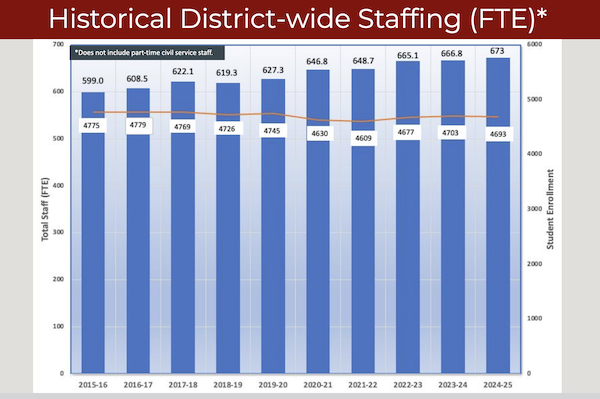
As anyone who studies the school budgets knows, the budget is 85% personnel costs. Salaries, health benefits and retirement costs eat up most of the pie.
In the past ten years, the district has hired 74 more full time staffers while enrollment has declined by 82 students. So payroll costs have risen and we’re spending more per pupil to educate Scarsdale students. At the same time, health insurance costs have risen, the district has more people to insure on their self-insured health plan and there have been recent incidents of very high one time claims for catastrophic events or illnesses. Health insurance costs have been difficult to estimate given the unpredictability of health claims.
Special Education
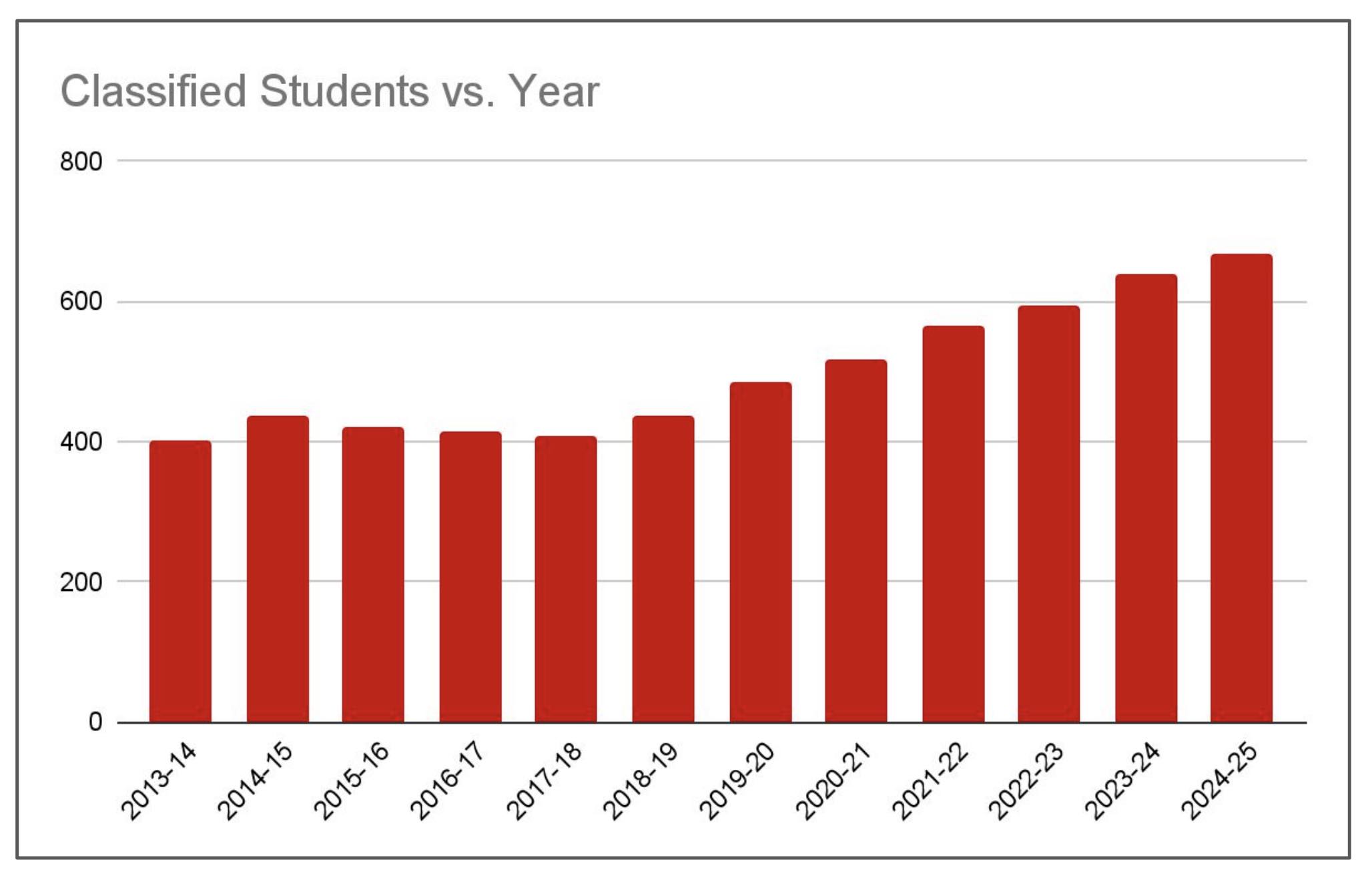
The Special Education program has also contributed to this increase in costs. Here is a graph of the number of special education students from 2013 – 2024. The program has grown by 50%.
In addition to the teaching staff, the special education administration includes many full time employees. Here is a chart of a presentation in December 2024.
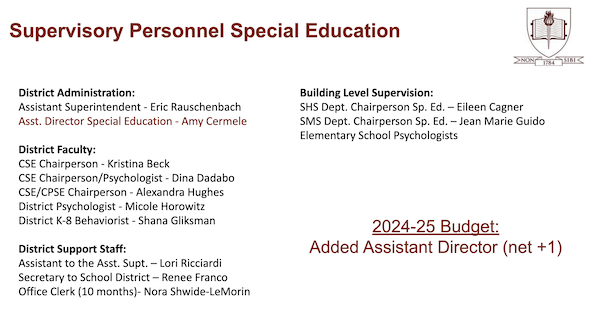
And there are plans to expand further in a chart that the Director of Special Education presented in December 2024.
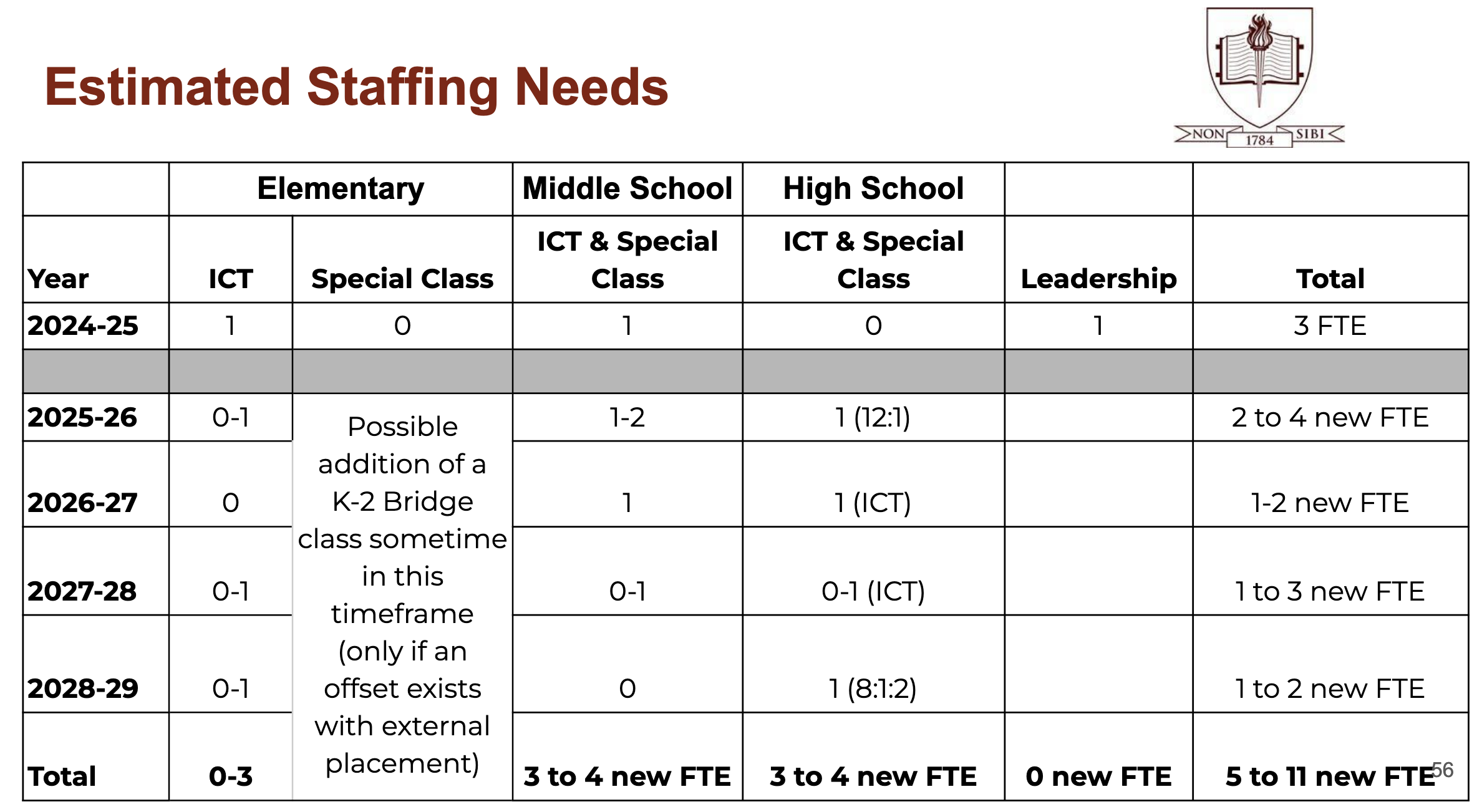
8:1:2 and 12:1:2 Classes
One program has been launched to serve a very small segment of the population with individualized needs. According to the chart, there were a total of 13 elementary school students enrolled in the 8:1:2 and 12:1:2 program programs last year. These classes are for more disabled students who require therapy and life skills education. They were formerly educated out of district. Each class has a teacher and two aids and requires a classroom along with support spaces for services such as speech and occupational therapy.
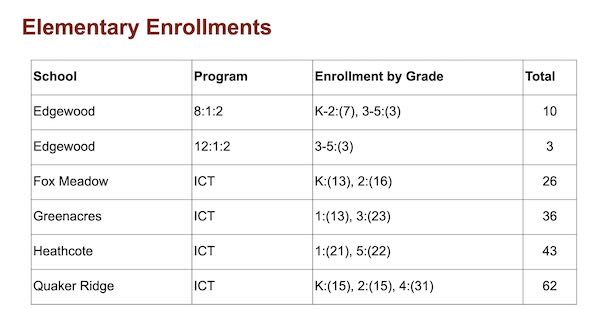
Staffing these classes is intensive and the positions are tenured jobs. The population of these classes is highly variable, but the district cannot hire and fire based on the program enrollment.
The decision to bring this program in house was based on the assumption that it is less expensive to educate these students in district rather than pay out-of-district tuition which was estimated at $83,000 per student. The math may work if there is existing space in the district for the required dedicated classrooms and support spaces, but we don’t have the real numbers.
At the BOE meeting on November 17, 2025, the administration presented a proposal to add $14 mm to the upcoming bond, to build six additional classrooms and five new support spaces, much of it to house this special program at Edgewood.
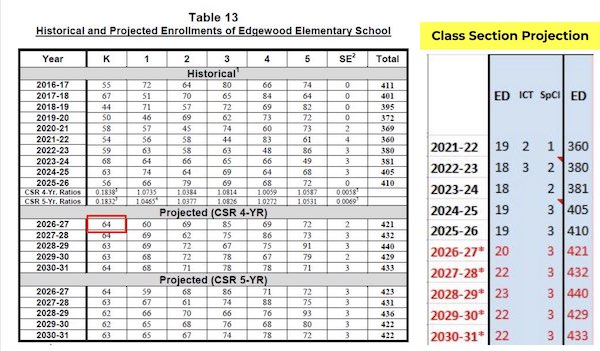
What are the true costs of this program? We have not seen a fully-loaded long term analysis of the cost of the extra teachers and administrators, health insurance, retirement costs, therapy costs and now the $14 mm spatial expansion to accommodate the program. Does it make sense to spend an additional $14 mm to build these facilities when BOCES and other schools already offer what is needed? As another option, why not use rooms at Greenacres School which were proposed to alleviate crowding at Fox Meadow?
We also don’t know parents’ preferences. The results of a special education survey have not been released. Do parents prefer the in-district program to out of district placements that might meet specific needs?
It sounds heartless to discuss the economics of the Special Education program but we cannot be faint hearted about our finances.
Commenting on Lennon’s five-year forecast, Board Member Bob Klein said, “I feel strongly that people should live within their means. You don’t spend money you don’t have. There is an assumption in Scarsdale that we can afford things. Do we need a wake-up call? Do we need to think harder? Are we being naïve about what we think we can afford to do? Some are necessary and some are nice-to-haves. Do we think we can afford things that we cannot afford? Are we being irresponsible?”
To answer Klein’s questions, the Board needs an in-depth analysis of the 8:1:2 and 12:1:2 program costs. It’s clear that the continued expansion of personnel, facilities and services for a very small group of students, will ultimately impact the larger school population. Especially as the administration is proposing to spend $14 mm on new classrooms due to capacity constraints when there is an option to utilize BOCES and other out of district options for students that have very specialized needs.
As Klein said, Lennon’s financial plan should be a wake- up call to the Board of Education. They need to ask for all the numbers associated with the 8:1:2 and 12:1:2 program so that they can determine how much we can provide without putting the overall educational program and our solvency at risk.