








Scarsdale School District Answers Questions About the Capital Projects Bond
- Sunday, 18 January 2026 18:19
- Last Updated: Tuesday, 20 January 2026 20:47
- Published: Sunday, 18 January 2026 18:19
- Joanne Wallenstein
- Hits: 2542
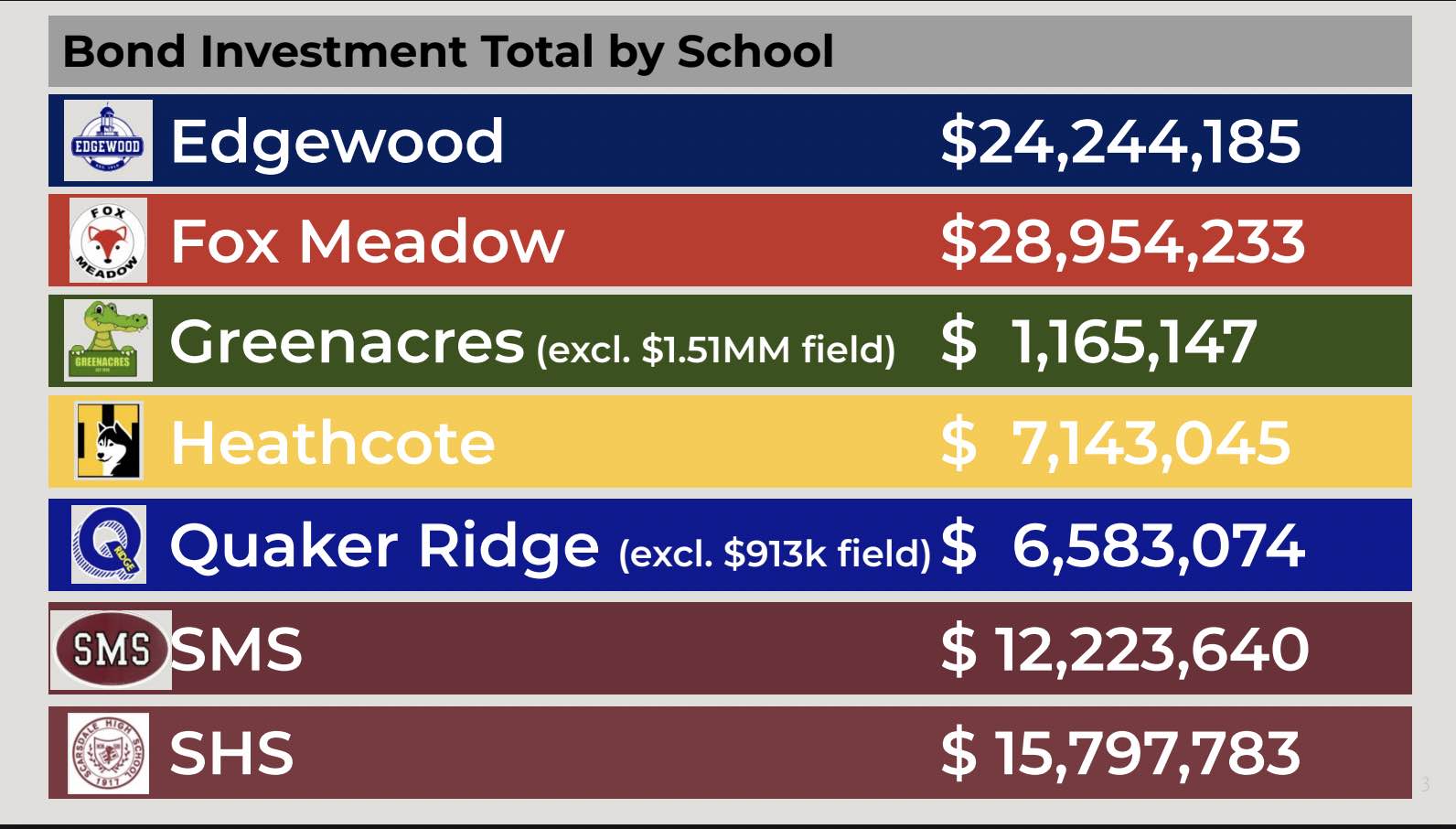 In early November, the PTC Budget Study Chairs and individual school PTA leaders posed questions to the district about the proposed $98.5mm school bond. Responses were received on January 16, 2026. Here are the questions and responses from the school administration.
Process and Timeline
Does the District plan to present other scenarios for the proposed capital projects?
Residents have seen what is proposed for about $96 million. The scope of work the Board has considered, totaling close to $100 million, has been whittled down from a much larger scope of approximately $400 million of potential work. The proposed work includes vital infrastructure projects, learning space additions and modernization, climate control for our learning spaces, and field projects to improve access and playability. These projects reflect a minimum investment to maintain our aging facilities while keeping us pointed toward the future, ensuring future generations of taxpayers aren’t left with an impossible task.
Are you able to please show the community what can be accomplished with $40 million and some amount above $96 million?
There are dozens if not more of multiple scenarios that individual Board and community members might prioritize from the list of projects that have been under consideration. The line-item budget for the existing work scope provides enough information for residents to envision what combinations of projects could be accomplished for $40 million.
The District’s Community Survey
According to the presentation of October 27, the survey generated 828 responses. However, it appears that only 77% of respondents were District residents, meaning that nearly one-quarter of participants were non-residents, including staff and potentially students who are ineligible to vote on a bond. A capital bond is funded through local property taxes, and only District residents are legally responsible for paying and voting on such measures. Including non-residents in a survey about the bond risks misrepresenting public opinion and could create a misleading perception of support. Furthermore, presenting student or staff input as a “vote” on the bond is problematic, as these groups cannot legally participate in the referendum. In the interest of transparency, accountability, and proper representation of taxpayers’ voices, we respectfully request that the Board provide clarification on the following:
The exact number of survey responses from the District residents versus non-residents (including staff and students).
This can be found in the October/January comparison report.
The methodology used to determine resident status, including whether property ownership or household address was verified.
Self-identification.
Whether non-resident or ineligible participants were included in the overall 828 responses, and if so, how their feedback is being used in the decision-making process.
Because respondents self-identified, there is no way to know.
How the survey results will be communicated to the public, ensuring that resident and non-resident input is clearly distinguished.
They are posted to the Bond webpage and have been shared publicly at BOE meetings.
Confirmation that the survey is advisory only, and that the actual referendum will reflect the votes of eligible District taxpayers only.
Confirmed.
One of the questions on the District’s survey asked about the scope of the proposed bond project. According to the results, 51% of respondents — including both stakeholders and non-taxpaying participants such as students and staff — felt the proposed scope was “just right,” 27% thought the amount was “too high,” and only 20% said it was “too low.”
Given these findings, how does the District reconcile the decision to consider going above the $96 million bond amount with the survey data indicating that a majority of respondents were either satisfied with or concerned about the current scope being too high?
This has been described as an iterative process throughout. A second survey was distributed in January, 2026 after new information and changes to the scope were discussed in public.
Ensuring that the survey and resulting bond proposals accurately reflect the views of those who are legally responsible for funding the bond is essential to maintaining public trust. We appreciate your attention to these concerns and look forward to your response.
Visuals of Buildings
Keeping in mind that the recommended scope for spatial enhancements and additions is approximately $44 million, it would be very helpful for the community to have a clear visual representation of what these additions entail. For example, Fox Meadow currently reflects the most expensive addition proposed.
Would a video presentation or virtual walkthrough illustrating the scope of work at each site greatly enhance understanding and transparency?
We are working on a communications plan and will make every effort to provide the community with the information they need to make as informed a decision as possible.
Additionally, providing a cost analysis by square footage—detailing the projected $/sq. ft. for both new construction and renovation components—would allow stakeholders to better assess the reasonableness and efficiency of the proposed expenditures.
Detailed cost estimates can be found in the bond scope budget.
Field Projects
Only 37% of the stakeholders and non-taxpayers, like students and staff, choose field access and playability as a top priority.
In the absence of a clear community mandate, is the District considering scaling back or removing the field-related projects to help reduce the overall bond amount?
The SMS turf field proposal was removed from the proposed scope of work on December 15, 2025.
Turf Field
Given the significant upfront and long-term costs associated with synthetic turf installation and maintenance, we respectfully ask that the District please provide clarity on the expected lifespan of the proposed turf field and the total cost of ownership, including future replacement and disposal expenses.
See above.
Considering our region’s limited outdoor playing season and the fact that the District already benefits from access to the Butler synthetic field, would it be more fiscally and environmentally prudent to pursue a high-quality natural grass field instead?
This is a worthy point of debate, though the projects is currently not included in the bond scope so will be deferred to a future discussion.
A well-maintained grass field could offer comparable functionality for the District’s needs while yielding substantial cost savings—funds that could be redirected to support instructional programs, special education services, or facility improvements that serve a broader range of students.
Construction Cost
While the CPI inflation has cooled over 2025, construction cost inflation remains higher YoY. Coupled with labor shortages and high material costs, it is not the most favorable time to build large discretionary capital projects.
Would it be advisable to defer non-essential projects or phase them to avoid peak construction premiums?
Yes, and many have been deferred.
Has the District created any cost-differentiated “buckets” within the proposed $96 million bond to separate essential infrastructure work from discretionary or enhancement projects? Would such an approach allow the Board to reduce the overall bond size and sequence construction more cost-effectively, ensuring taxpayer dollars are used prudently?
The scope of work the Board has considered, totaling close to $100 million, has been whittled down from a much larger scope of approximately $400 million of potential work. The proposed work includes vital infrastructure projects, learning space additions and modernization, climate control for our learning spaces, and field projects to improve access and playability. These projects reflect a minimum investment to maintain our aging facilities while keeping us pointed toward the future, ensuring future generations of taxpayers aren’t left with an impossible task.
Question From Budget Liaisons at individual schools;
Edgewood 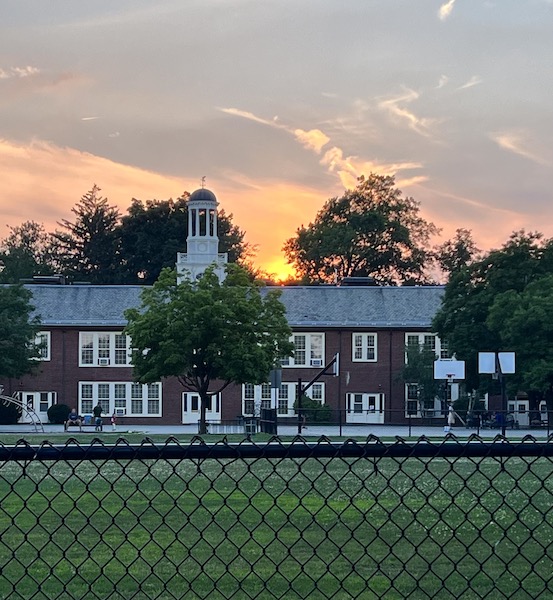
About the Demographic Study:
Table 13 - Is the Special Education (SE) column accurate? I believe there are more than three children in the self-contained program at Edgewood. Also, it indicates zero (0) for the 2025/2026 school year. Please provide more information on how the SE column is calculated.
This is a State IEP designation on students IEPs (ungraded) and the data is accurate. This number does not include self-contained students not designated as ungraded.
Table 13 - Why is the survival ratio for 2022/2023 excluded for Edgewood but no other school?
The size of the 5th grade class in that year reflects the last year of ICT at this school, requiring a statistical accounting for the change in program.
Has the District analyzed student yield per household for rental vs. owner-occupied homes?
No
Do rental households produce different enrollment patterns that should be factored into projections at the school level?
The historical reports indicate that demographic predictions are close in the short-term, suggesting a variety of factors are accounted for by the CSR model, which is a widely accepted standard approach in public school demography.
Why the decision to now include the 2021/2022 enrollment in the average survival ratio? It was previously excluded from the 2024 study.
This is a determination made by the demographer based on the individual average 4- and 5-year ratios by grade level. Thus, one or two annual cohort survival ratios may have been excluded from the 4- and 5-year averages because they are statistical outliers and would artificially lower the projection.
Enrollment data
What enrollment growth assumptions were used to size this bond’s spatial projects?
Detailed in the 10-27-25 BOE meeting.
What did the demographic study from 2024 anticipate for Edgewood for the next 10 years?
If the enrollment projection remains the same for Edgewood, will spatial projects be re-prioritized?
The Edgewood addition has been designed based on the short-term (within 5 years) projection for Edgewood.
How will the new 2025 study assess the risk of grade-level breaks at Edgewood (or any elementary school)?
Detailed in the 10-27-25 BOE meeting.
How is the District monitoring lot subdivisions, teardowns, and new home construction in each attendance zone?
Through discussion with relevant Village departments.
How are those residential trends being integrated into future space planning?
Known, confirmed projects are considered while those undetermined are not.
Has the District analyzed student yield per new home in different neighborhoods (e.g., Edgewood, Heathcote)?
No
As shown at the BOE meeting on October 6, between March and September, time and resources were devoted to designing a significant expansion for Edgewood (4 new classrooms, plus SPED classrooms, learning commons, etc.) based on enrollment data. What new enrollment information led to the removal of this proposal in September?
A new demographic study was initiated and informed the Edgewood proposal.
Are there any redistricting options being considered for Edgewood?
No, not at this time.
What is the basis for determining 2024 Edgewood enrollment data is incorrect or needs updating?
The demographic report.
Are the SPED students included within the enrollment projections for Edgewood?
Yes.
Are there any students who may not be “counted” in enrollment projections but would push Edgewood classroom sizes higher than those at other elementary schools?
No.
A published draft of the September 15 Capital Projects Update showed Edgewood at 389 students in 2024/2025. At that same BOE meeting, enrollment updates showed Edgewood at 404 students in 2024/2025. What accounts for the 15-student difference?
Projected versus actual.
What is the enrollment projection threshold that triggers the need for additional classrooms?
Our class size target of 22 students in grades K-3, and 24 students per class in grades 4-5.
At the BOE meeting on September 15, it was noted “Edgewood has some potentially similar concerns to Fox Meadow, but while Fox Meadow’s space constraints are immediate in the present, Edgewood's may be able to accommodate enrollment with some more modest modifications and program adjustments.” Please detail the “modest modifications and program adjustments” that would allow Edgewood to accommodate enrollment until the next bond cycle in 2035/36.
Edgewood may have to accommodate enrollment by displacing one or more “special area” teachers from a designated classroom to a push-in model in order to accommodate classroom sections prior to new classroom space being added.
Were Fox Meadow’s now immediate space constraints predicted 10+ years ago?
No.
Have these proposed modifications and program adjustments been reviewed with building leadership to ensure they are implementable?
Yes.
What contingencies exist in the bond plan for enrollment that exceed projections?
The primary contingency at any school is to accommodate “excess” enrollment by displacing one or more “special area” teachers from a designated classroom to a push-in model in order to accommodate classroom sections prior to new classroom space being added.
How will the District manage capacity if enrollment continues to rise before the next bond cycle?
See above.
Special Education (8:1:2 and 12:1 Program)
The 8:1:2 program originated at Edgewood School and is the home school for any Scarsdale District child who is placed in this program. It has become a cornerstone of the Edgewood experience, not only for the staff in the building but the parents and children of the Edgewood community. Edgewood no longer houses any of the ICT classrooms, and to take away either the 8:1:2 or 12:1 program would be a disservice to the children in the Edgewood community, as well as the students in the program that call Edgewood School home. If we are to believe the profile of a Scarsdale Graduate is to be a “compassionate leader,” you cannot remove the current programming housed at Edgewood or displace the children currently in the program. The children in this program are part of the Edgewood demographic and, therefore, should be planned for as such. Removing the program would be counterintuitive to the “Living” cornerstone of belonging.
What steps need to be taken within this bond to ensure that the children in these programs remain in Edgewood School as the permanent home to the Special Education program?
The inclusion of a classroom and support space addition at Edgewood will ensure this.
Furthermore, with the continued year-over-year growth of Special Education programming within the District, and the increase in taxes each year to support this, why would you not consider creating the space needed for this growth?
A classroom addition is included in the proposal.
If you are looking to increase enrollment in these programs to help balance the budget, how are you not accounting for the space needed to support this projected/needed enrollment?
A classroom addition is included in the proposal.
If the SPED program is relocated from Edgewood, what programming will replace it to ensure Edgewood has access to Special Education classrooms in the building?
This is not in our plans.
What was the cost of training Edgewood staff and the physical capital invested in Edgewood to accommodate the special education program?
Consultant training costs have averaged about 60,000 for the 23-24 and 24-25 school years. That is reduced by approximately half this year and will be an ongoing cost. Those reduced funds are being used at SMS for the 8:1:2 introduction this year. Edgewood has not had specific capital costs related to the special class program aside from furniture and supplies which were in line with other classroom expenditures.
Specials Programming Adjustments
Students currently engage in foreign language, arts, music, library, and technology. Currently, each special program has a designated class space in the building. Art and Music are not cart-friendly specials, but perhaps Technology and Foreign Language could be.
What meaningful space would be procured by potentially moving two specials to carts?
Two regular-sized classrooms.
What is the impact on the curriculum for the specials?
Moving specials to a push-in model decreases curriculum flexibility by limiting the range of materials and experiences that can be achieved when there is a dedicated classroom space.
What is the impact on the grade level teacher’s prep time?
They would have to relocate to another space to prep.
How do you reconcile the use of specials on carts with the Strategic Plan's commitment to “collaborative, future-oriented academic culture”?
We view this as an option of last resort.
What is your assessment of the pedagogical implications of cart-based specials instruction, particularly regarding learning environment quality, instructional effectiveness, and alignment with the District's educational standards?
Our talented faculty can make this work and provide a positive learning experience for students, but it is enhanced when there is a dedicated space.
What is the time threshold where this is an acceptable standard?
We don’t understand the question.
Specials have been on carts in the past at Edgewood and currently at Fox Meadow. Has there been any internal debriefing or research on the impacts of this on instructional quality and teacher morale?
There has been no formal research project, but the negative impact on morale has been articulated by practitioners and leaders.
Old Meeting Room Storage Space
What space or programmatic need does this new storage space solve?
It creates a more functional space for multiple uses when there is an ability to remove furniture and equipment that occupies floor space.
What space is currently being used that would be freed up with this storage space? It limits the use of the existing space.
This square footage (310 sf) is not much more than a storage shed; therefore $372k for a shed space when we need space for students and teachers is confusing. Please explain.
It will house furniture (tables) that need to be moved in and out of the space on short notice which would not be practical or feasible in a standalone storage space.
Spatial Renovation/Reconstruction
Why were Edgewood’s “spatial needs” included in the July 2025 baseline but minimized in the final September 2025 $95.6 M proposal?
We wanted to confirm the enrollment estimate given the shift of ICT out of Edgewood, inclusion of the 8:1:2 program, and post-Covid enrollment trends.
The BBS Facilities Study lists more than $2.4M in HVAC work, $970K in plumbing, and $2.9M in electrical improvements for Edgewood. How much of Edgewood’s $10.6M allocation is true educational enhancement versus deferred maintenance?
The current scope includes Priority 1 items and select high-priority District items. These can be viewed in the full bond scope budget.
What is the District’s policy on appropriate buffer space or classrooms to mitigate the risk of unforeseen population shifts?
No such policy exists. We use demographic forecasts to assess the immediate 5-year period.
What does the $175,000 per classroom upgrade cover?
Cost estimation and project scope for each individual classroom is unique, but generally includes lighting, wall finishes, blinds, furniture, white boards, and a program for storage.
Will walls be moved to optimize the current space, or is this money being spent on restoring to reasonable conditions and not actually upgrading anything?
Walls will not be moved with the exception of the existing FM library and MPR spaces. There will be significant improvements in the classrooms being renovated.
Proposed classroom upgrades could be classified under an annual budget, given they don’t require a building or construction permit with the described scope of work and seem to be part of regular maintenance requirements. Why are these being included in a capital bond now?
Significant economies of scale are achieved.
Has a phased strategy for classroom upgrades as part of an ongoing annual budget been studied?
It is in the early stages of discussion.
Some Edgewood classroom bulletin boards need to be improved ASAP. When will these be done if they get lumped under the capital bond with a 5-year rollout time frame?
They will be part of the bond scope.
What is the total minimum net square footage needed to create the classroom space needed for 4 classroom-like spaces, which can be used for breaking grade levels?
The target is 900 sq ft per new room. This will allow for 770 sq ft of usable space (22 students, 35 sq ft per) with the remaining space being allotted for casework, furniture, etc. Total needed for 4 classrooms would be 3600 sq ft. This sized space allows the room to be used for any grade level.
What is the total minimum net square footage needed for OT/PT support services?
This is really need-dependent and varies.
What is the total minimum net square footage needed to support our Special Education sections?
Regular classrooms.
Is there an opportunity for a smaller addition in conjunction with the current classroom “upgrades” in scope that can create the space needed?
The proposed additions are aligned with the identified needs.
Please compare the “courtyard” option with the option presented at the BOE Meeting on October 6.
That is what is currently proposed.
What is the net and gross area of each option?
As per the bond budget.
What is the program list for each option?
As per the bond budget.
What is the renovated area associated with each option?
As per the bond budget.
What is the difference in terms of construction cost per square foot?
The assumed cost PSF was the same, but the original proposal was not cost estimated by the construction management firm, only the current proposal had that detail performed.
What is the net (not gross) usable classroom area per child per elementary school?
This is enrollment dependent and not a calculation we have at the ready.
What is the net (not gross) usable specials (Spanish, music, etc.) area per child per elementary school?
This is enrollment dependent and not a calculation we have at the ready.
What is the net (not gross) usable multi-purpose area per child per elementary school?
This is enrollment dependent and not a calculator we have at the ready.
General
Were there written summaries or reports produced for each school describing existing space usage, deficiencies, or programming conflicts?
Yes- such a summary can be found here.
Does the District maintain a space utilization inventory (number of classrooms, specials rooms, support rooms, etc.), and if so, will it be shared publicly?
Yes, but because it is articulated via building floorplans, we do not intend to share electronically to the public due to concerns around these files potentially being accessible to someone wishing to do harm (i.e., it is a safety and security issue).
Will the District commit to releasing all non-confidential planning materials before any bond vote?
We have shared the non-confidential CPSC materials here. The remaining materials have been presented publicly and are on our website.
Were alternative bond scenarios (e.g., additions at Heathcote or Edgewood) developed and rejected?
Yes.
If alternatives were presented, will the cost and rationale for rejection be shared publicly?
We have discussed this throughout the process at BOE meetings.
How does the District define equity in facilities planning?
We do not have a “definition” per se, but recognize that our spaces would facilitate safe student access to our educational programs (equivalent across levels); vital infrastructure (particularly Priority 1 items) should be addressed regardless of the location; air conditioning should be broadly addressed in equivalent fashion; and major renovations should be addressed over time based on the age and condition of each building.
How will the bond ensure that students in all buildings have access to equivalent program quality and space for instruction?
The proposed projects accomplish this.
Has the District defined what inequity looks like in practice, for example, classes on carts, lunch in classrooms, or shared service spaces?
We have discussed this and have a broad shared understanding of this.
Has the District considered separating maintenance costs from educational improvements to allow clearer prioritization?
The project categories accomplish this.
Heathcote
Air-conditioning: This should be a priority given the number of hot days we’ve experienced recently. Our small size makes the heat even harder to manage.
The proposed scope includes significant air conditioning at Heathcote including all classrooms, the auditorium and Multi-purpose room.
Library: We understand the library is finally on the ballot for budget. Could you clarify the timeline — how many years will this take to be completed?
A proposed phasing of projects is underway, but not completed.
Space for specials: Our building doesn’t have enough rooms to properly accommodate specials. What is the plan or priority for addressing this? It feels unfair for parents and students to be exposed to this limitation.
The location of specials is in equivalent space at Heathcote as in other schools.
Classroom space: Our classrooms are small for the number of students we have. Are there any plans for an extension?
No.
Kitchen: The quality of lunches at the cafeteria is below average.
We disagree with this assessment. The district provides an above average program that is based on high standards set by our Food Service Committee by way of our contractual specifications which are monitored by both our District’s Food Service Director, a Nutritionist employed by Chartwell’s and an independent consultant. Our children deserve better nutrition, free of additives and chemicals. When can we have our own kitchens across the District so that we can provide better lunches? The Food Service committee is in discussion about food quality presently.
Or will you be changing the existing process/provider?
Custodial staff: Heathcote lost half a custodian, which makes a big difference to daily operations — and even impacts PTA activities. Similarly for aide cuts. Heathcote also urgently needs a full-time social worker.
These are items that would be addressed through the budget process, not the bond process.
SMS
Questions and Comments after Meeting with Principal Coughlin with a Focus on the Budget
Central Cafeteria- This space has been deferred in both the current and previous bonds. The proposed concept involves a central cafeteria that would serve all students by grade level, allowing the four existing cafeteria spaces to be used as valuable multipurpose rooms, maximizing the use of existing space and enhancing the overall functionality of all rooms. It's worth mentioning that during our walkthrough of the Popham Cafeteria, the 7th-grade students were having lunch, and it was very noisy, causing a distraction for the rooms close by. While we recognize that this proposal would require a significant budget and could affect tax neutrality, we would like to know if we could revisit it for further discussion. The central cafeteria is a desirable project that would have tangible benefits to the students at SMS. However, the program functions as it is currently configured, and unfortunately other more urgent priorities and a limit to the overall bond budget means this project has to be deferred to future consideration.
AC Band Room - The current budget includes air conditioning for the library, gyms, lunchrooms, and auditorium; the band room is not currently included. The band room is very warm, and the temperature significantly increases when the students are practicing with their instruments. Adding air conditioning to this space would be highly beneficial. It is included in the current bond scope.
Principal Coughlin identified the following priority order for AC installations:
Library
Band Room (not currently budgeted)
Auditorium
Gyms
Lunchrooms
Response from the District
Library - While the library will be renovated, it's worth mentioning that the librarian would love to refresh the look and feel of the library and noted some neighboring districts that’ve done a nice job recently. There is an outdoor area that presents a valuable opportunity to extend the learning and gathering space, particularly during good weather. It would be worth it to include it in the budget and add appropriate outdoor furniture. This could be considered as a budget request.
Field - Looks like the budget covers the turf and the paint, and this is supported by the school. However, while the cost (4M+) is allocated under the SMS budget, it's important to note that the field is also regularly used by the broader community and for recreational sports programs. Given this shared use, it may be worth exploring whether a portion of the cost could be shared or supported through Scarsdale Recreation, so the entire budget is not covered under SMS and perhaps allocated to another project. The field projects have been separated out in some of our informational materials, and are reduced in scope from the original proposal. They now include field upgrades at GA and QR.
Questions about the Proposed Bond
General Questions
How are SMS projects prioritized?
This was discussed in several public meetings, and reflect the highest priority improvements that can be accomplished on balance within the total scope of needs across the district.
Who was involved in the decision?
Steering committee members, district administrators, SMS leadership, and the Board, informed by community input.
Did parents provide their feedback on any of the projects already prioritized?
Parents have been invited to share feedback in multiple ways throughout the process.
What is the overall timeline for the SMS projects, including the expected start and completion dates?
A proposed phasing of projects is underway, but not completed.
What is the annual budget for SMS, and what does it cover?
The current budget can be found here.
What are the committees involved in the school budget? And what are their functions? I can see the description for CPSC.
There is no committee structure for the annual school budget.
Is the 95M budget set?
The bond scope continues to evolve, but BOE members indicated support for a $98 million budget on the January 12, 2026, BOE meeting.
Is there a budget reserve allocated for each school in case something goes wrong or above budget (for SMS)?
Bond scope includes contingency, soft costs, and escalation costs for each project.
The focus of the BOE meeting was on the capital bond budget, which includes mostly infrastructure, spatial, and field budgets. Where can the information on the budget for educational programs, support services, etc., be found? Is this also discussed at the BOE? Is it shared with the community?
The current budget can be found here.
Where can detailed information on the capital bond projects be found?
https://www.scarsdaleschools.org/bond2026
When will the community vote on the budget?
Tentatively the bond is scheduled for consideration on the same date as the school budget and BOE election, May 19, 2026.
Where can I find the abbreviation definition? This is helpful for someone new to budget meetings/study.
Please advise further - not sure what this is referencing.
Tax and Funding Questions
What are the funding sources for the $95 million?
The amount is financed through a combination of bond anticipation notes and bonds over time, with the debt paid through the tax levy (principal and interest payments annually) and State Building Aid revenue.
How much is the District getting per school? https://www.scarsdaleschools.org/bond2026
Do the school funds include contributions from the State or federal government, or any other outside sources?
Approximately 19.5% of eligible costs are reimbursed through State Building Aid payments over time. A financial analysis based on proposed phasing of projects is forthcoming.
What is the process for distributing the funds among the schools or projects?
The scope distribution was developed based on recognize that our spaces must facilitate safe student access to our educational programs (equivalent across levels); vital infrastructure (particularly Priority 1 items) should be addressed regardless of the location; air conditioning should be broadly addressed in equivalent fashion; and major renovations should be addressed over time based on the age and condition of each building.
District Priority Questions
Shouldn’t this be part of the maintenance budget?
Not sure what this is asking?
What does BCS Infrastructure Priority I (controls and cables) entail (780K)?
Line item detail is available in the current bond scope budget - https://www.scarsdaleschools.org/bond2026
Which controls and cables will be fixed/replaced?
The detail is still being finalized.
What does District Priority 2 (boiler) entail (374K)?
We are not sure what specific item this is referring to as no single project is planned at this amount. The projects that are included for SMS in the HVAC portion of infrastructure are designated as projects H-1, H-2, H-4, H-12, H-19, and H-22 of the BCS Report.
Will the boilers be fixed or replaced?
Replaced
Are all the boilers in the school included?
Yes
Committee Priority Questions
Shouldn’t some of the committee priorities be included in the annual budget or maintenance budget?
Yes, and they are.
Butler’s and Cooper’s lockers will be removed; will they be replaced by new lockers?
The Facilities Study and bond scope only included the removal of existing lockers. However, the facilities department and SMS administration are coordinating this work to ensure adequate locker space is available for all students. This may include modifying the scope of work to preserve some lockers, relocating lockers to a more appropriate location and/or replacing some lockers to provide more efficient use of wall space, all while ensuring proper hallway egress requirements.
What is the scope of work for the renovation for ADA @ Nurse et al?
That detail is still being developed.
Spatial and Fields
What specific expenses are covered by the $4,006,890 budget allocated for the multipurpose synthetic field?
Please see the current scope at https://www.scarsdaleschools.org/bond2026
Are basketball and tennis courts included?
Not at this time.
What improvements are covered for the SMS field? Basketball and tennis courts?
None at this time.
Cafeteria
What are the upgrades for each cafeteria?
Ceilings, lighting, flooring, paint - introducing fresh air and air conditioning, and new flexible furniture in each space
How was the budget for the cafeteria established?
Cost estimation involves generating a square foot cost per category (furniture, lighting, flooring, etc.)
I hear a lot of students complaining that the lines are too long to pick up their food, and they prefer to bring their own lunch. Are there any plans to improve how food is distributed to help shorten the lines?
This will be explored as part of the renovation planning process.
Library
For the library, will the configuration for the space change? Is there new technology? New book collections?. Can you provide more information on the renovations for the library?
The details for the exact renovation will be developed if the bond is approved. The budget does not include technology hardware, but does include a scope for electrical and data access. Books would not be a bond expense but rather a budget expense.
High School
Comments
Prior to any further decisions being taken, community outreach and engagement need to take place to share the recommended plans with the community. Overall awareness of the bond project amongst parents seems to be quite low.
This will continue and include a robust communications and education/awareness plan leading up to the vote in May.
The community should be informed on what inclusion of additional items (like the 20 million for SHS for the 62 classrooms) would mean monetarily, in terms of taxes per household should be spelled out so the community can have a voice in terms of what is being left out.
We have discussed the estimated impact for each $1 MM in almost every presentation and engagement opportunity.
Reporting Back from Two Meetings Thank You!
The SHS Budget Liaison subcommittee met with Ms. Simon to clarify questions on the process and why what was selected was prioritized. Ms. Simon stated that the priorities were driven by those in the building who identified these as priorities. An item that was considered but ultimately not pursued:
Refurbishment of 62 classrooms (incl 5 science labs, 5 art rooms).
An item that was briefly discussed, but the budget would have been too big and wasn't pursued:
A new common learning space that would go in the courtyard area outside the BoE rooms. Ms. Simon stated the committee was in unison to prioritize FM and EW, and thus, SHS didn't pursue more asks. The spatial improvements included were prioritized because they impact more students day to day experience.
The SHS Budget Liaison subcommittee also met with SHS student government representatives:
There's agreement that the AC of the gyms needs to be prioritized, but having it be a part of the bond might mean it's not done for several years, and this is too long.
A point was made that the wrestling gym is not included and should be for AC.
A lot of questions about what the partitioned spaces in the library are and how they'd be used.
Students seemed to have trouble visualizing how this would be an asset.
A request for one of the partitioned library spaces to be made into a multimedia lab
3 classrooms don't have any AC and should be refurbished, and some classrooms are in very bad shape and similarly need to be updated.
Parking spaces -- either need more or a re-organization of what's there to be better used (for example, a meeting was held at the A school, and the lot was completely empty, but students are not allowed to park there).
“We only had 20 minutes with them, but we left them with the two-page printout of the SHS proposal, and they seemed very engaged. A parent reported back that it came up at their dinner table, so to me that's an example of the desired trickle effect.”
Comments and Questions from Parents Emailed to PTC Budget Study Chairs
Questions and Thoughts after Village Pool Presentation
Would it be possible for the Scarsdale District to summarize key points of the proposed capital projects in a manner as the Village did about the Pool Project on slides 39 and 41-43?
Yes, we are working on a clear and concise summary now that we have a solid sense of the scope the Board is comfortable with.
The Village is using the mean assessed value for properties in Scarsdale, and the School District is using the median. Why is each using a different metric?
We are not sure, but we are working on an individual tax calculator that residents can use to develop an individual estimate of their own cost.
Staff’s Children in Scarsdale Schools
“I am writing to follow up on the first open question discussion during the Monday, October 27th board meeting. One of the topics raised by a parent was regarding the children of non-District teachers and administrators attending Scarsdale schools. From my understanding, there are approximately 30 students between FM and EW who fall into this demographic. I fully support the necessary upgrades and additions to FM and EW to meet growing demand and maintain the high standards and comforts we strive for in our District. However, if taxpayers are asked to approve funding for these improvements, I believe it is important that teachers and administrators whose children benefit from attending our schools also share a financial stake in this decision. Specifically, I would encourage consideration of implementing tuition payments for these families, as is standard practice in similar school districts across New York State. I recognize that this may require adjustments to union contracts and the collective bargaining agreement, but I hope this matter is being addressed in ongoing negotiations. Thank you for your attention to this matter, and I appreciate all the work you do to ensure the continued success of our schools.”
Please note that it is the district policy to relocate any non-resident staff member’s child if their enrollment causes the need for an addition classroom section and room under our class size guidelines.
Concern about ADA Compliance
Why do the Nurse’s Office and restrooms for ADA, for example, as shown in the Fox Meadow slide, cost $565,000?
The cost estimates for all renovated spaces have been updated to reflect costs per square foot based on current publicly awarded bid prices. These estimates were then increased to reflect assumed price escalation, contingencies for design, construction and hazardous materials, and soft costs. The initial costs estimates used for initial scope development have since been revised by the Construction Manager and included in our most recent presentations.
Are these new restrooms being built or just being renovated?
These are renovations.
The ADA fire alarm system costs $450,000 in the FM slide. Older school buildings don’t have to retrofit ADA fire alarms unless they’re being renovated or serving students/staff with accessibility needs — but any upgrade or major project must bring them up to current ADA and NYS standards.
The budget amount for Fire Alarm upgrades includes addressing any pre-existing, non-conforming conditions so they meet modern requirements.
New or renovated spaces will also meet those requirements.
Is this cost due to the proposed renovation, or is the District currently out of compliance?”
The district is currently in compliance based on the codes and requirements at the time each space was built or was last renovated expensively. The upgrades were recommended regardless of the renovations and additions that are currently proposed. However, given the extent of the renovations in some buildings, it is anticipated that NYSED will require these upgrades.
Cost Savings if Redistricting is a Significant Saving
“For several years, many Special Education students have attended schools outside their home zones due to the District’s rotating ICT classroom model.
Given that precedent, why is redistricting for certain Fox Meadow families being ruled out — particularly if doing so could yield meaningful cost savings and operational efficiencies for the District as a whole?
This was ruled out as the result of redistricting would not effectively alleviate the space shortage at Fox Meadow even if we maximize Greenacres enrollment.
How does the District reconcile this difference in approach with its stated commitment to equity and consistency across all student populations?”
Bond Timeline and Property Assessments
“A few of us are seeking clarification regarding how the bond timeline is affected when property assessments increase. Specifically, does an increase in property assessments shorten the duration of the bond?
No. A change in assessed values does not impact bond duration.
To illustrate, let's consider Round numbers and no interest if a bond valued at $90 million is spread over 30 years, which results in an annual payment of $3 million. For a property initially valued at $1 million, this might translate to an additional $100 per year. If, after renovations or redevelopment (as seen frequently in Edgewood), the property value rises to $3 million, the bond payment would increase to $300.
Generally speaking, increases in taxable assessed value will result in lower tax rates (all else being equal) because the annual tax levy is divided by the taxable assessed value of the entire district to determine the tax rates. When the tax rate is applied to an individual property that did not have a change in assessed value, the resulting tax bill will go down for that property. Note: property tax exemptions, equalization rate changes, and other changes impacting the tax levy also influence the annual tax rate.
Our question is: when this increase in property values occurs across 100 houses per year, does it effectively shorten the bond's term by a year?
No. See above.
Alternatively, does the annual bond cost decrease for properties that maintain lower assessment values?
See above
“An explanation of this for the public's understanding of the chain reaction on this matter would be greatly appreciated.”
This is noted. Thank you.
Questions from SHS Budget Liaison After Touring SHS Building, November 5
How was what was prioritized for SHS decided upon?
Input from SHS reps on the CPSD, discussions with staff and students, community input via the surveys and information sessions.
Was any broader student or parent input solicited?
Please see the summary above.
The past bonds have focused on communal spaces at SHS as well, and the classrooms are dated and in need of an update, in particular the science labs, which we understand have not been updated in the past 40 years. While we understand the initial scope for the bond did include updating 62 SHS classrooms, are there opportunities to address at least some as a part of this bond? Or if updating at the cost of $125,000 per classroom is out of the scope, can funds be dedicated to furniture updates in classrooms or the updating of the 5 science labs?
This is not currently part of the bond scope, but we are continuing discussion about our 5-year capital plan and how to possibly phase classroom upgrades over time.
What was the logic for the prioritization of the dividers at the library?
There are study rooms on the second floor that are used for classroom visits- could these be used instead for quiet study rooms to allow them for the proposed budget to be used for items like those identified above? Student feedback that we've heard questioned the prioritization of this. It was student feedback that drove this request out of a desire to have additional quiet study spaces as the library has grown into a more communal area for group work, community lunch meetings, etc.
Click here to see the original document.