







Back in the Board of Education Room, the Board Discusses the Return to School and Diversity and Inclusion
- Details
- Written by: Sammy Silberberg
- Hits: 2215
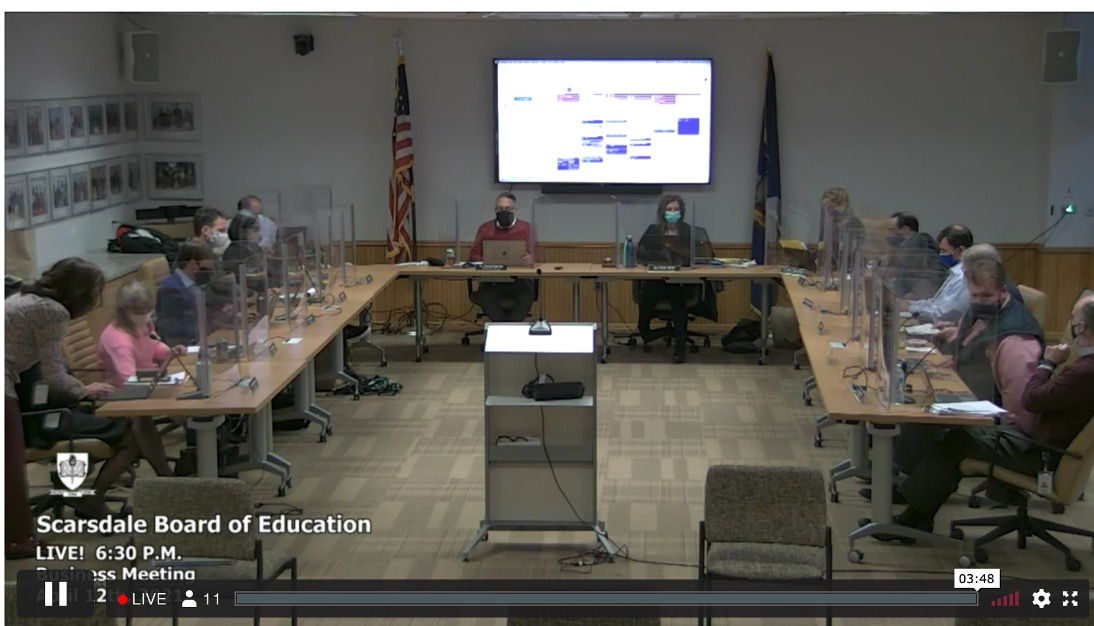 In a sign that the crisis is slowly abating, the Board of Education convened an in-person meeting in the Board of Education room, each board member masked and surrounded by plexiglass, on Monday April 12, 2020. They were able to address issues beyond the COVID crisis and had a lengthy discussion on a proposed board policy on diversity and inclusion.
Update on the Journey Forward
It was a big day for the district, as in-person classes resumed full-time for all middle school students. While there were some congestion and traffic hiccups during drop-off and pick-up, the administration plans to smooth out these issues over the next several days. Assistant Superintendent Eric Rauschenbach reported that kids were thrilled to be back in school and he was happy to see students in the classroom and using the outside grounds. The administration also reported that the full return at the high school is progressing and plans to open again for full-time in-person instruction for all students on Monday, April 19.
Social Distancing Guidelines Change
Superintendent Thomas Hagerman provided a critical update on the new CDC social distancing guidelines. These guidelines allow students, particularly elementary school students, to social distance inside the classroom three feet apart, a significant change from the previous guidance of six feet apart. This will dramatically improve the capacity to educate students and create a greater sense of normalcy in the classroom. The six-foot social distancing rule remains in place between adults and between adults and students. Additionally, six feet should be maintained when masks are removed for any reason, such as at lunchtime, or when an activity involves heavy breathing, such as physical education or choir. Six feet distancing also applies anytime students are outside of the classroom in common areas. The CDC also no longer recommends the use of barriers in the classroom. Despite this change, the administration states that a significant amount of time and resources were spent to obtain these barriers. Although no longer necessary by CDC standards, the administration emphasized the commitment they made to the community that these barriers would be in place when bringing back more in-person instruction. Thus, for the time being, these barriers will remain in the classroom.
Assistant Superintendent Stuart Mattey announced that the tents and picnic tables ordered for the middle and high schools will not be ready as originally anticipated. Despite several delays, however, the tents and tables should be ready for student use within the next month. This arrangement will allow students to comfortably spend their lunch hours outdoors and maintain COVID-19 safety protocol during nice weather.
COVID Tracking
Mr. Rauschenbach provided an update on the status of COVID-19 in the village. Currently, Scarsdale has 50 active COVID cases, which is up from 40 cases last week. The positivity rate in Westchester County is 4.48% and this rate is trending in the right direction. Over the last two weeks, there has been a small increase in cases, but that trend is currently settling down to the numbers Scarsdale experienced in mid-March.
Diversity and Equity Policy for Scarsdale Schools
The Board of Education spent considerable time discussing the proposed resolution: Policy 0105: Equity, Inclusivity, and Diversity in Education. Below find the most recent version of the policy proposal:
The Board of Education and Scarsdale Union Free School District are committed to creating and maintaining a positive and inclusive learning environment for all students, especially those currently and historically marginalized. As such, we are committed to ensuring that all students feel safe, included, welcomed, and accepted, and experience a sense of belonging and academic success.
We recognize that inclusive education is based on the principles of acceptance and inclusion of all members of the school community. Therefore, students and faculty should see themselves reflected in the curriculum, physical surroundings, staff/faculty representation, and the broader environment, in which diversity is honored and all individuals are respected.
In order to realize this goal, it is imperative that the Board, District employees and volunteers, and students understand the historical injustices and inequalities that have shaped our society and recognize and eliminate the institutional barriers, including racism and biases, that have and may continue to contribute to the disparate educational outcomes within our schools.
The Superintendent or designee(s) will ensure that curriculum and instructional materials reflect our shared commitment to educational equity. Curriculum and instructional materials for all grades shall reflect diversity and include a range of perspectives and experiences, particularly those of historically underrepresented groups. Curriculum materials shall be reviewed and examined for bias on a regular basis. Class instructional activities and extracurricular programs shall be designed and implemented to provide opportunities for cross-cultural and cross-racial interactions that foster respect for diversity and inclusivity.
The Superintendent or designee(s) will task the District Compact Committee with establishing goals and corresponding metrics related to this policy. The Committee will identify the multiple indicators necessary to monitor student outcomes, engagement, school climate, and specific data that will be used to ensure accountability for student, school, and District-wide performance.
There was a lengthy debate among Board members about designating this work to the District Compact Committee. Carl Finger stated that “this work is too important for the Compact Committee” because it is comprised of 32 people and he didn’t think the work could be addressed quickly enough. Mr. Finger suggested creating a Diversity and Inclusion Committee to run the implementation of the policy. Alison Tepper Singer pointed out that the Compact Committee is so large because it had diverse representation across the district and the schools, and that this could be a valuable asset to implementing the policy. Robert Klein added that he would like clear and tangible next steps to be outlined and asked for a defined organization of who or which committee would be in charge of implementation. Pam Fuehrer noted that the most effective solution might be to give Superintendent Hagerman as much flexibility as he needs to figure out which committee best aligns with the goals of the policy and what makes the most sense to him as the senior administrator. For now, the Board decided to remove the term “Compact Committee” from the draft while the best course of action is deliberated.
After making these adjustments, the Board voted unanimously to pass the policy resolution.
During Public Comment however, several constituents had issues to raise with the Board about the policy. Mayra Kirkendall Rodriguez spoke about her strong support of the policy but asked that the Board clarify several points, such as the precise objectives of the policy and what communication tools the Board will use so that the work of the implementing body is transparent. Ms. Rodriguez Valladares also asked several specific questions about the content. She stated “The policy states that it is ‘“imperative that the Board, its officers, and employees, faculty and students be fully conversant in the historical injustices and inequalities that have shaped our society.’” Does that mean that the BOE, staff and administration will be trained on these issues? If so, how, by whom, and when? The policy states that “’The Superintendent or designee(s) will ensure that curriculum and instructional materials reflect the Board’s commitment to educational equity.’” What is the Board’s commitment to educational equity and could that change as the composition of the Board changes?”
The highlight of Public Comment came from two Scarsdale High School Seniors. Vivian Guo and Karen Lee who are the co-founders of the Asian Conscientization and Empowerment (ACE) Club, and reviewed the policy with their club members, and came to the Board with four suggestions for improvement:
1. They asked to begin the policy with a statement of accountability. While the overall language was positive, they believe the Board should reflect on past actions to pave the way for growth.
2. They asked the Board to clarify how they will implement diversity and representation programs.
3. They asked for clarification on the actors who will build and review the curriculum at Scarsdale. The students felt that a lot of the language was phrased passively, and they wanted to know who would be in charge of taking an active role in diversifying instructional materials and evaluating the curriculum.
4. They asked for clarity on the commitment to providing opportunities for cross-cultural and cross-racial interactions that foster respect for diversity and inclusivity in the classroom and extra-curricular programs. The students said that many of their friends and club members of color share a feeling of being alienated or otherized at school. They added that the study body tends to segregate into different ethnic clusters and that they see many marginalized students turning towards each other because they don’t feel comfortable sparking discussions with white counterparts. The students noted that the nature of the Board’s statement is vague, and they pushed the Board to elaborate on how they will reach all students with these changes.
The young women spoke eloquently, and their efforts reflect a thoughtful review and reflection of the policy proposal. Dr. Hagerman noted that the administration is committed to enhancing the clarity and specificity of the policy and hopefully, these students’ suggestions will be fully reviewed and addressed by the Board and the administration going forward.
The 2021-2022 Budget
After many months of dedicated work by the school administration, the $166 million proposed 2021-2022 budget was voted on by the Board. Among other things, the budget funds the continued support for special education programs, increased funding for mental health and social and emotional support resources, a COVID-19 budget strategy to handle the continued effects of the pandemic, and continued excellence in Scarsdale's education system. The board unanimously voted to pass the budget, and it received high praise from each Board member. The budget now moves to a vote by the town which will take place at Scarsdale Congregational Church on Tuesday, May 18, 2021.
School Board Candidate Jim Dugan Wants to Contribute His Time and Energy to the Scarsdale Schools
- Details
- Written by: Joanne Wallenstein
- Hits: 4515
 Scarsdale resident, volunteer and attorney Jim Dugan has been selected by the Scarsdale School Board Nominating Committee as a candidate for the Scarsdale School Board. He will be on the ballot along with SBNC nominated candidate Jessica Resnick-Ault and independent candidate Alison Singer for the election on May 18, 2021. We asked Dugan to share some information and views and here is what we learned:
Tell us about yourself and your family. What drew you to Scarsdale, when did you move here and what do you enjoy about living here.
My wife, Shirley Salmeron-Dugan, and I are the parents of three girls, Sophia, age 14, Serena, age 12, and Stella, age 10. The two older girls attend Scarsdale Middle School, and the youngest attends Fox Meadow Elementary School. We are an active family; all three children enjoy acting and musical performance; and the two older girls are competitive swimmers. Shirley and I have been married for 18 years; she is from Arizona, and I was born and raised in New York City, in Queens. Shirley and I moved to Scarsdale 15 years ago for the great public schools and the proximity to Manhattan, where we both worked at the time, and also because it is a lovely town. We have since made many friends in the community. We both love the beauty of the village and the many interesting and accomplished people we have met since moving here. Scarsdale is a great place to live because it has everything: great schools, great people, and a great sense of civic responsibility.
You’ve been involved in many volunteer committees in town. Tell us about your volunteer resume.
Since moving here, I have been active in community organizations as well as local religious organizations. I was elected to the Citizens Nominating Committee, and thereafter served on the Procedure Committee, and got a firsthand view of our non-partisan volunteer system in action. I also served on the Board of the Overhill Association as well as President of that Association, and was a member of SNAP – the Scarsdale Neighborhood Association Presidents. I co-founded, along with Arthur Rublin and others, the Coalition for Scarsdale Schools nine years ago to advocate against increased class sizes in the elementary schools. Shirley and I belong to the St. James the Less Episcopal Church, where I have served in the Parish Choir, as a member of the Vestry, and as a Warden.
How does your professional background complement your ability to serve on the Board of Education?
I have been a litigator and counselor for over 26 years, and I have spent much of my career advising corporate boards of directors, especially in times of crisis. Through this experience, I have learned how boards operate and have developed the skills necessary to participate meaningfully in the decision-making process. I also believe that this experience will serve me well in working with other Board members to assess and respond to matters that come before the Board. As a litigator, I have honed public speaking, advocacy, listening and consensus building skills, and I have learned to quickly assess and understand problems, think critically about solutions, and work to achieve best outcomes. If I am elected, I will bring all of these skills to bear.
Why did you decide to run for the School Board this year?
This has been a challenging year for everyone; I really wanted to contribute my time and energy to help the community as it recovers from and adjusts to the pandemic experience. I have long believed that one of Scarsdale’s greatest assets as a community is its public schools, and I especially wanted to devote my volunteer efforts to help support the excellence of our schools at this time.
With three children in the Scarsdale Schools, how was your life changed by the pandemic and the closing of schools this year?
The pandemic and the closing of the schools has been difficult for everybody, and my family is no different. We have had to adjust to a radically different school experience, and all three of my children have reacted differently. My wife and I have had to be more active in our children’s education experience in order to keep them focused in a setting where many distractions loom. It has been challenging but in many ways it has brought us closer together as a family.
What are your views on the way decisions were made regarding remote schooling and the timing of the re-opening of schools? As a resident, did you feel the process was open and transparent?
As a resident, there were times when I would have appreciated a better line-of-sight into the process and timing of re-opening our schools. In addition, many in the community feel that the process should have been more open and transparent and I think their concerns are valid.
Past Board protocol calls for the Board of Education to “speak as one,” sometimes preventing those with differing viewpoints to speak out. Do you agree with this policy? How can Board members exercise oversight if they are not permitted to offer their opinions?
I do not wish to take issue with specific Board policies in connection with the election; however, if elected I will come to the position with an open mind and without any preconceived notion in favor of any particular policy, especially if there are compelling reasons to go in a different direction.
What are your personal goals for service on the Board of Education and how do you feel you can add to the mix?
My personal goals for service on the Board, if elected, are to hit the ground running and make an immediate contribution to the Board’s deliberative process. I am a strong believer in the power of education to mold lives and build minds. I am also a believer in public education as a key to building strong and successful communities. I am running on the SBNC slate because I believe strongly in maintaining the excellence of the Scarsdale Public Schools, and I bring to that position decades of experience in advocacy and community volunteer leadership. I and my fellow SBNC slate candidate, Jessica Resnick-Ault, will bring a fresh perspective to the Board, one that is firmly rooted in the voice of our community.
Anything else you want to add is welcome.
Thank you for this opportunity to address our community.
SBNC Selects Jessica Resnick-Ault and Jim Dugan as Candidates for Scarsdale School Board
- Details
- Written by: Joanne Wallenstein
- Hits: 4698
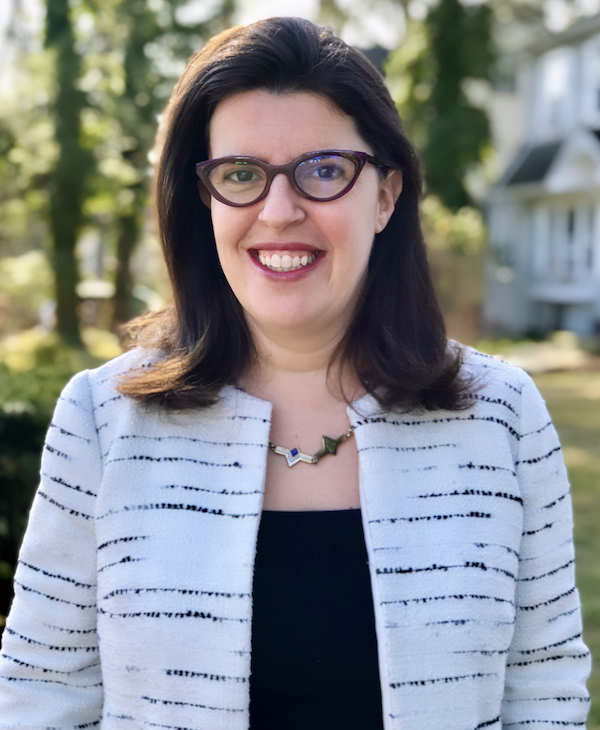 The Scarsdale School Board nominating committee has completed their deliberations and announced the selection of Jessica Resnick-Ault and Jim Dugan as their candidates for Scarsdale School Board. If elected on May 18, 2021, these two candidates will replace Board President Pam Fuehrer, who will complete two terms of service, and Board Vice President Alison Singer, who will complete one three-year term.
This is the second time in recent years that the SBNC did not re-nominate a sitting board member to stand for a second term. In March 2018, Fuehrer was not re-nominated for a second term by the SBNC but chose to run as an independent candidate. She won the election and ultimately became Board President. If re-elected this year, Singer would have presumably served as the 2021-22 President of the Board of Education. Singer and others can run independently if they so choose.
The 2020-21 school years was undeniably a chaotic one as, for the first time in its history, the district moved to remote learning due to the pandemic. This proved to be challenging for parents, children and teachers alike, and tensions often erupted during the public comments sessions at virtual meetings of the Board of Education.
Though all deliberations of the SBNC are conducted in closed session so the public does not know what was discussed, this outcome may be a sign of community dissatisfaction with the district’s decision-making process during the crisis and the Board’s oversight of the administration.
Here is the announcement from the School Board Nominating Committee which comes two days after the much-anticipated decisions were made.
School Board Nominating Committee Announces Two School Board Candidates
SBNC Statement from Nikki Hahn, 2021 SBNC Chair and Kerry Hayes, 2021 SBNC Vice-Chair
As the 2021 School Board Nominating Committee (SBNC) has completed its nomination of Jessica Resnick-Ault and Jim Dugan for election to the Scarsdale Board of Education, we thank all members of the SBNC for their time, thoughtfulness, and diligence in performing this important civic responsibility. We also thank all of the applicants. Scarsdale benefits when so many talented citizens are willing to present themselves to the SBNC each year, as well as from the efforts of an engaged SBNC.
Our community created the SBNC to nominate school board candidates who will work to maintain and enhance the quality of education provided by the Scarsdale schools. This year the SBNC was composed of 28 voting members (elected from each of the five elementary school areas) and one non-voting member. Pursuant to its governing resolution, the SBNC judges and selects candidates “solely on their qualifications to serve the community.”
If elected to the school board in May, Jessica and Jim will assume their roles on the School Board for three-year terms effective July 1. The SBNC is grateful to the talented and engaged citizens who were willing to put themselves forward to serve on the Board of Education. All current voting members of SBNC will sign the nominating petitions and submit to the district.
The Candidates
The SBNC strongly endorses Jessica and Jim for election to the School Board. These two qualified candidates will bring different backgrounds and experiences to serve our community and share a deep commitment to maintaining the excellence of the Scarsdale schools and serving different constituents.
Jessica Resnick-Ault
Jessica has been a resident of Scarsdale for six years, along with her daughter, who attends Edgewood elementary school. Jessica is a journalist at Reuters News, writing about public policy and finance with a focus on energy markets, companies and climate for the past seven years. In her role as team leader, she demonstrates aptitude with complex data, financial documents and cross-team collaboration. She frequently interviews high-profile executives, national politicians and scholars. During her career as a reporter and editor, she has built and led teams of increasing size, emphasizing diversity and inclusion with high-quality co-working relationships. She has worked both as a unionized reporter and a manager of unionized journalists, developing a unique appreciation for the balance between unions and administrations.
Jessica is probably best known locally for having founded the “Grant a Wish” program for local charity Bake Back America (“BBA”), which has helped expand the organization’s reach from addressing food insecurity to broader community service. Jessica has piloted programs that are a key to BBA’s substantial educational component. BBA has obtained and distributed laptops and other electronic learning devices for students living in low-income local school districts and volunteers now provide about 250 hours per week of tutoring to community children in need. Jessica has also served repeatedly as a PTA Class Parent, co-chaired Edgewood’s Community Service committee, and volunteered as a workshop leader at Scarsdale’s Young Writer’s Workshop. A graduate of Brown University, she has been active in the school's alumni interviewing network.
Jessica is an active community organizer devoted to improving the lives of our neighbors and is willing and able to devote the time and energy to being a conscientious and effective member of the Scarsdale Board of Education.
Jim Dugan
Jim has been a resident of Scarsdale for 15 years. He and his wife, Shirley, have 3 daughters who attend Scarsdale Middle School and Fox Meadow Elementary School. Jim is currently a partner in the Litigation Department at Willkie Farr & Gallagher, LLP focusing on complex commercial litigation. He has more than 25 years of experience representing Fortune 500 companies, hedge funds, private equity firms, C-level executives, and accounting and financial services firms in securities class actions, shareholder derivative litigation, bankruptcy litigation, contract disputes, employment disputes, and restrictive covenant and non-compete litigation. He is a member of Willkie’s Pro Bono Committee, dedicating his time to work on cases for the Innocence Project. He served on the Cornell Law School Alumni Board for 3 years and is currently a member of the New York City Bar Association.
Shortly after moving to Scarsdale, Jim became an active member of the Overhill Neighborhood Association, joining the board and then eventually becoming president of the association and serving for two years in that role. Through this role, he was instrumental in fostering a sense of community for that corner of Scarsdale and keeping neighbors apprised of key issues around the village. He was also a founding member of the Coalition for Scarsdale Schools which was engaged around the issue of elementary school class sizes. This was a natural role for him as he was passionate about maintaining the excellence of our school system. He has also served on the Citizens Nominating Committee, the CNC Procedures Committee, and has served in numerous roles at St. James the Less Episcopal Church. In each of these community roles he was a tireless volunteer, giving of his time and expertise to work collaboratively to make Scarsdale a great place to live.
Jim is vested in Scarsdale and will serve the School Board and community well with his valuable skills and perspective.
The School Board Nomination Process
The SBNC nomination process involves several stages.
First, the SBNC initially heard current school board members’ views on the role and structure of the school board, the school board’s relationship to various stakeholders, the roles and responsibilities of board members, and the anticipated challenges and opportunities for the school board during the next three years.
Second, SBNC members then sought potential board candidates through public appeals and by recruiting committed community members. All qualified candidates are encouraged to apply. Each interested applicant submitted a biographical form and presented via Zoom to the SBNC over the course of the past several weeks.
Third, pursuant to rules of procedure, committee members conducted due diligence by confidentially contacting dozens of people outside of SBNC for their input about the candidates’ qualifications to serve the community. In order to get a complete view of the applicant, SBNC members contacted references provided by the applicant. Committee members then reported relevant factual information to the other committee members, who were instructed to keep open minds and listen to one another carefully.
Finally, the committee discussed the qualifications of all proposed candidates fully and candidly before taking a vote and voted by secret ballot to fill each vacancy in turn. This year’s SBNC members were devoted to the process despite the changes presented by the current pandemic restrictions which only allowed the committee to meet via Zoom. Voting was conducted using the anonymous poll function.
Discussions and deliberations regarding candidates are confidential in order to encourage people to apply, protect the privacy of candidates and references, allow for candid discussion among SBNC members, and select nominees based solely upon their qualifications.
For more information about the SBNC and its procedures, visit the “About Us” and “Join the School Board”.
Please Participate
Scarsdale is fortunate to maintain a nonpartisan election process for the Board of Education that selects candidates based solely on their qualifications to serve, not on their campaigning abilities or positions on specific issues. Informed and engaged residents willing to serve on the SBNC and the School Board, along with voter participation, help to ensure the highest quality school board leadership. Please consider serving or suggesting other school district residents to fill future vacancies. You can do so at any time by emailing sbncchair@gmail.com
In addition, please consider a donation to the SBNC. The SBNC elections and process are financed by your contributions alone. Donations are solely used for running the SBNC elections and not towards any candidate. Any amount would be appreciated. Please visit https://scarsdalesbnc.com/please-donate/
Finally, please remember to vote on the school budget and in the school board election on May 18, 2021. Details on the voting process will be forthcoming.
Students Reflect on the Re-Opening of Scarsdale High School
- Details
- Written by: Sydney Piccoli
- Hits: 3098
 Recently, the Scarsdale High School administration announced that starting March 8th students will spend an extended amount of time learning in-person. Instead of going in only during Monday and Thursday mornings for four hours at a time, students in Cohort A will now remain in school for an additional three hours. Similarly, students in Cohort B will spend Tuesday and Friday afternoons in Scarsdale High School as well as the previously scheduled mornings.
More in-person schools will follow suit as on Sunday March 7, the district announced that Scarsdale High School is slated to open to full, in-person learning on April 19th. Although details are not known about the April schedule, it has already produced much conversation among the Scarsdale High School student body. “At first, I had been dreading the April 19th schedule because I thought each day would seem a lot longer. However, after my first full day of school on March 8th I realized how energizing being around all of my friends was. Lunch is something I'm really glad I get to spend with them now. Classes... have mostly been the same experience. Even though they are shorter, they feel similar to fifty minute class periods, but being in the school has made them less draining and easier to get through,” remarked Emily Wang, a Scarsdale High School sophomore who is learning hybrid. “We do not know a lot yet about the new schedule, but from what I can tell it seems like school is finally beginning to return to normal. I am definitely excited because it indicates that we have finally gotten to the other side of the pandemic... I am also worried that going back to five full days will be a big adjustment to make,” added Charlotte Davis, a Scarsdale High School junior who has selected the hybrid model.
The administration plans to maintain the standard of six feet between student desks and a classroom capacity of approximately 50% of normal occupancy. All periods will be reduced to forty minutes except period 10, which is currently period 5, being 25 minutes. Students will be permitted to leave the campus during free periods assuming they properly follow safety protocols. Last, the new schedule will include designated school lunch periods during which students and teachers can dine either inside or outside the school. As far as inside dining, students will be confined to their lunch seats by polycarbonate barriers, will record their lunchroom and seat number on a Google form daily and maintain six feet of distance from one other — the last guideline applying to outdoor seating as well.
As to why this course of action is being taken, the administration explained, “We are making this change to increase the time students are in the school building, as we know that the in-person educational experience benefits learning and mental health. There is no evidence that the virus has been transmitted in classrooms with appropriate physical distancing and mask-wearing. Revised protocols were implemented in January which does not require students or teachers in such classrooms to quarantine.” Other factors contributing to the administration’s decision include the decrease of positive case percentages and cases per 100k in Westchester County as well as the increased availability of vaccines for educators and the wider community.
In addition to health metrics demonstrating extremely low in-school spread, the administration believes more in-person school time will enhance academic experiences and social/emotional health and mitigate the difficulties of remote and hybrid educational models.
What effect, if any, will the new schedule have on whether students choose to attend in-person school or remain virtual?
The new schedule has convinced many previous all-virtual students to once again enter the halls of Scarsdale High School while several remain unaffected by the news. “After the schedule change, I made my decision to go back in person based on a few reasons. The biggest reason was the fact that spending a full day in school is a step towards normalcy and returning to life pre-COVID which is very exciting. Another factor was I just could not fathom the idea of staring at my computer screen for the entire day,” reflected SHS junior Anna Forest. Conversely, “the new schedule does not impact my decision at all. I choose to stay away from school predominantly because of the health risks, but I've also become accustomed to the home-learning routine and I quite like it,” added SHS junior Lydia Jin who has chosen to remain all-virtual. “My decision to return to in-person school with the April schedule, however, depends on what happens in the next few weeks. My family and I would only feel safe risking exposure if the majority of students get vaccinated, and we're not quite there yet, so I anticipate staying virtual for the rest of the school year,” added Jin.
In February, Principal Bonamo alongside the Scarsdale High School government sent out a video urging students to attend in-person school, which could have played a role in the shifting dynamics of school attendance. Although no specific conclusion can be drawn, it is clear that the new schedule has persuaded a decent amount of previous all virtual students to return to the building. “From walking around today and talking to teachers...early feedback indicates more students are coming to school,” mentioned Bonamo, reflecting on the March 8th school day. It is also evident that students will continue to have the choice to either attend in-person or virtual school depending on their personal preference.
Another consideration is how the new schedule will affect the student population aside from which mode of learning they select. A major incentive to enacting the new schedule is the potential positive effect it could have on student mental health. “I think the change may be difficult at first because students are so used to the hybrid schedule and returning to full days may initially be tiring. With time, I think this will have extremely positive mental health effects because we will be able to interact with our peers all day instead of being isolated in our rooms,” mentioned Forest. With the new schedule, in-person students will spend more time in classrooms conversing with peers and teachers alike; as in-person interactions have been proven to alleviate feelings of social isolation, which are most prevalent in today’s society, the new schedule could easily improve student mental health.
For virtual students who have extenuating circumstances and are unable to attend in-person school, the new schedule poses several worries. At the start of the school year, the minority of the student body was learning solely from home, which meant teachers were focusing more of their attention and energy on those in the classroom rather than on the computer screen. However, as the year progressed, more and more students became attracted to the flexibility and ease of virtual-learning. Rather than attend school for only a small portion of the day, students wanted to enjoy the benefits of online learning including a familiar environment and more time to focus on one’s health. With the population of virtual students increasing, teachers were forced to adapt their mode of learning to equally engage in-person and virtual students.
As the new schedule incentivizes students to come to school, those who remain all-virtual are scared that their teachers will once again solely focus on those physically in the classroom. “At the start of the year when I was the only all-virtual student in most of my classes, several teachers were not very accommodating, and sometimes they would even forget to start the Zoom call. I hope that by now most teachers know how to make virtual learning efficient, but I still worry that they won't pay much attention to me anymore,” remarked Jin.
As it’s now a year since the COVID-19 pandemic shut down Scarsdale High School, a widespread notion is that students feel as though their lives have become rather monotonous and consumed with routine. Having a new schedule introduced just in time for spring may very well provide high school students with something to look forward to and a break an otherwise mundane routine. More in-person school could mean a taste of pre-COVID times and a glimmer of hope in a time when we need it the most.
What Metrics Need to Be Met to Reopen Scarsdale Schools?
- Details
- Written by: Joanne Wallenstein
- Hits: 5302
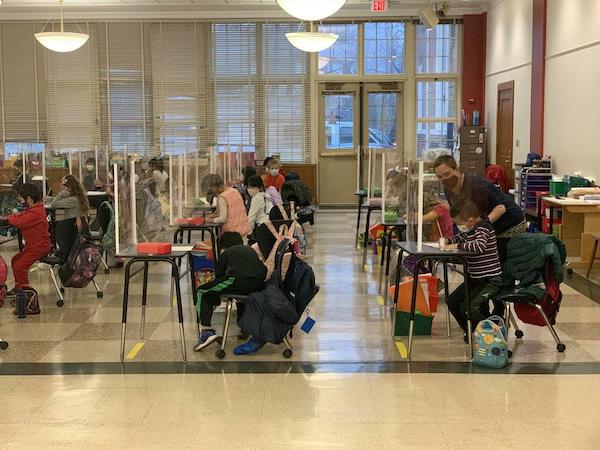 With so many neighboring districts reporting plans to re-open schools full time as well as the availability of vaccines for teachers and indications from the NYS Health Commissioner that the six foot social distancing requirement may be relaxed, many are wondering what’s holding Scarsdale back from re-opening the schools?
Ardsley, Bronxville, Briarcliff, Byram Hills, Chappaqua, Dobbs Ferry, Eastchester, Harrison, Hastings on Hudson, Mt. Vernon, New Rochelle and Rye are either in school full time or have announced plans to transition to full time school in the next few weeks. In Scarsdale, elementary school students will return to school, however the Middle School is only moving to 2 days and alternate Wednesdays on March 17 and the High School is going from 2 half days to 2 full days in school on March 8.
Plastic Barriers
We learned that the district has purchased plastic partitions and thought that might be a sign that a fuller return to school was in the offing, however the information we received from Superintendent Thomas Hagerman offers no timeline and makes no guarantees. Here are responses from Hagerman received on March 1, 2021:
(Q) The parents shared the news that the district has purchased 4,200 barriers to be used for grades 3-12. Will these be installed soon or are they intended for the fall?
(A) So far we have spent approximately $180K in total for barriers as follows:
-Mid/Late Summer 2020: $53,000 - 660 barriers primarily for special education settings and one for each classroom for one on one instruction if needed. Also for offices. Prices were extremely high at this point and time was of the essence.
-Late-Fall 2020: $32,000 – 1,200 barriers for k-2 students primarily used at lunch.
-Early-Feb (on order): $93,000 – 4,200 barrier for grades 3-12 primarily to be used at lunch and instructionally as determined by teachers.
-An additional $2,000 for miscellaneous other barriers needed along the way related to all of the above
(Q) Howard Zucker has indicated that the state is re-examining the six-foot rule and says he wants to get kids back in school. Will this change the district’s plans?
(A) If the NYSDOH changes the social distancing requirement to say, 3ft., this will not change plans--which has always been to get all kids back in school as soon as it is safe to do so for students and teachers--but it would certainly accelerate our timeline.
(Q) I am sure you are aware that many Westchester districts have now announced plans to fully re-open in March and April. Do you expect Scarsdale to follow suit?
Like other districts, we have been planning for a full return throughout this process. The availability of vaccinations for faculty and staff is new risk mitigation that we will believe will help us lessen six-foot social distancing and get us back into school more quickly.
Metrics
Since the beginning of the crisis, parents requested a list of required metrics that, if reached, would enable full-time school to open. Concise criteria for opening were never presented, but one fact was clear. Both the administration and the Board of Education insisted that the school’s physical plant could not accommodate the full school population at six feet apart as required by the NYS Department of Health.
Social Distancing
When parents repeatedly questioned calculations that showed there was insufficient space inside the buildings, the administration invited district architect’s BBS to present their plans at an 11/16/20 Board of Education meeting. At the time, Architect Kevin Walsh of BBS shared his schematics for the layout of two sample elementary school classrooms, one at Heathcote and another at Edgewood. Walsh showed desks placed six feet apart with 56 square feet of space per occupant. According to Walsh, the layout must allow for two means of egress from each classroom. For a classroom of 785 square feet, 14 students could be accommodated along with a teacher and an aid. Depending on the number of teachers and aids, an additional student or two could be added.
Relying on these calculations the board and the administration spent months claiming that this was a major hurdle for full time school.
Frustrated with the architect’s analysis, Scarsdale resident Irin Israel obtained floor plans of the elementary schools and used a graphic approach to draw in the desks in the rooms. He quickly noted that desks that bordered the walls of the rooms did not need six feet of distance on the side abutting the wall, saving considerable space.
However, when he presented his renderings to the district, they failed to acknowledge his solutions. He wrote to the Board and administrations saying, “Comparing the architect’s square footage method (which was used to make all layout determinations and decisions this past summer and fall) to the graphic method (which I presented on 11/9/20), the graphic method allowed for an additional 507 kids to fit in our Scarsdale schools at six-foot distancing (17% more children).
Then suddenly, on February 9, 2021 Superintendent Thomas Hagerman announced that students in grades three through five would return to school in March, following grades K-2 on November 30, 2020. This meant that the elementary schools would be fully populated with students and staff.
Explaining the change in direction, Dr. Hagerman made a distinction between six feet of social distancing and remaining “functionally six feet apart.” Here is what his email said.
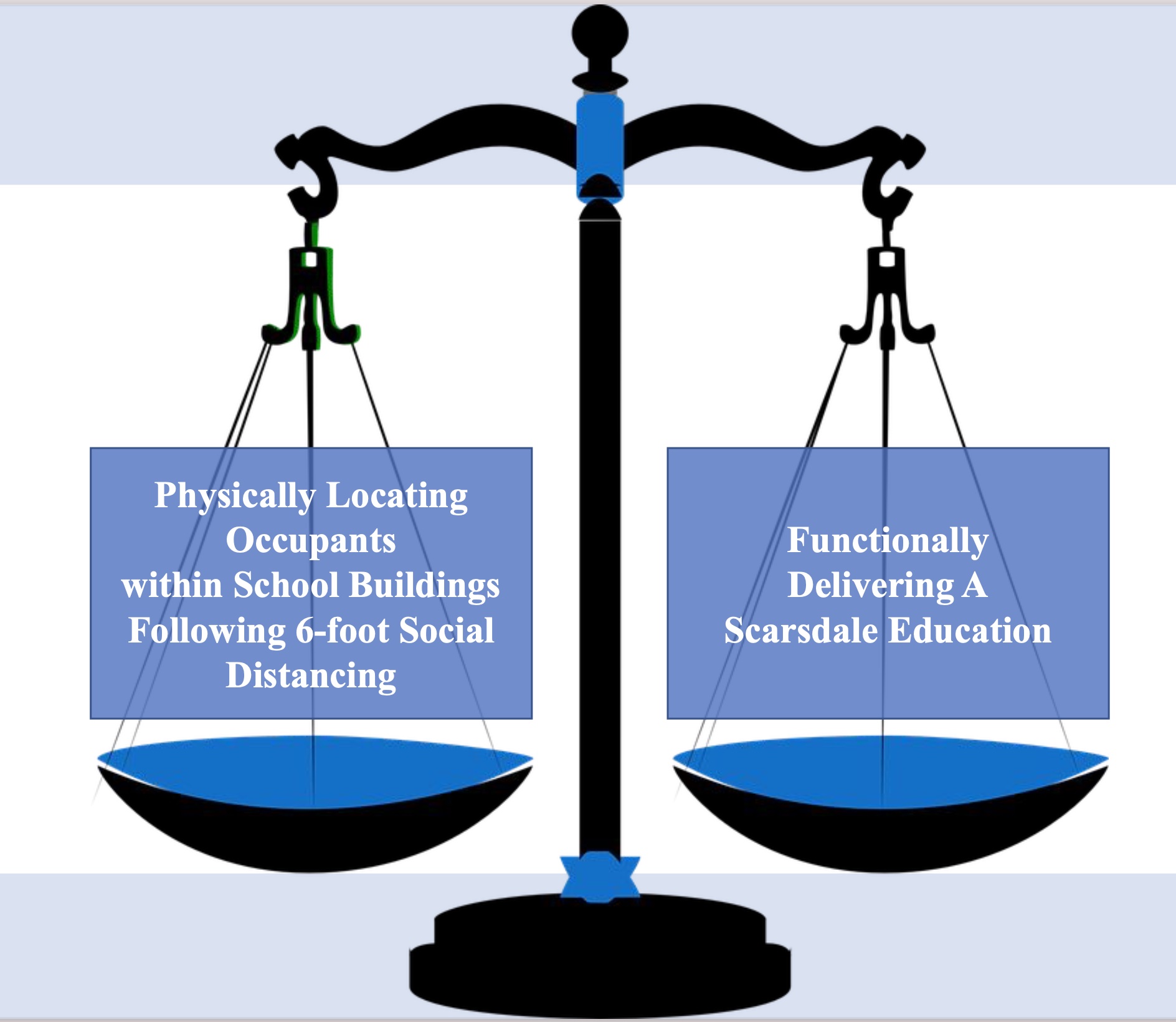 A report from District Architects BBS dated January 8, 2021 showed that the full school populations of each elementary school could safely attend school.
“Specifically, how can students fit back into our buildings when we were told they could not because of the need for six-foot social-distancing? The answer is that students could not have fit all this time and remained functionally six feet apart. The idea of social-distancing focuses on reducing the contact between all individuals in an environment. In our assessment, this concept goes beyond the measurement of six feet between desks to encompass the full range of functions necessary to run a school. The new arrangement moves from a more cautious application to accepting a purely mathematical interpretation of 6 feet of distance. This represents a fundamental change in our application of social-distancing, and, at least partially, weakens one of our core mitigation efforts. We resisted this for some time primarily because of health and safety promises we had made to the staff and community, but also because we did not have confidence in our ability to run “school” safely and effectively, given the complex intricacies of a typical day.”
Now a response to a FOIL request from Israel, reveals that the district was aware that there was adequate space in the schools for all elementary school students to be social distanced at six feet. In fact, the administration received a report from district architects BBS dated January 8, 2021, that demonstrated how the rooms could be laid out to give students and teachers ample space. Why the change in the numbers?
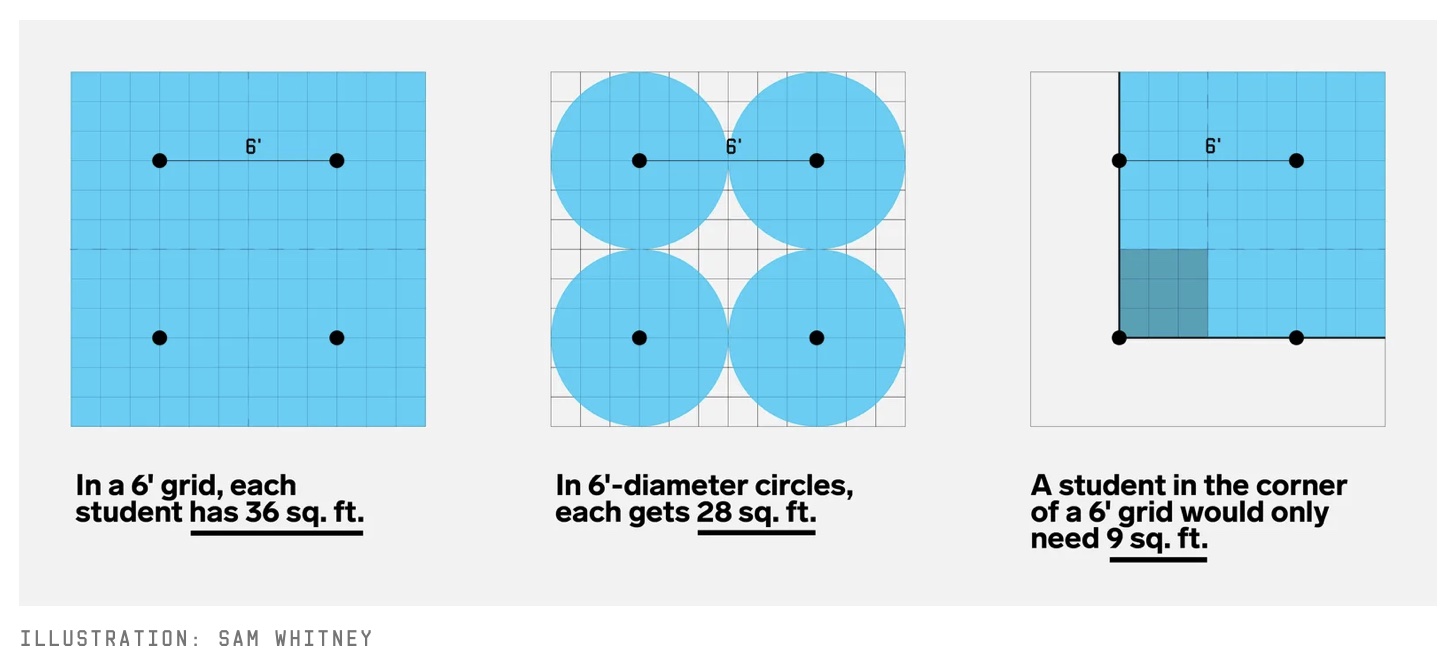 An analysis from Wired Magazine shows that 56 square feet of space per student is far more than is needed to maintain 6 feet of social distancing.It appears that the architects initially used a simple mathematical calculation to determine how many students could safely fit into schools. Architects assumed that each student would need 56 square feet of space, and they took that number, divided it by the total square footage of the school and calculated the number of people that could be safely placed in the building. That figure of 56 square feet was far higher than the 44 square feet used by neighboring districts –and 44 square feet was later determined to also be too high. See the analysis here:
In the report from the architects dated January 8, they compare the square footage method to the graphic method and determine that all students and teachers could safely attend school, and there would still be remaining open spaces. In the most extreme example, only 22 rooms at Greenacres would be needed, leaving 18 rooms including the learning commons, gym and new multipurpose rooms open for use.
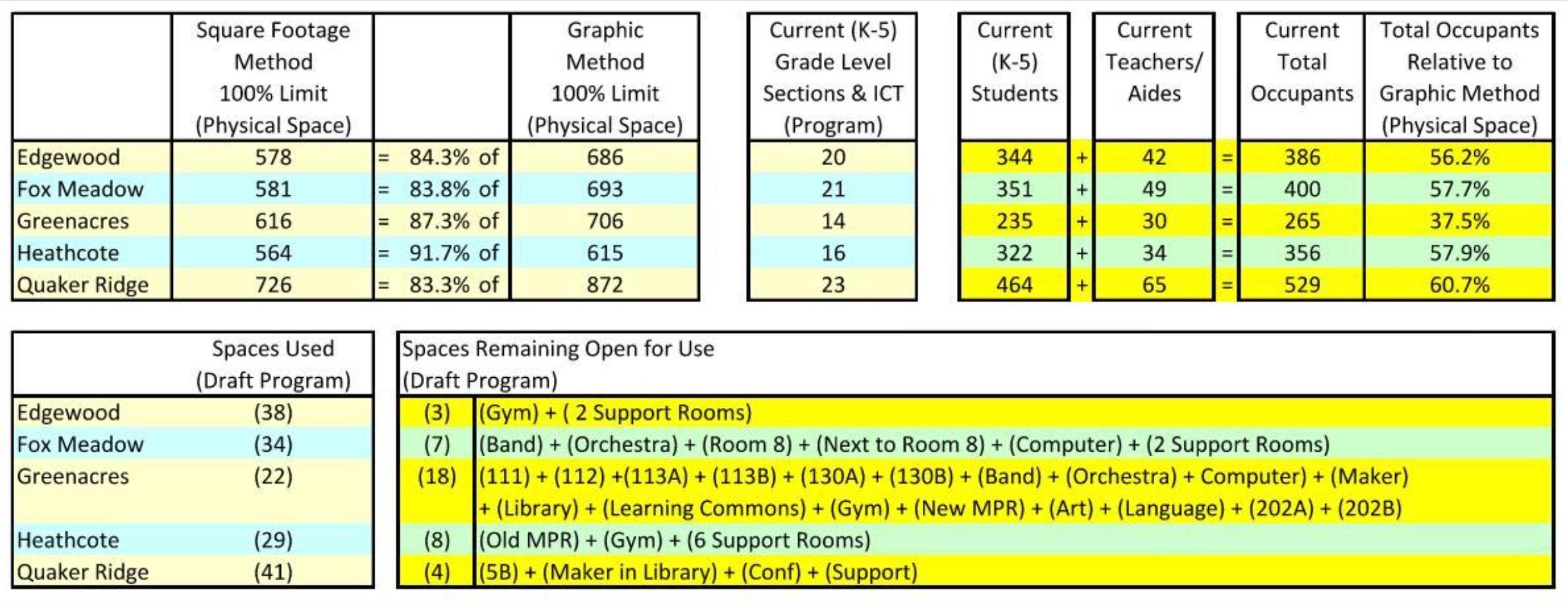 January 8, 2021 analysis from BBS Architects
However, as far as we know, the administration did not share this report with the Board of Education and did not make it available to the public.
With this new information in hand, Israel shared it with Board of Education and asked the following:
1) Comparing the architect’s square footage method (which was used to make all layout determinations and decisions this past summer and fall) to the graphic method (which I presented on 11/9/20), the graphic method allowed for an additional 507 kids to fit in our Scarsdale schools at six-foot distancing (17% more children).
2) 40 rooms, including some large rooms like gyms, would be unused and not needed for classes (but could be used for other purposes) even with all children fitting at six-foot distancing. 40 empty rooms.
3) Zero rooms need more than capacity (at six feet), only 12 rooms total in the 5 schools would be 100% capacity (at six feet), and 79% of rooms used would be at 80% or less of capacity (at six feet).
Basically, it’s not even close.
Before you yell “density!”, keep in mind that we have yet to hear any metrics of density and where the line between safe and unsafe lies. 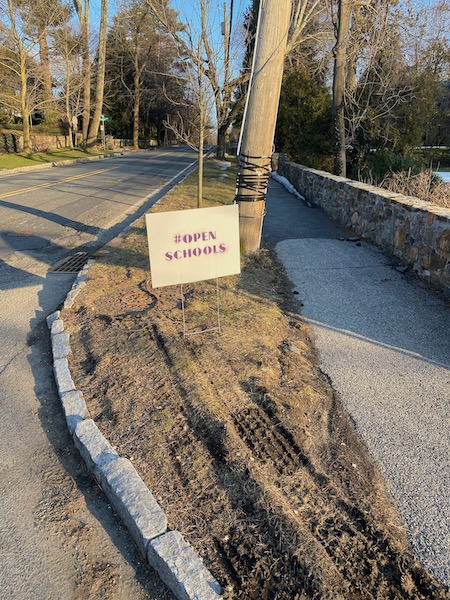 Sign on Fenimore RoadRegardless, with these drawings, while the school density would obviously increase, the density per classroom would not increase at all.
I spent much time this past fall illustrating exactly what these documents show, and here, it is unequivocally proven true: that all current in-person Scarsdale elementary children can fit full-time at six feet and have been able to fit since the beginning of the school year.
1) Is BBS Architects the correct district architect for Scarsdale? This architect has blatantly dropped the ball by using a sub-par mathematical equation to position the children in our schools. This was a simpler and less effective method, rather than doing the full work to assess the maximum capacities within the safety regulations. Their information misled the district and community and affected many critical decisions this year.
2) After denying the truth of this information, the District learned the truth on 1/8/21, yet did not share this pertinent information with the community nor the Board. In fact, I would suggest that the administration would not have revealed this information to the Board had it not been for my request, since they had not revealed it until my request was being filled 7 weeks later. This is further lack of transparency. This is information that must be used to judge the Administration’s performance in attempting to follow the Board’s policy directive of getting the children back into school full-time safely and according to the regulations this year. It is critical that this information be used when judging the performance of the current Superintendent and Administration this school year.
What’s Next?
The district’s lack of transparency, even with the Board of Education, is puzzling. Why did they conceal this information? What other factors are preventing the opening of the schools? What is the district’s agreement with the teachers’ union? With adequate social distancing, a supply of plastic barriers and staff vaccinations in place, what are the reasons for not reopening schools?
As the weeks go by, and many grow increasingly frustrated with ZOOM school, social isolation and fears for their children, many parents are waiting for answers.