








Raiders 1, Horace Greeley 1 in Tight Soccer Match
- Details
- Written by: Anna Cho
- Hits: 5061
 Senior and captain Benjamin Rubin setting up to kick the ball in the second half of the game. Scarsdale Raiders Varsity A Boys Soccer team tied 1-1 with Horace Greeley in a grueling, tight match on Tuesday September 3 in Scarsdale. The game went into overtime, with two, ten-minute halves. These soccer athletes kept at it until the last second. Every player was either grinding on the field or enthusiastically rooting for their teammates on the bench. These athletes never showed a lack of effort, and worked their hardest during every aspect of the game.
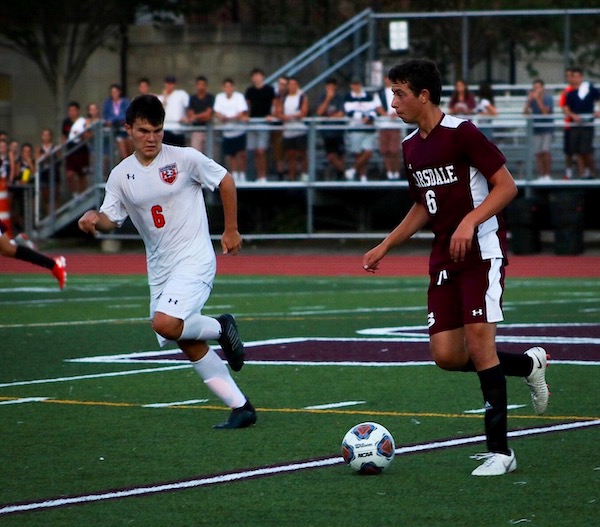 Junior Cooper Cohen is seen running down the field with the ball.
“We have a very talented team and a lot of hard working players, and I believe we can compete with any team in the section,” commented senior and captain Zach Medvinsky who has been on the team since freshman year. The boys aim to win the section this year, and are very determined to do so. They are dedicated players, who “want to win and work hard for each other,” says returning junior Cooper Cohn. The team’s focus on building their friendships both on and off the field has motivated them further to win for one another as a unified team.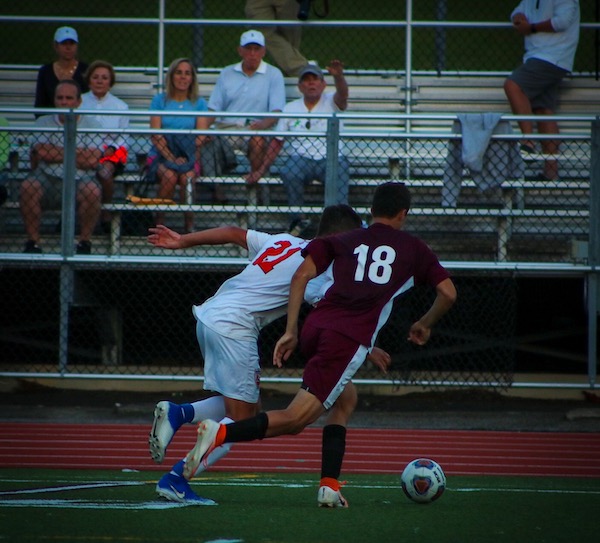 Junior Adam Wasserman is pictured running to the ball before his adversary from Horace Greeley.
Although the boys have lost and tied their first two games, they “have had a much better start than previous years,” claims Medvinsky. The team has recruited six new players, some being from Varsity B and JV who are “very solid and have been doing a very good job creating many scoring opportunities,” states returning junior, Jack Porter.
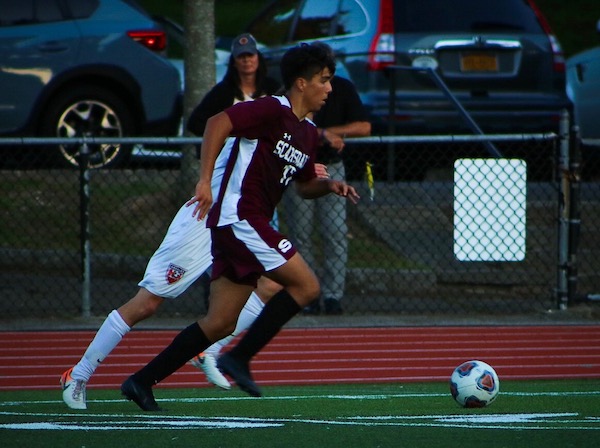 Junior Estaban Rudolff is seen sprinting to the ball before an adversary from Horace Greeley.
The team looks forward to a very successful season filled with hard work, fun, and countless wins. Catch these impressive athletes at their next game against Arlington at 12:00 on Quaker Ridge Fields this Saturday.
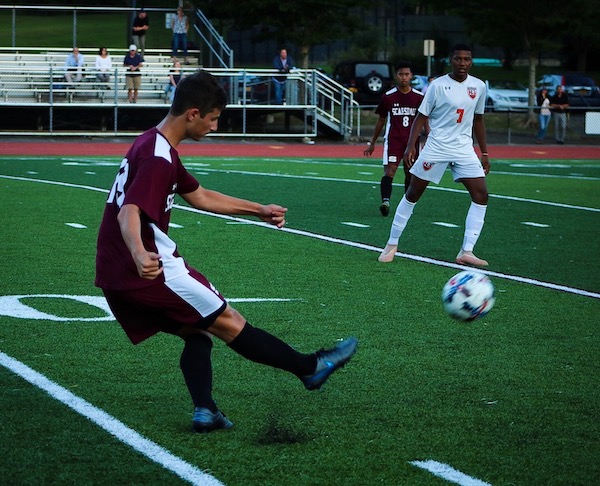 Sophomore Roman Tirabassi is pictured kicking the ball in tight game against Horace Greeley.
Scarsdale-1, Horace Greeley- 1
Team members: Patrick Artes, Kian Batliwalla, Cooper Cohen, Cameron Davis, John Dowd, Lukas Forsingdal, Eli Gledblum, Katcher Adam, Calvin Lee (Captain), Adrian Lim, Aidan McKenna, Zachary Medvinsky (Captain), Luke Peltz, Jack Porter, Benjamin Rubin (Captain), Estaban Rudolff, Luca Schettino, Joshua Stressberg, Rafael Tassari, Roman Tirabassi, Adam Wasserman, and Michael Waxman
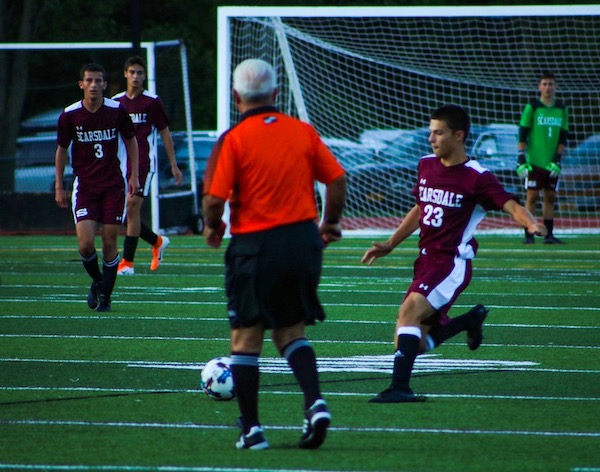 Junior Michael Waxman is shown kicking the ball during the game against Horace Greeley.
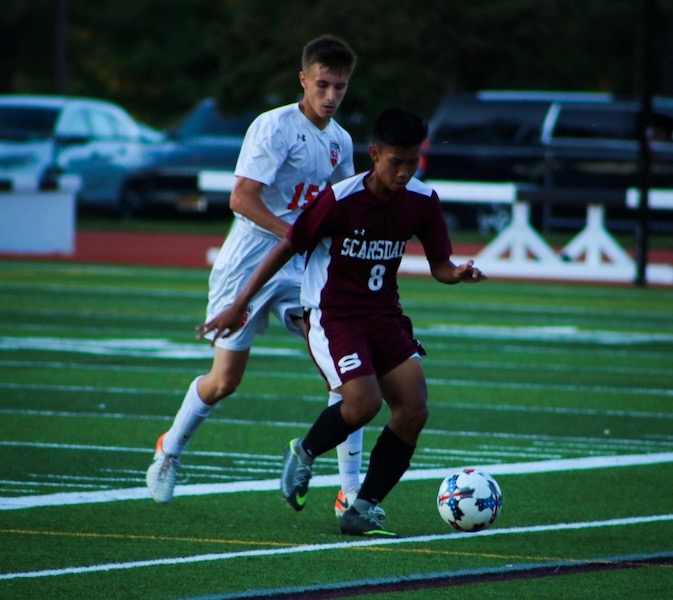 Senior Patrick Artes is seen dribbling the ball and keeping it away from a Horace Greeley opponent.
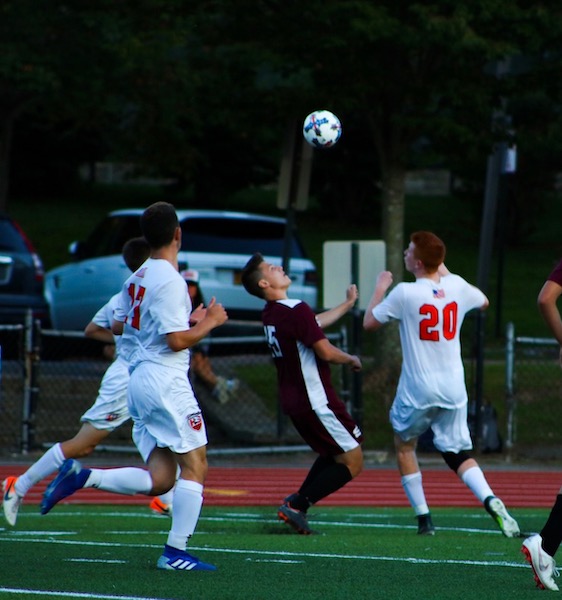 Senior John Dowd against surrounded by three opponents from Horace Greeley.
School Facility News: Greenacres Transformation in Process, Security Vestibules Delayed
- Details
- Written by: Joanne Wallenstein
- Hits: 4434
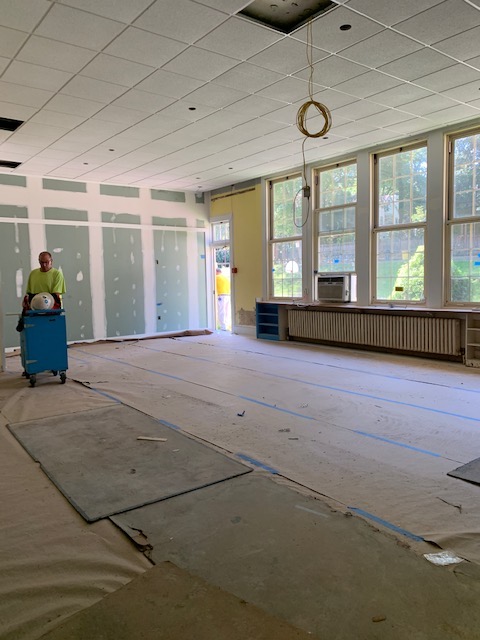 Will the classrooms at Greenacres be ready in time for the opening of school? The district sent out the following communication on Friday August 23 indicating that these rooms were in their “final stage of transformation.” They anticipated that some classrooms might not be set up in time and said the principal would send out further information.
We walked through Greenacres two weeks ago and saw that casework and cubbies had been removed from the classrooms and painting and spackling were underway.
In other developments, according to the memo below, the security vestibules which were scheduled to be built at each elementary school this summer were not installed due to “contractor delays,” but the new safety monitors will start work in September.
See more about facilities work below:
Dear Parents,
As you may be aware, this summer marked the commencement of work on capital improvements that were included as part of the Bond approved by voters in February 2018. Much has been accomplished this summer, for both Bond projects and projects included as part of the annual budget. As summer draws to a close, school facilities staff and construction crews are busy finishing these projects and preparing our buildings for student and staff arrival. Please find below a brief summary and status of all this work.
Security Vestibules
Unfortunately, scheduled construction of security vestibules at each of our elementary buildings this summer is now postponed until early September. This postponement is due to unanticipated contractor delays in the ordering and the delivery of building materials. Although exact schedules haven’t been finalized, all work will occur after daily school/PTA activities are over, through to project completion in early October. In the meantime, new safety monitors will start the school year as planned, along with implementation or continuation of the visitor management system in each building by the end of the first week allowing for the smooth transition of new parents and students into our schools.
Greenacres
The nine classrooms and two other spaces scheduled for renovation are now in the final stages of their transformation. This work, along with final cleaning and other preparations, is anticipated to go through to Labor Day which may mean that some teachers will have to finalize their room preparation during the first day or two of school. Principal Hill will notify you of any specifics as we get closer to September 3rd. Work on construction of the new addition is also underway and is on schedule for completion in a year’s time. We have begun to populate the website with project information which can be found here.
Heathcote
Replacement of the roof is expected to be completed by the end of this week.
Air conditioning in each pod has been installed.
Fox Meadow
Construction of the field access stairs has been completed.
Air conditioning in the library has been installed.
Exterior painting, including that of the cupola, has been completed.
Quaker Ridge
Air conditioning in the library has been installed.
Edgewood
No major work this summer.
Middle School
Replacement of water heaters is scheduled for completion by the end of this week.
The addition of an egress door for the Band Room which increases student capacity is delayed and expected to be completed in the coming weeks.
The Orchestra Room humidifier is scheduled for installation next week. This will prolong the life of student instruments stored in this space.
Elevator renovations are currently delayed while awaiting final architect specifications.
High School
Butler Track and Field renovations are now substantially complete with some corrective measures required in both areas.
Replacement of boilers is scheduled for completion within the coming weeks.
Elevator renovations are currently delayed awaiting final architect specifications.
SHS Track Closed for Repairs for Two Weeks
- Details
- Written by: Joanne Wallenstein
- Hits: 4385
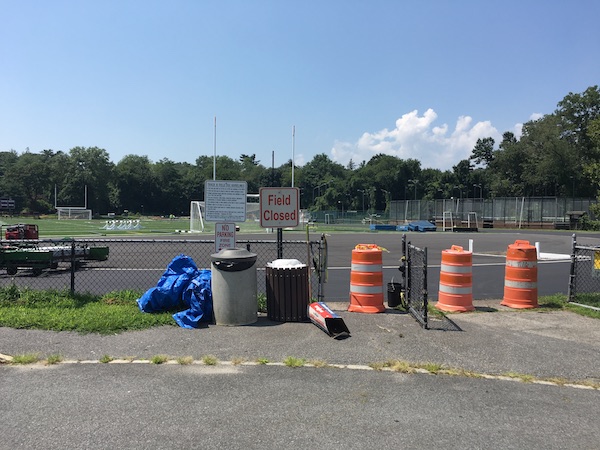
If you smell hot tar wafting down Wayside Lane, here's why. The Scarsdale High School Butler Track and Field will be closed for approximately two weeks. The track will be undergoing renovations, including resurfacing, recoating, and relining. Once completed, residents will have a beautiful new track to use. Here are some updates on the progress so far.
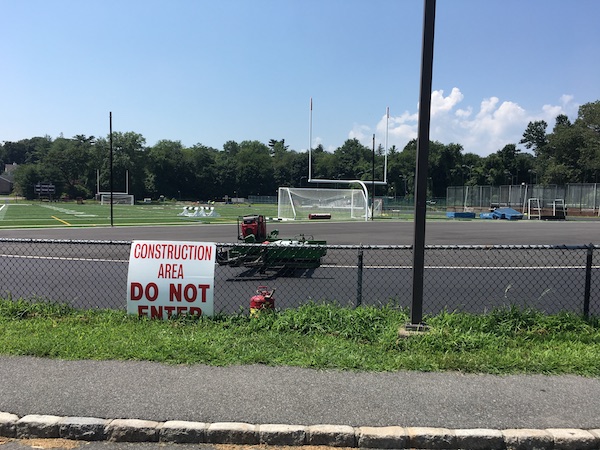
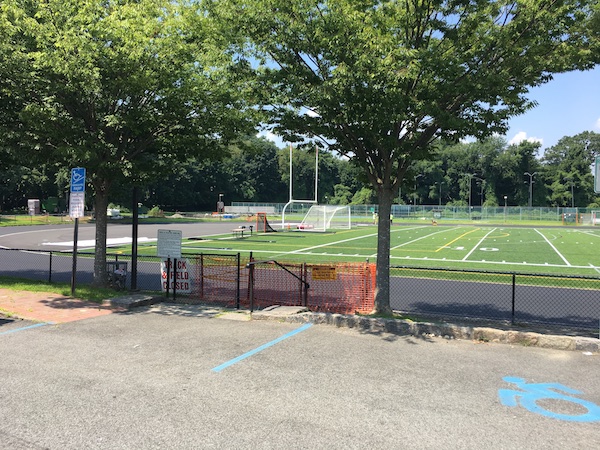
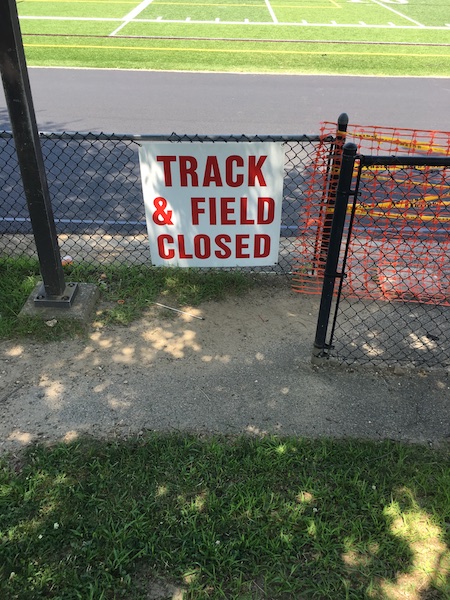
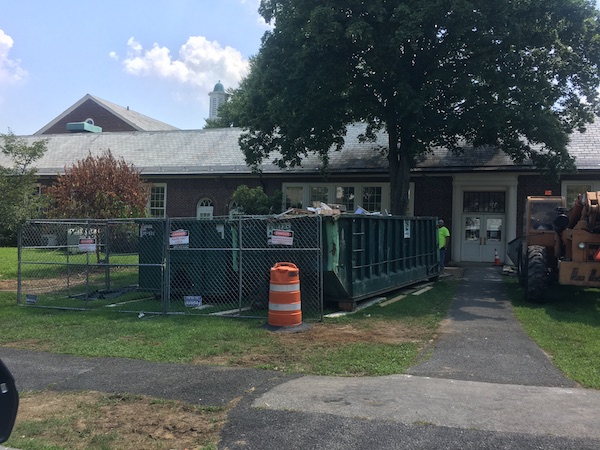
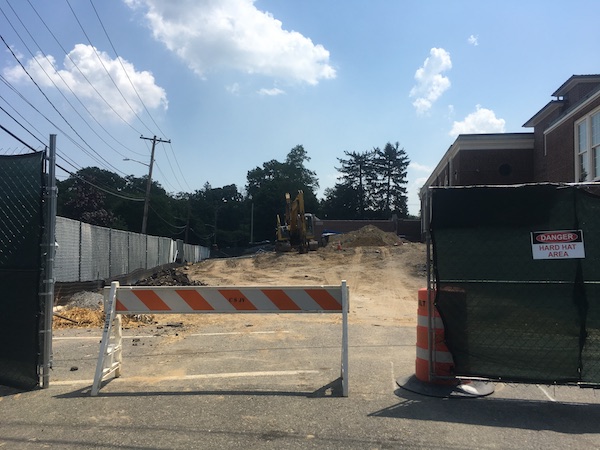
We also drove past Greenacres Elementary School to see the progress there. We saw dumpsters and backhoes. It appears they are excavating the site to prepare for the large addition. Here are some photos:
School Construction Has Begun Plus Updates on Butler Field
- Details
- Written by: Joanne Wallenstein
- Hits: 5222
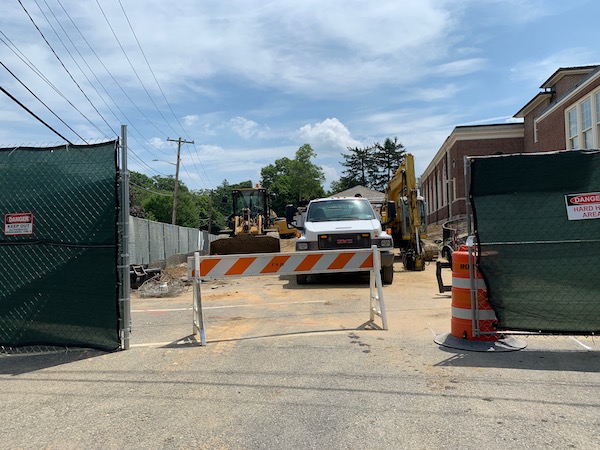 Excavation for the addition at Greenacres Elementary School is underway.School facilities and renovations were top of mind at the first summer meeting of the Board of Education.
Butler Track and Field Update: Athletic Director Ray Pappalardi provided an update on the agreement regarding use of district fields and highlighted a few changes that were made since the last meeting.
The agreement now allows use of the field and the lights for practices until 9 pm rather than 8 pm.
Specifically, here is the draft of the regulation:
Practices on Butler Field using lights may be scheduled in August, September, October, November, March, April, and May. Practices with lights shall be used Monday through Friday only with lights off by 9:00 p.m.
The section on amplified sound now stands on its own and reads as follows:
Amplified Sound
a. Amplified sound will be used only for Scarsdale School events and only for:
i. a thirty (30) minute warm-up period prior to each contest;
ii. pre-event announcements and introductions;
iii. the National Anthem;
iv. event-time announcements.
The agreement specified a phone number and email address for complaints and permits exceptions with the approval of the Superintendent and/or his designee.
The list of Independent Sports Organization permitted to use the lit field was expanded to include Scarsdale Little League.
Pappalardi reported that he had prepared and submitted a packet to the Village for consideration by the Village Planning Board on July 31, 2019.
Following Pappalardi’s presentation, Board members had the opportunity to comment and Ron Schulhof said, “I have concerns with the change to 9 pm. We are in a dense setting. This is a concern. There has been no community meetings about changing the time from 8 pm to 9 pm. I would be uncomfortable to make the change to 9 pm without holding a meeting with all the stakeholders.”
Chris Morin defended the change, saying “We spoke about it at length. We had overwhelming support for 9 pm. The goal is to provide flexibility to the community at times when fields are wet. This would not be burdensome to the community as it would just be 10-15 kids.”
Scott Silberfein added, “The lights would be off by 9 – so practice would be over before then. It would be stopping at 8:45…. We’ll have opportunities for more public comment if the project is going to go forward.”
About the language that requires the Superintendent or his designee to make an exception, Dr. Hagerman said, “All provisions have clauses like these. People have to trust that we’ll use good judgment.” He continued, “We have no interest in being bad neighbors or upsetting people who live around the field.”
Mr. Mattey provided an update on the many construction projects going on in the district.
At Greenacres Elementary School the work has begun and the construction and staging fencing is up. The excavation for the addition on Huntington Avenue is in process. Inside the school, workers have begun demolition and the asbestos removal is largely complete. There will be additional demolition later on. Today, Mattey said, “Everything is on schedule.”
A meeting of the Greenacres Safety Committee was held on July 10 and Mattey said, “There have been no complaints so far, but some emails with suggestions.”
At Heathcote Elementary School the roof is being replaced. Mattey said, “It is a big project.”
At the High School, workers who were digging out the foundation to install new boilers hit some “heavy metals.” Mattey said these metals require testing and abatement. He said, “We were not expecting that. We believe it is left over from decades ago.”
Also planned this summer are the construction of security vestibules at all five elementary school. Mattey reported that the plans for the vestibules at Edgewood and Greenacres have been approved and the district does not expect these to be long projects. However, work at the other schools “will be more involved.”
Mattey anticipates that the asphalt at Butler Field track will be completed by Tuesday, July 16. After a 30 day waiting period, the track coating will be applied, and the work should be done after the first week of fall sports.
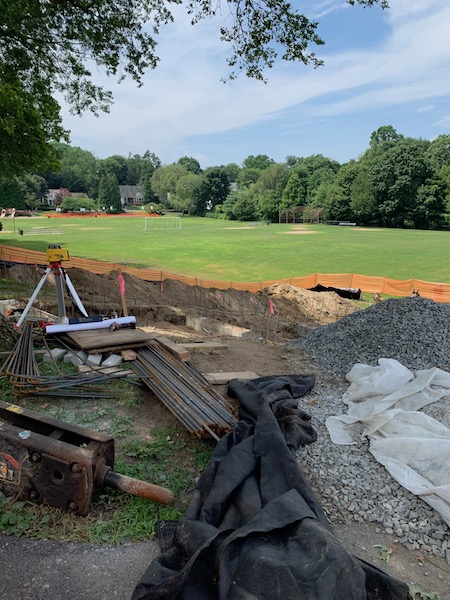 Stairway construction is in process at Fox Meadow Elementary School.At Fox Meadow work on the outdoor stairs from the school to the field is in process.
Air conditioning installation in the Heathcote, Fox Meadow and Quaker Ridge Libraries are in process.
At the Middle School new water boilers will be installed in mid-August.
Work on the emergency egress to the band room is ongoing and HVAC for the orchestra room will be installed in late August and early September. However, he reported, the new stage rigging will happen “more towards the winter.”
New elevators will be installed at the middle school and the high school. However, this has not been bid out as yet. Mattey reported that the elevator to the Foreign Language wing of the high school is now out of service. It will take 6-8 months to install a new one. Mattey said the installation will be “large and lengthy” and called it “a bear of a project.”
The Board of Education room at the high school will be redesigned with more functional and stylish mobile furniture that can be easily configured for a wide variety of usage of the room. Dr. Hagerman and Mr. Mattey are in the process of selecting it.
Resident Bob Harrison has spent years advocating for a comfort station – or bathroom – at the Middle School Tennis Courts, and this project now seems to be in process. Mattey reported that he met with representatives from the Village to look at possible locations.
Asked if they had found anything that could hold up the construction at Greenacres, Mattey said, “There was no moisture in any of the walls…… we have time to work around any issues.”
The interior work on the classrooms in the existing school is scheduled for completion by the beginning of the school year to allow the school to be used during the construction of the addition.
Edgewood Says Goodbye to Dr. Houseknecht and Completes Cenetennial Celebration
- Details
- Written by: Joanne Wallenstein
- Hits: 5683
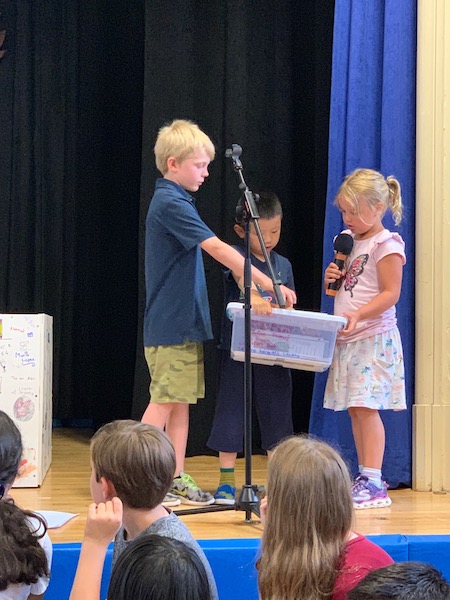
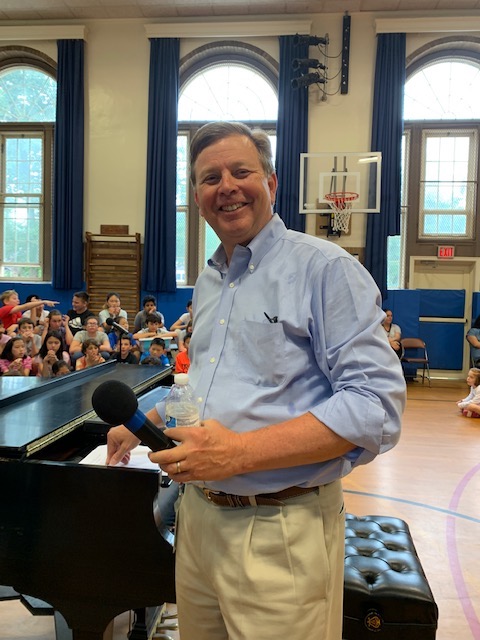
 Edgewood Elementary School students, teachers and parents gathered on June 25 for the final assembly of their centennial year to remember 2018-19 and say goodbye to Principal Scott Houseknecht who retires after almost 30 years at the school.
They sung the school song and looked back on a special year that included a talent show, the opening of the new Edgewood Library, a night at Citi Field, the unveiling of the time capsule, Edgewood Academy, a festive gala and much more. Assistant Principal Mr. Yang put together a slide presentation highlighting a year of events and celebrations at the school. Each class had the chance to contribute some mementos to the time capsule and a book of well wishes by the children was presented to Dr. Houseknecht.
Yang also arranged for aerial photography of the students in the school arranged to communicate a few parting messages – which you can see here.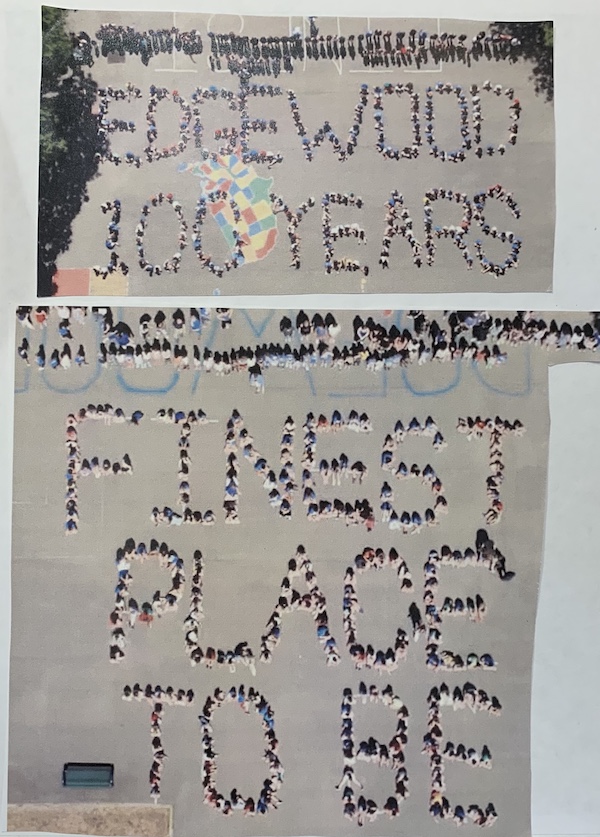
Dr. Houseknecht will forever be rememberd at Edgewood as the new library and media center was named the Dr. Scott Houseknecht Library and Media Center.
Finally, the PTA presented this beautiful watercolor of Edgewood School, painted by Mike Teatoro to be displayed at the school.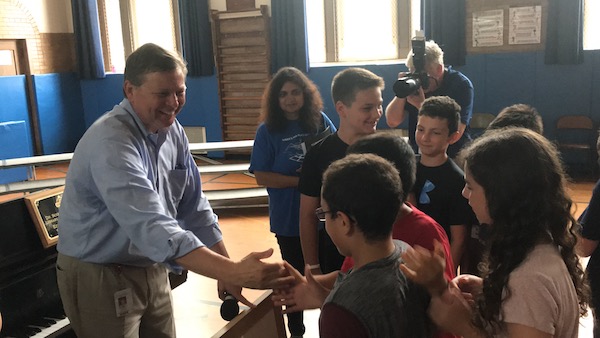
Presenting the watercolor, PTA co-Presidents Susie Smith and Heedan Chung-Goh said,:
Dr. Scott Houseknecht, thank you for being our principal for close to 3 decades. During your tenure at Edgewood School, our children greatly benefited from your leadership in driving innovative educational practices within our building. Through your interest in teaching the history of our school, and cultivation of old and new traditions, you have nurtured in our children a sense of identity and place as citizens of not just Edgewood, but of greater Scarsdale. You have ensured that Edgewood is the finest place to be, a place of learning, caring, and belonging.
In your honor, the Edgewood School PTA is gifting a watercolor of the school.
This watercolor painting by Mike Teator is in special recognition of Edgewood School’s one hundred years of rich history for which the school has grown from a twelve-room schoolhouse in 1919 to the one we have today seen in this painting in 2019. In honor of our Centennial celebration, the Edgewood PTA lovingly dedicate this painting today, June 25, 2019 to the school and to Dr. Scott Houseknecht, Edgewood’s sixth principal from 1990-2019, who oversaw the growth of not only the construction of the building but also the hearts and minds of students.
- Proposal to Install Lights at Butler Field Referred to Village Planning Board
- Retiring Teachers and Board Members Honored at Final BOE Meeting
- SHS Counseling Director Provides Perspective on Granting Students Extra Time on College Admissions Test
- SHS Juniors Get the Tea on College from Returning College Freshmen