








State Senator Shelley Mayer Comments on ICE, Universal Pre-K, Con Ed and More
- Details
- Written by: Joanne Wallenstein
- Hits: 593
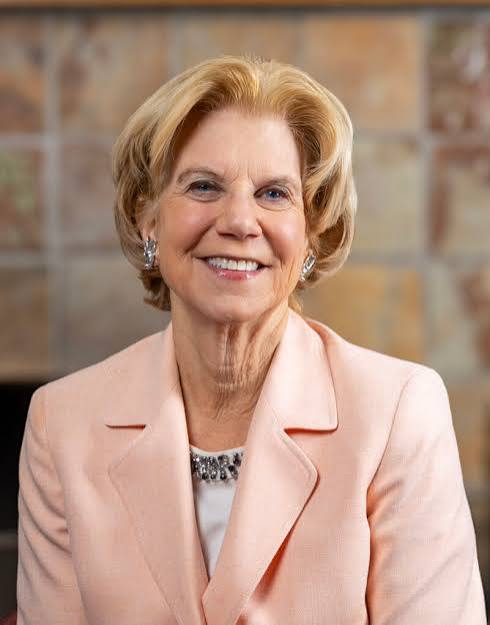 State Senator Shelley Mayer has been representing the 37th district of NYS, including Scarsdale, since 2018. She is now running for re-election and answered questions from Scarsdale10583 below:
Tell us about your work during the past legislative session. What has been your focus and what were some of your accomplishments?
One of my top priorities has been reigning in utility costs, such as Con Ed rates. Although we didn’t go as far as I would have liked in this year’s budget, the final enacted budget made several changes to the utility rate-making process (most of which are based on bills I sponsored).
Among other things,
• we required utilities to return excess profits to ratepayers, rather than apply them to their next rate application;
• we increased scrutiny of utility executive salaries;
• we established a commission to examine the causes of rate increases and makerecommendations to the legislature; and
• we limited potential rate increases to the rate of inflation and prohibited the recovery of lobbying, political, and public relations expenses from ratepayers.
In addition, as Chair of the Senate Education Committee, I have prioritized ensuring all students have access to a quality education. Among other achievements, I
• fought for and achieved at least a 2% increase in Foundation Aid over last year for all of New York’s public schools, including Scarsdale;
• $432.5 million year-to-year increase in universal pre-kindergarten and a requirement that all public schools offer full-day pre-K to 4-year-olds as requested by parents in the next school year;
• the budget adopted my proposal to protect students and schools by prohibiting ICE intervention in schools unless they possess a judicial warrant; and
• the budget clarifies that under NY law, every child has the right to a public education regardless of immigration status.
• I continue to lead the fight to ensure our schools teach about anti-semitism and hatred, not just about the Holocaust, which is currently required by NY law. We need to do a far better job educating all our children in all schools about anti-semitism, racism, and the increase in acts of hatred throughout our society.
The NYS tax cap puts severe pressure on our schools to maintain increases below the cap, even though state mandated pension and retirement costs go up more than 10% each year and health insurance costs continue to increase. With very limited state aid for districts like Scarsdale, the cap forces very difficult decisions for local school boards. Any thoughts on repealing the cap or providing state aid to close the gap?
There are very challenging circumstances for all school districts, including Scarsdale. As you note, expenses, particularly health care, are far outpacing increases in the property tax levy cap. Yet we have some of the highest property taxes in the nation and cannot continue to put additional pressure on taxpayers. I want to work with districts and the State to find creative solutions to address the health care premium increases school districts face, and I am working with the NYS Council of School Superintendents on this issue. I also believe the funding formula must be updated further to reflect the greatly increased costs of special ed to all districts, including Scarsdale. I remain open to ways to direct additional state aid to any district facing unique challenges with the tax cap.
We hear universal Pre-K has now been mandated statewide. What will that mean for Scarsdale?
We expanded full-day pre-K for 4-year-olds by increasing reimbursement to school districts and requiring them to offer it starting in the 2028-29 school year. This can be accomplished in partnership with community-based organizations and existing providers. To the extent Scarsdale schools indicate this poses unique challenges for the district, of course I will work with them to try to address them.
What are your thoughts on the assault case at Cornell? Given that part of the school is funded by SUNY, does the NYS legislature have the authority to regulate activity there?
Cornell does receive New York State funding, but any changes we require of Cornell and our SUNY institutions ought to be required of all our universities and colleges in New York. The alleged crimes committed by the seven men at Cornell University are horrific and utterly deplorable. We can and must strengthen our laws to protect victims. One immediate action we can take is to remove voluntary intoxication as a defense in sex crimes. This is Senator Nathalia Fernandez’s bill, which has passed the Senate twice but has not passed the Assembly yet. I hope this bill becomes law in the coming session.
Republicans are calling for an end to New York’s restrictions on local law enforcement partnerships with ICE. What are your thoughts?
Local law enforcement needs to have the trust of the local community. Allowing ICE to come into our local communities and partner with local law enforcement, making local police departments agents of the federal government, does not further public safety and diverts resources from the essential work of our police. I believe our local police, like the excellent Scarsdale Police Department, should continue their highly professional work in the Village and beyond, as required, and should cooperate with ICE only when a judicial warrant is presented.
We see that you have been appointed to serve as Co-Chair of the state legislature’s Legislative Task Force on Demographic Research & Reapportionment, known as LATFOR. When will new maps be proposed and what do you hope to see?
The Legislature has adopted the first passage of an amendment authorizing mid-decade redistricting in NYS if adopted by other states, which has now occurred. If the Legislature passes it a second time and voters approve this Constitutional amendment next November, work will begin on new maps thereafter.
Con Edison is in the process of installing a high transmission gas line through the center of Scarsdale Village. The gas is intended primarily for use in Queens. The project has taken far longer than planned, the construction has already damaged private property and now they plan to re-excavate 40 sites to examine the welds. Do you think a large pipeline should run through a residential neighborhood? Has the Public Service
Commission done enough to regulate Con Ed?
I have concerns about the level of oversight and inquiry the Public Service Commission provides to new projects by Con Edison and other investor-owned utility companies. I am concerned that the approval process for this particular pipeline, the damage to private property, and the potential risks that it poses all require far greater scrutiny by the PSC. They need to give this project far greater attention to reassure residents and the entire Scarsdale community.
Anything else you wish to add is welcome.
It is an honor to represent Scarsdale in the NYS Senate. I have worked hard to respond to the needs of individual residents and the Scarsdale community. I have an excellent working relationship with the Mayor and the village Trustees, and we work cooperatively. I am a big fan of the wonderful Scarsdale Public Library and appreciate their partnership on numerous events that I have sponsored. In addition, I have provided funding for motorcycles for the Scarsdale Police Department and cardiac defibrillators for the Scarsdale Volunteer Ambulance Corps; along with Assemblymember Paulin, I have funded the installation of a new traffic signal at the intersection of Route 22 and Edgewood Road; and I have allocated funding to the Scarsdale, Edgemont Family Counseling Services. I hope to continue representing the people of Scarsdale
and look forward to working together as we move ahead.
Book Signing and Discussion Dinner for Bill Doescher’s "Removing Barriers: Diverse Voices Shaping Tomorrow" Scheduled for Oct. 21 at Hitchcock Presbyterian Church
- Details
- Written by: Traci Dutton Ludwig
- Hits: 1040
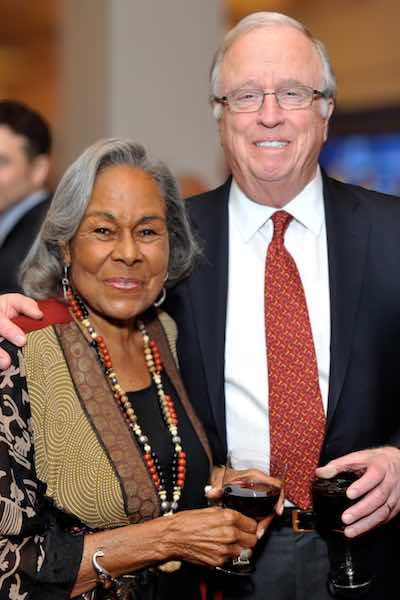 Rachel Robinson and Bill DoescherBill Doescher, a former 40-year-long resident of Scarsdale who now lives in an adjacent vicinity, has written a book about diversity in collaboration with 19 collaborators from the Scarsdale area and around the country. His first book, “Dear Folks: Essays and Insights from a Public Relations Leader,” was published by the PR Museum of New York City in 2019. Doescher's new book, “Removing Barriers: Diverse Voices Shaping Tomorrow,” published by Orange Frazer Press, is expected on booksellers’ shelves and online by late October 2026.
On Wednesday, Oct. 21, a book signing and and discussion will be hosted at the Lower Children's House at Hitchcock Presbyterian Church, at 6 Greenacres Avenue in Scarsdale. The cost of the event is $35, which includes a copy of the book and a light dinner. For participation in the event, please respond to Rev. Pete Jones at Revpetejones@gmail.com.
In “Removing Barriers: Diverse Voices Shaping Tomorrow,” Doescher has collected 19 voices (Black, white, known and lesser-known) who understand the sensitive dynamics around diversity and have been involved with well-defined missions to fight for social justice during the last 60 years. Doescher notes, “The co-writers of my latest book, who are a mix of Black and white Americans, male and female, were hand-picked for their knowledge and expertise about the almost always controversial subject of diversity and for their penetrating personal stories.”
During Doescher's residency in Scarsdale, he was a Village volunteer extraordinaire, serving such roles as the president of the Scarsdale Historical Society for more than seven years, chairman of the Village’s Ethics Committee, a member of the Cable Commission and a member of the Board of Governors of the Scarsdale Golf Club. He has also been an elder, choir singer and bell ringer at the Hitchcock Presbyterian Church. In his profession as a public relations guru, Doescher was, for decades, a well-known worldwide and highly respected award-winning communications and marketing executive.
Doescher said he worked diligently with his writing associates to develop the book's chapters over emails, telephone calls and Zoom meetings.
"Inside these individual chapters, the co-writers recount personal stories directly related to diversity and its history. Some of these stories recall abusive, destructive and even life-threatening encounters. Some of these stories outline positive triumphs and progress made,” Doescher says. "The purpose of this book is to invite numerous voices to retell their lived experiences as a way of expanding the conversation about diversity for greater awareness, understanding and positive change."
He adds, “These co-writers no doubt over time most likely have made their parents, close relatives, as well as their high-school-and-college teachers and professors, other fellow diversity voices and leaders, and close personal friends, extremely proud of their words and deeds. Without hesitation or fanfare, they tell it like it is in an unvarnished way.”
And equally important, Doescher, a self-described "octogenarian white guy" who for years "has sung in Hitchcock Presbyterian Church’s Chancel Choir, played bells, been an elder and given sermons there, and who continues as a vibrant church participant," doesn’t hold back on his personal thoughts on diversity, which he includes in his expanded chapter, which serves as the book’s to-the-point and straight-forward introduction.
Reasons for Doescher’s Second Book
The impetus for writing this book, according to Doescher, was primarily inspired by his long association with Rachel Robinson who taught him a lot about diversity. Robinson is described as one of Doescher's mentors and a dear friend, who is now 104 years old. Robinson is the widow of the famous baseball legend, Jackie Robinson, affectionately nicknamed "No. 42," who broke the color barrier in Major League Baseball after signing a contract with the always colorful Branch Rickey, then president and general manager of the Brooklyn Dodgers, and playing in his first professional game for the Dodgers in 1947.
A Baseball Contract That Stunned the Country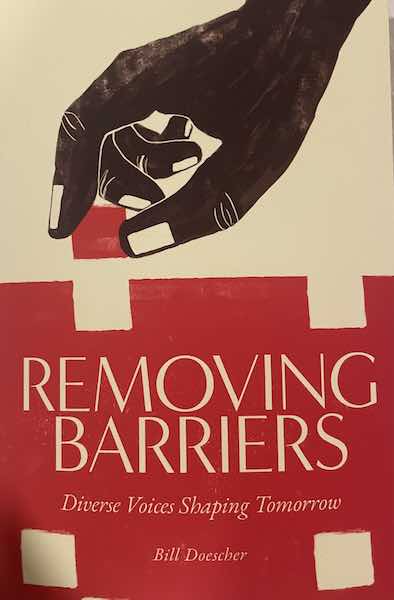
Ira Berkow, a former sports columnist and features writer for The New York Times, wrote in “the [1986] definitive biography” for McGraw-Hill about Red Smith: “Rickey had defied the other 15 major league owners (then) and stunned not only the baseball world but the country in signing Jack Roosevelt Robinson to a Dodgers contract.”
According to Doescher, after Jackie Robinson's untimely death, Rachel Robinson founded the Jackie Robinson Foundation (JRF) at her kitchen table in Connecticut in 1973. It was an organization that picked up from the ideals to which Rachel and Jackie had committed themselves -- to create different kinds of diversified activities and support for the future and betterment of America and its minorities.
“For sure,” Doescher says, “the work of JRF was intended to honor Jackie Robinson, while providing a superb and active development program and a stipend to help minority youths with, among other things, college expenses. The foundation also organized annual conferences for all of its scholars at the time, about how to always perform politely and intellectually in public and private as a proud JRF scholar.”
Over the years JRF, for which Doescher served in differing capacities on its Board of Directors for 22 years, including as Director of Development, has nurtured more than 2,200 minority college students.
“I learned a lot about diversity from Rachel, her daughter Sharon and son David, as well as from the other dedicated, professional and highly respected board members over those 22 years. They have included people well-informed about the various diversity issues in the U.S.A.,” Doescher continues, “such as Martin Edelman, the highly respected global lawyer who was at Rachel’s kitchen table as a lawyer and advisor in 1973; Leonard S. Coleman, Jr., Chairman of JRF for nearly 20 years, as well as one time the President of Major League Baseball’s National League, and an affiliate of the late South African and Apartheid Leader Archbishop Desmond Tutu; Della Britton, current President and CEO of JRF, and for more than two decades for days on end, has worked on transforming its relevant college scholarship program into a significant educational initiative, and Norman Siegel, former Executive Director of the New York Civil Liberties Union -- as well as JRF's always hard-working and dedicated staff members and the JRF scholars themselves.”
“Collectively,” he adds, “they certainly opened my eyes wide to a different kind of world, more diversified than I could ever have imagined growing up in Utica, a somewhat small city in Upstate New York with then 100,000, now about 65,000, citizens, including back then a relatively small number of Black people, or attending the distinguished liberal arts college, Colgate University in Hamilton, NY, 30 miles down the road from Utica, in the 1950s as an undergrad economics major, or later as a master’s degree student in public relations and communications as well as an adjunct professor at the Newhouse School of Public Communications at Syracuse University and teaching and lecturing in a variety of communications and investor relations courses at an ever-growing list of other colleges and universities, including Columbia University, New York University, Iona University, University of Maryland, Utica University and Colgate, my alma mater." Or early on, working as a young sportswriter for The Evening Press in Binghamton, NY, or two other newspapers, his hometown Utica Observer-Dispatch and Utica Daily Press. Or still later, employed at a number of blue-chip companies including The Chase Manhattan Bank, then headed by the late Chairman and CEO David Rockefeller, the youngest son of John D. Rockefeller, Jr., Dun & Bradstreet, Champion International and Drexel Heritage Furnishings, where he recommended and for a number of years supervised the company’s sponsorship of a regular and still functioning PGA golf tournament -- the Heritage Golf Classic, on Hilton Head Island, SC.
His last corporate job before semi-retirement was with Dun & Bradstreet, where for 22 years he worked in increasingly important positions, and at the last was the Senior Vice President and Chief Communications Officer, and publisher for 15 years of D&B Reports, a small-business magazine he revitalized with highly recognized senior editors in the U.S. and creative and modern graphics from Ken Resen, a Mamaroneck, NY, resident, and well-known international graphics magician with a Yale University sheepskin.
Doescher adds, almost with tears welling-up in his eyes, “The education I received at JRF while serving as a board member for 22 years was nothing short of spine-tingling.”
“Scarsdale’s Intellectual Team”
Doescher selected co-writers for his book from what he dubs “Scarsdale’s Intellectual Team,.” The group includes two of the most popular clergy and residents in town--Senior Rabbi Jonathan Blake of the Westchester Reform Temple and the Rev. Pete Jones, Senior Minister at the Hitchcock Presbyterian Church.
Blake graduated from Amherst College in 1995, and was ordained from Hebrew Union —Jewish Institute of Religion in Cincinnati, OH, in 2000. He took over the role of Senior Rabbi of Westchester Reform, a position previously held by Rabbi Richard Jacobs, who in 2011, became president of the Union for Reform Judaism.
Jones, who joined Hitchcock as the pastor at age 37 in 2016, has followed in the footsteps of his father, sister and brother as a minister. He graduated from Dickinson College with a major in religious studies and a minor in political science. In addition, he is a graduate of Lexington Theological Seminary with a master in divinity, and he also holds a doctorate of ministry from Louisville Presbyterian Theological Seminary.
Also, equally as popular as Blake and Jones and also included in Doescher’s second book is Jane Veron, former mayor of Scarsdale from 2021 to 2023, and a most devoted person who has dedicated her career to helping under-resourced entrepreneurs and their small businesses across the U.S.A.
Veron’s notable career is marked by her dedication to public service and her commitment to emerging small-business owners. Seeking to mobilize talent for the public good, Veron co-founded, in 2012, and continues to serve as CEO of, The Acceleration Project (TAP), a non-profit social enterprise company that empowers thousands of under resourced small-businesses in the U.S. and accelerates their growth Veron's organization is 88 percent women-led, with 200 pro-bono specialized volunteer professional consultants who provide first-rate advice—strategic, financial, operational and marketing.
Jane earned a BA magna cum laude degree from Yale University and an MBA with honors from Harvard Business School. She is also the leader of EJA Industries, a holding company for middle-market private equity investments and serves on several boards. Previously, Veron worked in strategy and marketing at Bain & Company, and she also worked for American Express.
CEOs Weighs In
Rich Nightingale, president and CEO of Westhab, is also a co-writer in the book. Nightingale's Westhab, which is headquartered in nearby Yonkers, is dedicated to its mission to assist underserved Westchester County and New York City residents with necessary resources, including housing, Nightingale first started at Westhab as a teenager during the summer months following the strong recommendation of his parents and after receiving approval from the higher-ups at Westhab. In his mind, he fell in love with the work and never left, even though he still found the time to obtain college and post-graduate degrees from Tufts University and Fordham’s Graduate School of Social Science, as well as leadership training at Harvard Business School.
Also included in Doescher’s book is Earl G. “Butch” Graves, Jr., formerly a Scarsdale resident, who was a top student and outstanding basketball player at Scarsdale High School (SHS). Graves went on to attend Yale University and Harvard Business School, and he played for three professional teams in the National Basketball Association. He is currently President and CEO of Black Enterprise, succeeding his late father, Earl Sr., in that position.
Jeremy Whyte, another proud SHS graduate, also contributes a chapter in the book. Whyte is the son of Rudy Whyte and Beverly Thornhill of Scarsdale. He is now married with two children, and he resides in Chicago. After graduating from Columbia University and working for a large technology company, Jeremy attended Harvard Business School.
Others Selected for the Book
Others selected by Doescher and included in the book are Marc Morial, President and CEO of the National Urban League and former mayor of New Orleans; Jesse Jackson, Jr., a former U.S. Congressman of the 2nd District of Illinois and son of the late Jesse Sr., a well-known civil rights activist for decades; Westina Matthews, a non-profit executive, author and first woman and person of color to be named as secretary and trustee of the Merrill Lynch Foundation; Lori George, an ordained minister and former global diversity executive at Coca Cola at its Atlanta headquarters; and Diane Ciccone, a lawyer, TV executive and the first Black woman elected to the board of trustees at Colgate University.
In addition, the book also includes Keith Alexander, a writer at The Washington Post, who twice won a Pulitzer Prize for co-authored news stories; Vickee Jordan Adams, daughter of the late Vernon Jordan, who is herself a seasoned public relations executive for well-known PR and investor-relations firms; Kenn Gaither and his father Thomas Gaither, who are respectively dean of Elon University’s School of Communications in North Carolina, and a dedicated Civil Rights Movement activist; Kim Hunter, a renowned diversity advocate and the owner of three communications agencies/foundations on Wilshire Boulevard in Los Angeles, CA; and Andia Winslow, a former Jackie Robinson Foundation scholar and Yale University graduate, who briefly played for the LPGA, and who is now an award-winning voice-over actress for such books as WNBA star’s Brittany Griner’s “Coming Home.”
Other co-writers include Griffin Granberry, a Generation Z activist working as a book center manager at Madison Reading Project in Madison, WI, and Dr. A. Najah Salaam Jennings-Bey of Syracuse, NY, whois CEO of Street Addiction Institute Inc.
“Banded together, these 19 contributors represent a solid and diverse group of Americans talking about the subjects of diversity and social justice,” Doescher says. “Their thoughts and stories are real, refreshing, honest, and intellectually stimulating. I hope that their voices inspire and add to the conversation on these important topics."
Doescher, who turns 89 in early December, says this is not his last rodeo. He is already at work on several other books, and he continues writing the 1959 column for the Colgate Magazine. He was married for 48 years to the late Linda Blair Doescher, a well-known interior designer in Scarsdale, Westchester County, New York City, Connecticut and Florida, who in May 2005 was the lead designer for a successful and profitable showhouse at the Scarsdale Woman’s Club on Drake Road, where she successfully managed the participation of 20 other professional interior designers and decorated the largest room in the house, the first floor's “Grand Salon,” herself. In what Doescher describes as a well-functioning ecumenical family, they have four grown children and seven grandchildren.
Survivors Among Us Preserves Stories of Local Holocaust Survivors
- Details
- Written by: Joanne Wallenstein
- Hits: 828
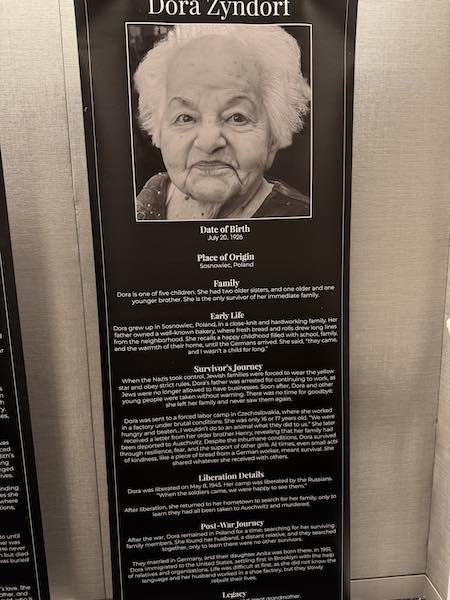 An exhibit featuring the stories of Westchester’s Holocaust survivors drew a packed room at Scarsdale Library on Thursday night October 1, 2026. The exhibit, entitled “Survivor’s Among Us” highlights the personal histories of some of the last living survivors of the Holocaust shown on large banners and narrated with oral histories. Now in their late nineties – and even early years of the next century, survivors are a quickly vanishing group, and the exhibit was timed to share these life stories before it’s too late.
The exhibit is a collaboration between the Scarsdale Library, the Friends of Scarsdale Library and Westchester Jewish Community Services, and it is just the first event in a month long series of programming on the holocaust. See below for a list of upcoming events.
Library Director Beth Bermel credited Scarsdale’s Toby Milstein-Schulman for bringing the exhibit to Scarsdale. She told Bermel, “We needed to bring this exhibit to the library sooner than later!”
Milstein noted that antisemitism is again on the rise. She said, “We are living in a moment where Jewish creatives have found themselves excluded, where Holocaust history is not taught or distorted…..When a public institution says Jewish voices belong here – that matters.” The exhibit “allows us to see holocaust survivors as not just survivors but as members of our community. ….they provided oral histories because they understand how important it is that we know these stories…. Their voices don’t have to disappear. The responsibility for carrying it forward now belongs to us…. May we listen, may we remember and may we carry these stories forward.”
WJCS CEO Seth Diamond said, “Each banner tells a different story – of survival, loss and rebuilding…. What can happen after the darkest moments of a person life? This is important at a time when antisemitism is again in our lives.”
He explained, “Scarsdale is the exhibition’s first stop – and it will travel – next stop the JCC Mid-Westchester…. These are deeply personal stories. The stories belong among us.”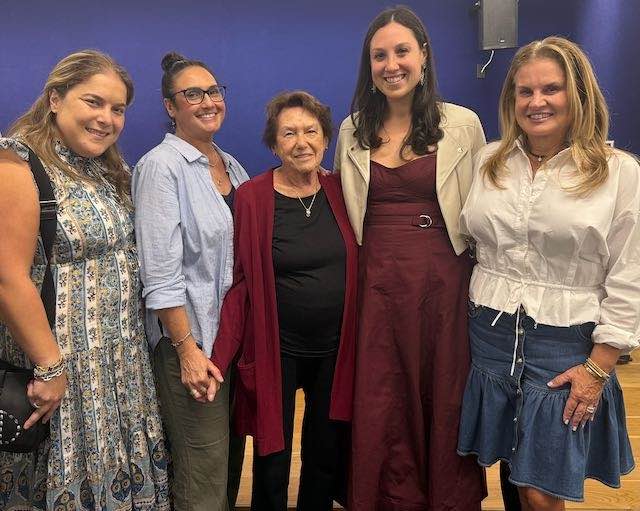 Daniela Retelny, Daniela Hutter, Lisa Tobias-Hutter, Toby Milstein, Cynthia Samwick
The main attraction of the evening was survivor Lisa Tobais-Hutter who told the story of her families journey to survive the Holocaust. She was just five years old when she was separated from her parents and her brother and moved in with another family who did their best to make her feel like part of the family, even registering her in school. When things got more dangerous they moved into a barn in a remote location in France with three families. Their fathers worked in the resistance.
Hutter credits the non-Jews with risking their own lives to save the Jewish families, saying, “It is impossible to overestimate the risk that this French family took for us…. even in the most dangerous times, some people don’t lose their convictions. It took a Village to save a child. Thanks to the family who welcomed us in 1939 we survived the war.”
Asked what messages she took away from the experience, Hutter said, “Cherish life, cherish family and be kind. Never take a single day for granted.”
Commenting on the event, Cynthia Samwick said:
As the daughter of a Holocaust survivor, last night’s opening of Survivors Among Us at the Scarsdale Public Library was an especially meaningful evening for me and, I believe, for our entire community.
The Scott Room was packed as we listened to Holocaust survivor Lisa Tobias-Hutte share her story. Her words touched all of our hearts. I am so grateful for her courage, strength, and commitment to sharing her story with us. There is something profound about hearing history from someone who lived it, and Lisa reminded us why these stories must continue to be told.
We listened, we learned, and we remembered. Most importantly, we were reminded that the stories of local Holocaust survivors are not simply stories from the past. They are part of our community’s history, and it is our responsibility to make sure they continue to be heard by the generations that follow.
A heartfelt thank you to Toby Milstein Schulman for her extraordinary vision, dedication and commitment to bringing this important program to Scarsdale, and to Westchester Jewish Community Services for helping make it possible.
And enormous appreciation to Beth Bermel and the entire Scarsdale Public Library staff, who have embraced this exhibit so wholeheartedly and have created an entire month of opportunities for people of every age to learn, reflect, and engage.
Thank you as well to the Friends of the Scarsdale Library and especially Daniela Retelny, for the dedication you and Toby give to making our library such a vibrant and meaningful part of our town.
If you haven’t yet been to the library, please go. The Survivors Among Us exhibit will be there throughout the month, with programs and opportunities for children, teens, families, and adults. There truly is something for everyone.
One of the survivors said something last night that stayed with me: “It takes a village.”
It does.
And last night, we saw what a village can accomplish when people care deeply enough to come together.
As the daughter of a survivor, I cannot thank everyone involved enough for giving our town this extraordinary gift. My father would have been so proud to see our community remembering, learning, and carrying these stories forward.
Thank you, Scarsdale Public Library. Thank you, Friends of the Scarsdale Library. Thank you, WJCS. Thank you Beth and the entire library team. And thank you to every survivor who has entrusted us with your story.
What a gift to our village.
The exhibit will be on display this month in the Scott Room, followed by:
-A teen talk with Hanne Holsten on Saturday October 10 at 2 pm
-A movie screening of “Survival in Shanghai” on Thursday October 15 at 5:30 pm
-A Children’s Book Discussion on Monday October 19 at 4:30 pm
-A presentation on Scarsdale and the Holocaust with Village Historian Jordan Copeland on Wednesday October 21 at 6 pm
-Closing Reflections with Steven Goldberg, Director of Education at the Holocaust and Human Rights Education Center on Sunday October 25 at 3 pm.
Find all information here:
Someone to Talk To: A Conversation with Scarsdale Middle School's Youth Outreach Worker Liza Fahey
- Details
- Written by: Maggie Xie
- Hits: 1035
 Another email from the middle school landed in my inbox, and one line caught my eye: an activity hosted by a Youth Outreach Worker. Those words — Youth Outreach Worker — show up in school emails every so often, and I wonder if you've ever found yourself curious, like me, about what these women actually do. As the mother of a high schooler, I know that one of them has become one of the people my own child trusts most at school, and I'm grateful for how they've walked alongside him through the anxiety and emotional ups and downs of adolescence.
I've more than once recommended their services enthusiastically to friends here in Scarsdale, explaining that these clinicians are licensed counselors from Scarsdale Edgemont Family Counseling Service (SFCS), stationed full-time at the middle and high schools, providing support for kids' growth and emotional wellbeing, free to the families.
But how their work actually unfolds day to day — what they do, how they interact with students, why it makes such a difference — I'll admit, I only had a vague picture. So, out of curiosity, I sat down with Liza Fahey, one of three SFCS clinicians stationed at the middle school.
What Does a Youth Outreach Worker's Day Actually Look Like?
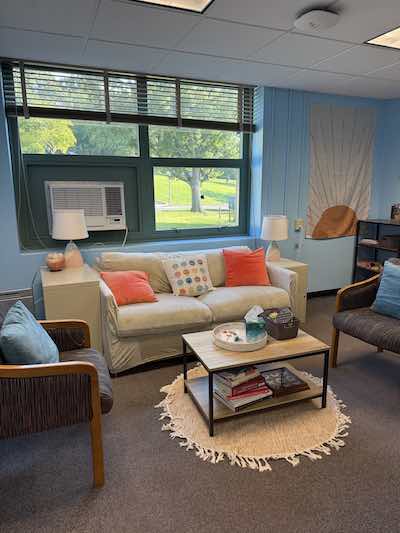
Liza's office sits on the first floor of the middle school, where a few of the school's houses meet. Settling onto the comfortable little couch inside, met with her easy, put-you-at-ease smile, I felt like I was catching up with an old friend rather than making small talk with someone new — so I got straight to my questions.
“We have a caseload of students that we meet with. We’ll reach out to them by email and schedule times to meet throughout the week. The frequency of our meetings depends on the student and whether they want to meet weekly, biweekly, or once a month. It really depends on their individual needs and how frequently they want to meet with us.”
A lot of her time throughout the week is spent meeting with students individually, or sometimes in small groups when there are friendship challenges and the students want to come together. “Sometimes it can be a little intimidating for a student to come in and meet one-on-one with us, so we always give them the option of bringing a friend if they feel like that would make them more comfortable.”
When a student has a 504 plan or an individualized education plan, Liza is often part of the related meetings for students on her caseload, "to make sure that we are supporting the student to the best of our ability and advocating for what they need throughout the year." With a family's permission, she also stays in ongoing contact with a student's house counselor and teachers — checking in on how they're doing, or making sure school administration is aware if a friendship conflict is escalating into something bigger.
Every other week, Liza's entire counseling and clinical team — the outreach workers, the social worker, all the house counselors, the school psychologists, the administrators — meets to make sure everyone's on the same page about the cases they're tracking. On top of that, every quarter the team goes into health classes to co-teach a lesson with the health teacher, "so students continue to get to know us." Liza covers bullying prevention, self-advocacy, and communication skills with sixth graders; her colleague Olivia talks with seventh graders about mental health; and Megan covers social media use with eighth graders.
Why Bringing Mental Health Support Into the School Matters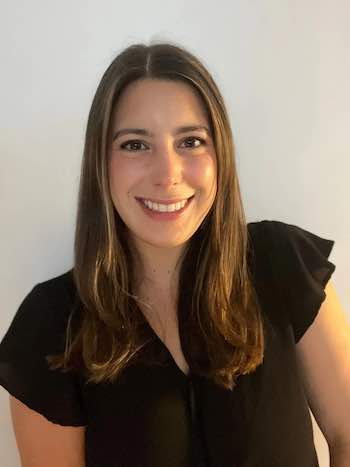
Asked about the benefits of putting mental health services directly inside the school, Liza's first answer was accessibility. “Having easy access to mental health support in school is really important” she said — whether a family can't afford outside support, or a student simply isn't ready yet to talk to their own family about what's going on and wants to start in a school setting first.
Time is a real, practical factor too. “Sometimes students will say they don’t have time for counseling after school.” At school, seeing Liza becomes almost part of the day itself — they're only pulled from things like PE, music, an elective, or lunch and before/after school, never from academic class. " Meeting with us becomes a part of their day.” as she put it, so they don't have to spend what little downtime they have after school to get support.
Having so many mental health professionals inside the building also quietly chips away at the stigma. “We get referrals from house counselors, parents, and teachers. Having so many people talk to students about the benefits of mental health support has helped reduce the stigma around it in school.” She's noticed how normal it's become — students asking, "can my friend come next time?" or "my friend wants to talk to someone now." It spreads by word of mouth.
Early identification and intervention is another idea Liza kept coming back to. “That’s a big part of why we have these services in the school, to identify challenges and mental health concerns and give students a space to talk through them before they become more serious. And finally, being embedded in the building lets her see a fuller picture of a student's life “We’re able to see where they’re at socially and academically and understand the day-to-day dynamics of the school.” As she put it, only half-joking, "I know what the lunchroom's like — an outside therapist might not.”
What Are Today's Students Actually Going Through?
Asked about the most common challenges she sees, Liza didn't hesitate: anxiety, and the school stress that comes with perfectionism. "Scarsdale is a very high achieving district," she said, with high expectations around academic performance that put a lot of pressure on kids. She'll talk with sixth graders who tell her, "if I get a B, I'm not getting into a good college.” "They’re thinking so far into the future and it can have a negative impact in their well being” That stress and fear of failure, she says, genuinely affects students' mental health.
She's also noticed more students tying their self-worth directly to academic performance — feeling like a failure when grades slip, feeling okay about themselves only when they do well.
“We work with students on separating the two. Helping them raise awareness that their self-worth is important, and it’s important that they love and appreciate themselves without tying that solely to their academic performance.”
Constant comparison through social media is another theme she's seen intensify. “This is such a pivotal time socially for kids. They really value their social connections. “It’s not just about fitting in with peers in person anymore — kids are also watching everything happening online: “For some students seeing how others present themselves and spend their time can create a sense of pressure to fit in. Social media can amplify these comparisons, making it easy to feel that there is a certain way one is expected to look, behave, or participate in order to feel accepted.” On top of comparing themselves to influencers close to their own age.
At the same time, middle school is naturally a period of figuring out identity — values, gender identity, sexuality — and some students, she's noticed, start realizing they may be more neurodivergent as they compare themselves to peers: “I’m struggling in this area more than some of my peers. What’s going on with me?" All of it together, she said, "can contribute to low self-esteem, a lack of confidence, difficulty advocating for themselves, and difficulty feeling good about themselves overall.”
What About the Kids Who Aren't Ready to Ask for Help?
Not every student says, "I need help" — and Liza is candid that this is something they're constantly navigating. “Sometimes a student will say, ‘I don’t want to talk to anyone.’ Whatever the reason, we can’t force them. Our services are voluntary, and our goal is to meet students where they are, respect their boundaries, and support them when they’re ready.”
Her approach leans on patiently building trust. “We always try to highlight that there are many trusted adults in the building that they can go to.” Teachers work on building relationships with students, and the outreach workers do the same — staying visible around the school so students start to trust them before they ever need to ask for help. “Some students who are referred to me may initially be hesitant to meet or feel like they don’t need support, but because we’re visible throughout the school, they may get to know us through everyday interactions. Once they’ve had a chance to meet me and get to know me a little, they may feel more comfortable and decide they want to give meeting a try.” They need to form that initial relationship, she said, before they feel ready.
When she senses a student isn't ready yet, she doesn't push. “If a student isn’t ready or comfortable opening up, I won’t push them. I’ll focus on getting to know them and building that rapport first.” She'll ask something lighter — "how's your day," "what do you like to do outside of school," "what are your interests" — so it doesn't feel like she's presenting them with a problem, but simply building a connection: "Okay, now I know who Liza is. Maybe I can talk to her about something that’s troubling me.”
Every student moves at their own pace. “Sometimes I’ll have students who walk right in and are ready to talk about everything that’s going on. Other students may take two months or more before they feel comfortable opening up. That’s why we use activities like games and coloring—to help students feel more at ease, build trust, and develop that connection.” She also noted how easily that trust can break: “If they come to you or share something and feel like they’re being shut down, dismissed, or not heard, they’re going to pull back,” she says. Staying open and validating their feelings matters because “the second they feel like they’re being shut down, especially as a teenager, they can pull away very easily.”
Is There a Moment That Stands Out to You?
Without sharing identifying details, Liza described a student she'd actually known years earlier, back when she worked at the elementary school level, though only in a group setting — never one-on-one. The student remembered her. When they reached sixth grade and started meeting with Liza individually, they slowly opened up — about social struggles, and about feeling really down, depressed, hopeless.
“I said, ‘Why didn’t you tell me you were feeling this way last year?” Liza recalled asking. The student explained that back then, it never felt like a setting where they could talk about any of it. “The middle school setting with counseling is a little different. They have a lot more privacy and confidentiality, so they felt more comfortable opening up about struggles.”
That familiarity with Liza, combined with a space that felt confidential, safe, and non-judgmental, is what finally let the student open up — and the two were able to work through it together. Today, Liza said, that student is doing much better, both socially and emotionally. “They had been feeling this way for probably five years and had never talked about it. Eventually, they reached a point where they felt comfortable opening up and talking about it.” Liza still thinks about it: "What if I didn't meet with you? What if you didn't get familiar with me and then decide to utilize services? What would have happened? Where would you be right now?" There's no answer to that question — but it says everything about what it means for a student to have a private, safe place to talk.
Beyond One-on-One: The LEAD Club
Beyond individual counseling, SFCS also runs a leadership club at the middle school called LEAD( Leadership Advocacy Empowerment and Development) which Liza co-leads with a house counselor. “I think it’s a valuable program because it gives students another opportunity to connect with me and the house counselor. We also get to work with them on leadership skills and on building a stronger school community rooted in inclusion, empathy, and kindness.” It's been well attended.
The club also does community service and fundraising. “We focus on helping students learn to advocate for themselves, use positive decision-making, and lead with empathy and kindness. “In Liza's view, it also reinforces something important: “You can be a strong leader and have all these strengths while also needing support or wanting to talk about things going on in your life.” Every September, the school holds a club fair where any interested student can sign up on the spot. Just before this interview, the club held its last meeting of the semester — the students raised money for the Prospector Theater through a fundraiser and are headed there on a field trip. The club members have great ideas for implementing even more leadership opportunities, like picking a leader each week help teach a new leadership skill.”
And the Parent Support Groups?
Outside of her in-school work, SFCS also runs parent support groups for every grade, sixth through twelfth, each led by a different clinician.
“The purpose of these groups are to provide a space for parents to connect with each other, receive support, and talk about things going on in their lives, whether it’s positive experiences or challenges.” Liza said the goal is a supportive, collaborative environment where parents share what they're facing with kids at that age and find common ground with other parents — “parents often hear someone share an experience and say, ‘Oh my gosh, I’m experiencing something very similar right now,’ or, ‘I’ve been there. This is what worked for me.’” As she put it, “it’s a space where parents can come together, share their experiences, and feel less alone in what they’re going through.”
Alongside the grade-level groups, there's also a specialty group called Beyond the Basics for parents of children with learning differences, where families can talk more specifically about social or academic challenges, or navigating an IEP within the school system. Common topics across the groups include academic stress, the social dynamics of group chats and social media, feeling excluded or navigating friend groups, and conflict resolution — “I think a lot of middle schoolers are still learning how to handle and work through conflict.”
Parents also talk about how to communicate with their kids and create a more open, supportive environment at home, along with mental health and social-emotional learning, screen time and phone-use agreements, and the executive-functioning and study-habit shifts that come with the transition from elementary to middle school and middle to high school. “More recently, we’ve been talking a lot about how parents can have difficult conversations with their children at home”— whether because of what's happening in the world, or simply the territory that comes with adolescence.
In Closing
Toward the end of our conversation, Liza said, simply: “I believe the Youth Services Project, through Scarsdale Edgemont Family Counseling Service, provides an important and accessible resource for students and families in the community.”
She and her colleagues talk often about how fortunate it is that a school district offers this kind of accessible resource. “The students and the community are great. Making sure families know about and can access these services is so important, especially at this age, so students can get support when they need it.” She also mentioned that the program started at the middle school level, but as it grew, the team realized early intervention was needed even earlier — which is why, three years ago, the program expanded into the elementary schools as well, “because they saw a need for these services in the elementary schools.” For Liza herself, the most rewarding moments are with the students who take longer to warm up — when it finally clicks, and she can tell they're comfortable and open. “It’s really rewarding when we can work through a challenge together and I can see that a student feels comfortable enough to open up.” I really enjoy the work I do.”
Read Liza's bio here.
Author Maggie Xie is a Scarsdale resident and mother of two school-aged children. A board member of Scarsdale Edgemont Family Counseling Service (SFCS), she is passionate about supporting families and strengthening community connections. Through her work and community involvement, she hopes to help local families discover the resources and people who can support them along the way.
Community Mourns Nancy Shaw Chochrek
- Details
- Written by: Joanne Wallenstein
- Hits: 2684
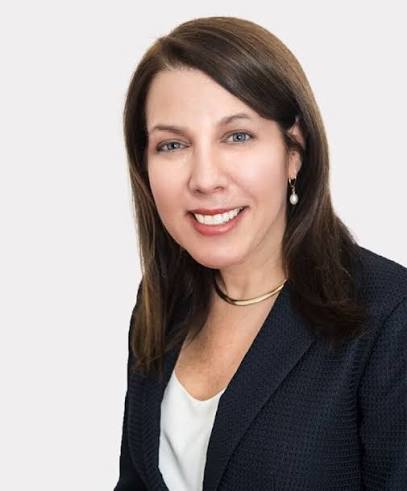 Nancy Shaw Chochrek, who was beloved by her family, friends, and colleagues for her vivacious personality, generosity of spirit, good humor, and searing intelligence, died on September 12, at the age of 63, from metastatic breast cancer.
Born in 1963 to Joan Tart Shaw and Martin M. Shaw, Nancy grew up in Scarsdale, New York, and graduated in 1981 from Scarsdale High School, where she was editor in chief of the yearbook. She graduated from Brown University in 1985 and from Boston College Law School in 1988.
For nearly 12 years, Nancy practiced law in Chicago, first at Lord, Bissell & Brook and then at Smith, Hemmesch, Burke & Brannigan. In 1996, she married James Chochrek, and their three children—Anna, Ella, and Ian—became the center of their world, the heartbeat of their home. In 2000, she and James moved to White Plains, New York, and Nancy launched a long and distinguished career in Scarsdale real estate, following in the footsteps of her mother. For several years, Nancy was a top-selling agent at Julia B. Fee and Houlihan Lawrence. For the past 8 years, she was the manager of the Scarsdale office of Houlihan Lawrence, one of the top-performing real estate offices in all of Westchester County.
Nancy balanced work and family life with aplomb. She was an extraordinarily devoted mother to Ella, Ian, and Anna, who were her pride and joy. No matter how busy her work schedule, Nancy always made their needs and concerns (and Anna’s and Ian’s ice hockey games) her priority. She loved nothing more than the afternoons and evenings she spent at home surrounded by her family as they watched, analyzed, and cheered on the Chicago Bears, Blackhawks, Bulls, and Cubs.
Nancy had a knack for making and keeping friends from every chapter of her life, and she would keep in touch with them with endless phone calls during her morning walks and daily commute. She was especially devoted to her friends from Camp Walden in Denmark, Maine, where she was arguably the most spirited camper in Walden’s 110-year history.
In addition to her husband and children, she is survived by her cherished brother, Daniel, and his husband, Ramon Montala, of Falls Village, Connecticut, and Ridgewood, New York.
On a personal note, I knew both Nancy and her mother Joan Shaw who was also a leading realtor at Julia B. Fee for many years. In fact, Joan spent countless days house hunting with my family and was successful at helping us buy the home we have stayed in for 25 years.
When Nancy became the manager of the Houlihan Lawrence Scarsdale office, we worked together regularly, and she was a big supporter of Scarsdale10583. She was warm, had a good sense of humor and never questioned our editorial independence. I will be forever grateful to both Joan and Nancy for the roles they played in my life in Scarsdale.
A memorial service for Nancy will be held on Thursday September 17 at 2 pm at McMahon, Lyon & Hartnett Funeral Home, Inc., 491 Mamaroneck Ave., White Plains, NY 10605.
Post your memories about Nancy below.