






District Struggles to Resolve $1.96mm Budget Gap
- Category: Schools
- Published: Wednesday, 04 March 2026 18:38
- Wendy MacMillan
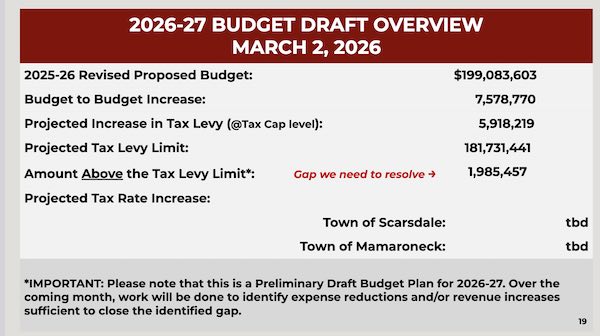 The Scarsdale Board of Education held their Budget Study Session #2 on Monday, March 2nd and reviewed a revised 2026–27 spending plan that trims nearly $600,000 from earlier projections. Despite the District’s efforts to curb spending, the proposed budget still sits $1.98 million above the state tax cap, setting up difficult decisions ahead of the third Budget Study Session to be held on March 16th. The current proposal calls for a 4.5% tax levy increase, which would require a 60% supermajority vote if it remains above the cap.
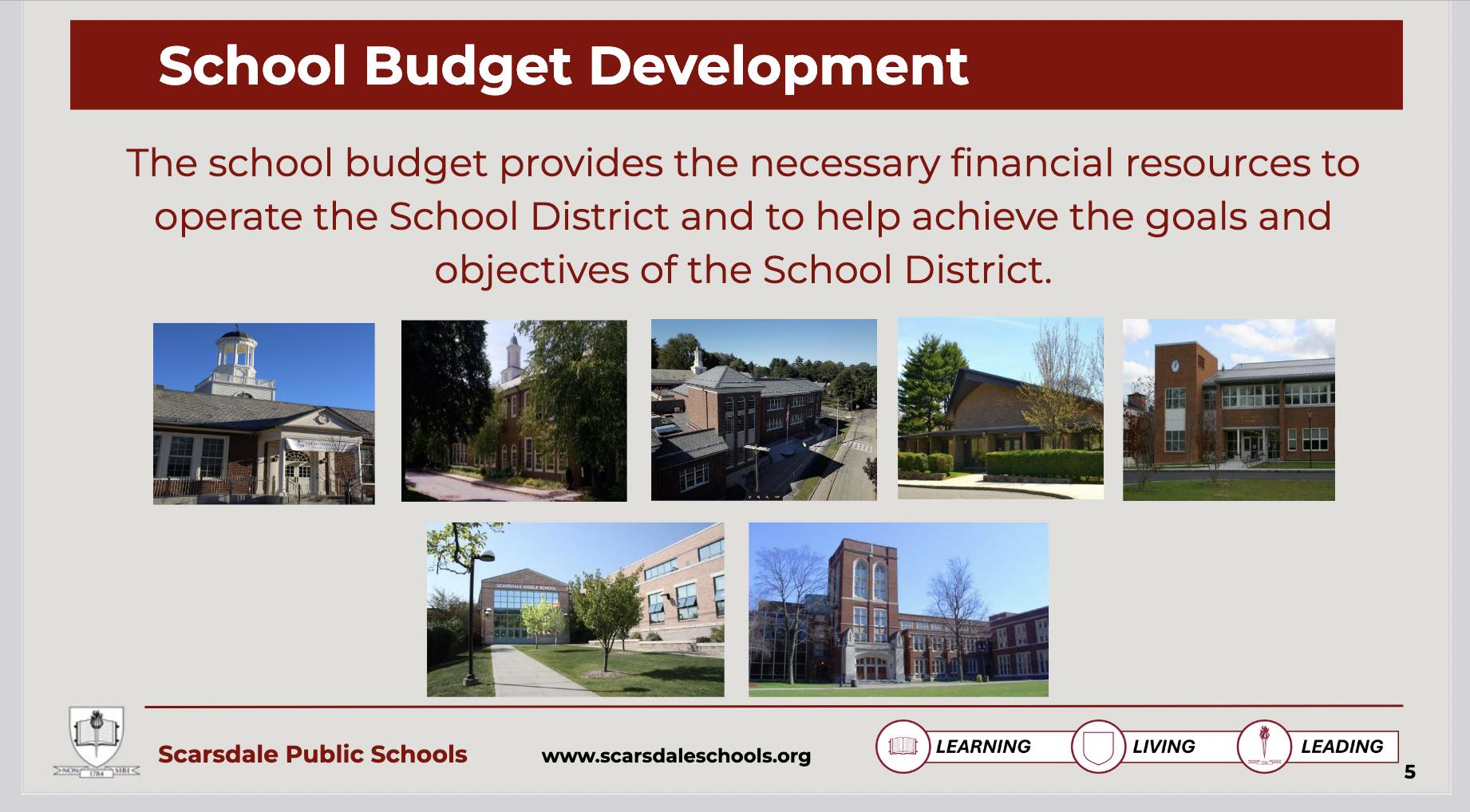
To start the session, Superintendent Dr. Drew Patrick briefly reviewed the school budget development process and highlighted that the students are always at the center of the planning and that, “the school budget provides the necessary financial resources to operate the School District and to help achieve the goals and objectives of the School District.”
Patrick also framed the discussion within broader statewide pressures. Referencing guidance from the New York State School Boards Association which noted:
-Districts are contending with the 2% tax cap that by design doesn’t keep up with inflation, rising health care costs and new mandates such as zero-emission buses.
-School districts have many costs that they little or no control over and health care costs are a prime example
-Sate educational initiatives (such as transitioning to zero emissions buses) have local cost impacts.
Patrick expressed that these factors (and more), greatly affect costs across the board and makes budget planning exceedingly difficult.
The New York State School Board Association article can be found in the presentation here
Athletics: Cost Controls Without Cutting Programs
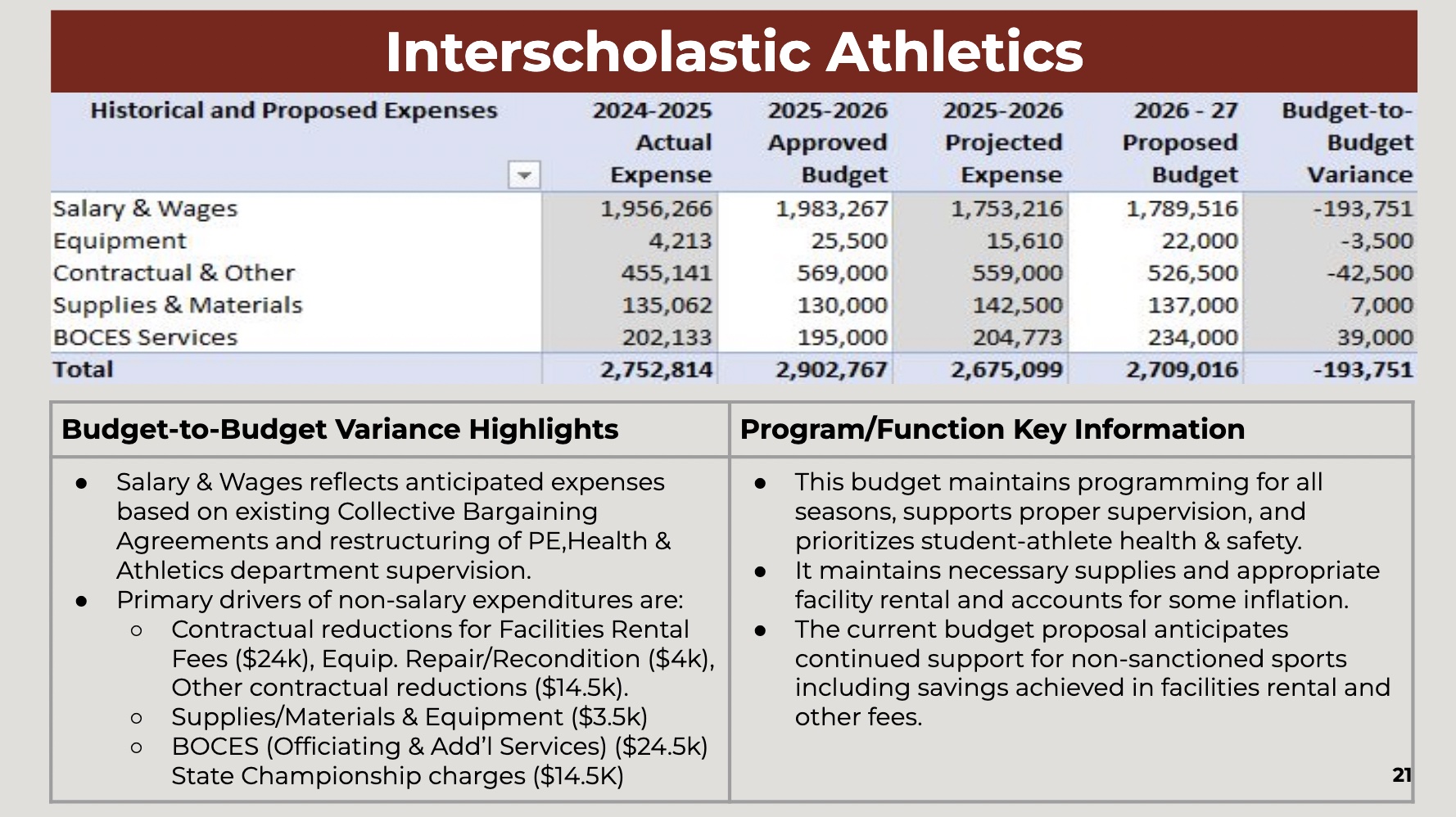
Athletic Director Cindy Parrott told board members the current proposed budget “maintains support for the current level of athletic offerings, supports proper supervision and prioritizes student-athlete health and safety.”
The plan preserves supplies and facility rentals while factoring in inflation and tariff-related equipment surcharges. However, the athletics budget shows a notable drop in salary and contractual lines.
“Most of that decrease is due to the restructuring of the leadership of athletics, physical education and health,” Parrott explained. Additional savings came from replacing long-standing coaches who retired or moved on “with coaches that are starting at lower salaries, as per the teachers contract.”
Contractual reductions reflect closer alignment between projected and actual spending.
“For example, our bowling team used to be enormous,” Parrott said. After physical education exemption rules changed and participation declined, the district had been carrying a contract “incredibly high compared to what the actual expense was.” That figure has now been adjusted to reflect reality.
Similarly, choreography expenses for cheerleading were reduced after the program downsized. “We haven’t had a JV team,” she noted. “There would be no reason to spend money on a JV choreography. And if you know anything about cheerleading, nothing is cheap.”
Still, some increases are unavoidable. Officials’ fees are rising 3–5%, and new BOCES bill-backs for individual state championships will add an estimated $14,000 next year.
“These are costs we don’t really have a lot of control over,” Parrott said. Using outdoor track as an example, she noted Section One’s total projected cost for state competition is $115,000, billed at $418 per participant. “We’ve been super successful. We’re sending a lot of kids. That’s the good news, but we need money to cover them making it to the state championships. And I think that’s money well spent.”
Participation in non-sanctioned sports remained steady despite newly implemented fees, and attendance improved. “Most of the feedback I’ve heard from parents has been, ‘We’re just happy our kids still have this opportunity,’” she said.
Special Education
Assistant Superintendent Eric Rauschenbach began his presentation by reminding the board that, “The vast majority of students can be accommodated in a “regular education” classroom with appropriate supports and classified students have the right to receive all of the accommodations and modifications on their IEPs.”
Rauschenbach further explained that the district currently serves 662 students with IEPs (14% of enrollment), which falls below state and county averages. He noted, “We must look to expand the continuum of service, in a financially sustainable manner, to service the greatest amount of students within our own programs.
Rauschenbach went on to share that while classification rates have leveled off, spending pressures persist. “We’ve seen a major increase in the non-resident tuition rates,” he said, referring to state-controlled costs for out-of-district placements. Additionally, the district experienced two unexpected residential placements at the high school level, “which cost in excess of $225,000 each.”
The budget also reflects increased use of contracted Registered Behavioral Technicians at the elementary level. Though only a small number of students require the service, Rauschenbach described it as individually very high cost because of the high level of training the technicians have.
The proposed special education budget rises by $854,720 (3.8%), maintaining current programs while expanding Integrated Co-Teaching (ICT) services in middle school English and math. “We’ve tried to move ICT up through the middle school for the benefit it has to students,” Rauschebach said, noting the goal is to provide a “just right fit” between restrictive and less supportive environments.
Rauschenbach also pointed to long-term savings from expanding in-district special class and SSP programs, reducing reliance on outside placements.
To learn more about the special education program in Scarsdale see here.
Student Services and Safety
Mr. Rauschenbach also reported that the Student Services budget maintains counseling, nursing, psychology and social work programming and increases elementary social work support. Slide 29
Safety and security funding remains steady, with a $50,000 equipment reduction following completion of major door sensor upgrades. Remaining funds would allow for modest camera additions next year. Slide 30
Technology: Infrastructure, AI and Cybersecurity
In her presentation, Jeannie Crowley Director of Technology and Innovation, emphasized that while the department represents a small slice of the overall budget, continued investment has enabled device upgrades, a new website, improved emergency communications and a transition to updated HR and finance systems.
Crowley also stated that, “Annual investments in our supporting infrastructure (switches, storage servers, network controllers, phone system, firewall, etc.) are necessary to ensure our equipment is up to date, secure, and meeting our needs. Investments in infrastructure are primarily driven by manufacturer end-of-support dates.”
She noted that a lease restructuring aligns equipment payments with useful life spans, lowering annual principal costs. The budget also includes new Chromebook carts for high school humanities classrooms.
On cybersecurity, Crowley described weekly vulnerability reviews, phishing simulations and active monitoring.
One board member commented, “It’s very hard in today’s day and age with AI to recognize threats, but I’m constantly pleasantly surprised by how adept our community is at flagging concerns in real time.”
The district is also developing its 2026–29 instructional technology plan, with growing focus on AI literacy, ethics and data privacy.
After the presentations, board members had the opportunity to ask questions and acknowledged during their discussion, the difficulty of closing the remaining $2 million gap. “We’re struggling to identify Scenario A right now, let alone Scenario B,” Patrick related, indicating the March 16th meeting will likely present a specific set of recommended reductions.
One board member suggested providing clearer illustrations of tradeoffs and potential tax impacts for households. Administrators agreed to consider ways to contextualize what various levy levels would mean for residents.
A public budget forum is scheduled for March 23rd, with final adoption required by April 13th.