










District Takes Measured Approach to Artificial Intelligence in Education
- Monday, 01 June 2026 10:36
- Last Updated: Monday, 01 June 2026 10:48
- Published: Monday, 01 June 2026 10:36
- Wendy MacMillan
- Hits: 928
 On Friday, May 29th, community members were invited to join Jeannie Crowley, Director of Technology and Innovation, and William Yang, K-12 Coordinator of Digital Literacy and Learning, for a discussion about the District’s approach to Artificial Intelligence (AI). High school administrators and teachers who have been actively involved in the District’s multi-faceted AI initiatives also participated in the fruitful discussion.
The session explored the development and implementation of AI policy, the District’s technology guardrails, and how teaching and learning at Scarsdale High School are evolving to meet the opportunities and challenges presented by AI. Participants had the opportunity to learn more about current practices, ask questions, and engage in an important community conversation about the future of education in an age of rapidly advancing technology.
The “Parent Coffee” came as interest, and concern, about AI continues to grow among students, educators, and families. The discussion drew a full house of parents, educators, and community members eager to learn more about how AI is shaping teaching and learning. Crowley and Yang emphasized that while AI presents exciting opportunities, the district is taking a careful, research-based approach to adoption.
Five Technology Guardrails Guide District Decision-Making
At the center of the district’s AI strategy are five technology guardrails designed to ensure responsible and thoughtful use of emerging technologies:
-Privacy Policy
-Safety and Well-Being
-Intentionality
-Collaborative Inquiry
-Digital Competencies
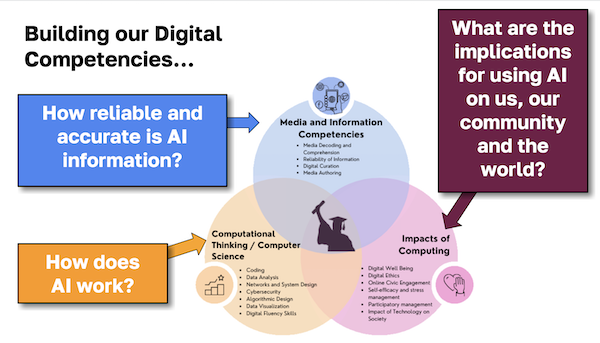
These guardrails encourage students, staff, and families to think critically about questions such as:
-How does AI work?
-How reliable and accurate is AI-generated information?
-What are the implications of AI for individuals, communities, and society?
These principles are informing district-wide conversations and professional learning opportunities as the District develops a thoughtful and balanced approach to AI.
Learning Together Through Inquiry
The district is supporting AI exploration through a variety of collaborative learning structures, including:
-STI Inquiry Groups
-Technology Teachers, Librarians, and Coordinators
-Administrative Council Learning Time
-Family Forum Sessions
-CFII Inquiry Proposals
-Building-Based Study Groups
These initiatives provide opportunities for educators and community members to examine emerging research, share experiences, and develop thoughtful practices around AI use.
A Measured Approach to AI Adoption
One of the strongest themes from the discussion was the district’s commitment to moving deliberately. Crowley and Yang shared that lessons learned from previous waves of educational technology have informed their current approach. Rather than rushing to implement AI tools, the district is monitoring ongoing research and evaluating evidence about AI’s impact on student learning before expanding adoption. “We have learned from past waves of EdTech trends and are being very measured in our approach,” Crowley explained. “We are waiting to see more research about the impact of AI on learning before moving too quickly.”
Changes in Writing Instruction
AI has already influenced classroom practices, particularly in writing instruction at Scarsdale High School. Teachers have adjusted some assignments to create more opportunities for students to produce authentic, in-class work. This shift has also enabled educators to provide more frequent and targeted feedback on specific writing skills. Educators noted that these changes have helped preserve opportunities for students to develop independent thinking and writing abilities while adapting to the realities of AI-assisted tools.
Developing Clear Guidelines
The district currently has AI guardrails in place for employees and is developing additional guidance that will provide more explicit examples of appropriate and inappropriate AI use. These forthcoming guidelines will likely include a “green, yellow, and red light” framework, helping staff determine when AI can be used freely, when caution is warranted, and when use is inappropriate. This work parallels ongoing efforts at Scarsdale High School to establish student-facing AI guidelines that can be adapted to the needs of individual classrooms.
Recognizing that AI use may vary across disciplines and instructional approaches, Crowley shared that teachers need the flexibility to explore and evaluate the technology within their own professional contexts. “There is variation between classrooms on how AI is used, and this is expected,” Crowley noted. “Faculty need space and agency to work with this new tool and determine how and when it can support learning.”
Guidance for Parents
Parents attending the forum asked what conversations they should be having with their children about AI today. District leaders offered several recommendations:
Acknowledge Different Expectations for Adults and Students
Parents are encouraged to explain that AI use in the workplace may differ from expectations for students. Research suggests that experts often benefit more from AI tools because they already possess deep knowledge in their fields, while students are still developing foundational skills and expertise.
Discuss Potential Risks
Families should talk openly about AI-related risks, including deepfake images and manipulated content. Parents are encouraged to create an environment where children feel comfortable seeking help if they encounter harmful or distressing online experiences.
Monitor Vulnerable Students
Special attention should be given to students who may be vulnerable to self-harm, eating disorders, or other mental health concerns. AI chatbots are often designed to be supportive and affirming, which can unintentionally reinforce harmful thoughts or behaviors for some users. Open communication and appropriate monitoring can help ensure student safety.
Looking Ahead
As AI continues to evolve, district leaders emphasized that the conversation is far from over. Ongoing research, community dialogue, and thoughtful experimentation will continue to shape local policies and practices. The district remains committed to balancing innovation with caution, ensuring that any use of AI supports student learning, protects privacy, and aligns with the community’s educational values.