







Tensions Over Antisemitic Incident Erupt at School Board Meeting
- Category: Schools
- Published: Tuesday, 12 May 2026 13:47
- Joanne Wallenstein
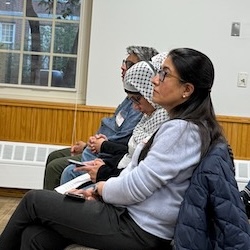 (Updated May 13, 2026) Emotions ran high at a charged meeting of the Scarsdale School Board on Monday May 11, 2026 when residents aired their thoughts about a series of events that rocked the community and ultimately caused the President of the School Board to step aside on April 24, 2026.
It’s a pivotal time for the school community. With a school budget vote, a bond vote and a contested election for two school board seats on May 19, as well as end of year events like prom and graduation on the calendar, the board and administration sought to renew confidence and trust while listening carefully to their constituents.
Parents, students and community members came to the mic to decry antisemitism, to both defend and criticize the response of the district and the board, and to demand that the school take action to both condemn expressions of hate while ensuring free speech at the same time. The age old conflict between allowing freedom of expression while fostering a safe and welcoming environment spiraled in all directions.
Speakers included students from the Israeli Culture Club, members of the Muslim community, members of the clergy, friends of the Dugan family, attorneys, members of the Alternative School community, a history professor and others who offered their perspectives on recent events and their suggestions on how we can move forward.
Before the 90-minute public comment period, a new Board President was elected and sworn in to serve out the two months remaining in the school year. Former Board President Suzie Hahn was elected unanimously and took the oath of office.
She said, "I would also like to address the last several weeks. I will be honest, this has been a challenging time. We care deeply about every member of this community, and we have seen the genuine concern, pain, and worry that many of you are carrying.
To reiterate a recent letter to the community from the Board, this Board condemns, in absolute terms, all forms of antisemitism, hate, and discrimination. We are committed to creating and sustaining learning environments in our schools that reflect our values of dignity, respect, inclusion, and safety that we strive to uphold for every student.
One of our board members recently shared that the Mandarin word for “crisis” describes a moment of danger and a critical turning point—and within that turning point, the opportunity to shape what comes next. We intend to meet this moment with that mindset, to engage it seriously, to learn from it, and to do the work required to emerge stronger as a community of students, faculty, and families.
To that end, I would like to share that on April 22nd, members of the Board participated in a full-day workshop at Purchase College entitled, “Identifying and Addressing Antisemitism in our Schools,” presented by Brandeis University’s President’s Initiative on Antisemitism and Boundless, in partnership with Westchester Jewish Council and UJA-Federation of New York. This training focused on how anti-Jewish bias and hate manifests in today’s schools. Board members have also over the last few months experienced the Common Circles exhibit Drew mentioned in his earlier comment, and have approved a transfer to allocate funds in our budget to help bring this exhibit, to increase empathy, reduce bias and antisemitism, to Scarsdale.
These are important steps, but they are not sufficient. We are committed to continuing this work, and to ensuring that we are educated about all forms of bias and hate, so that none of them can take root or go unaddressed in our schools."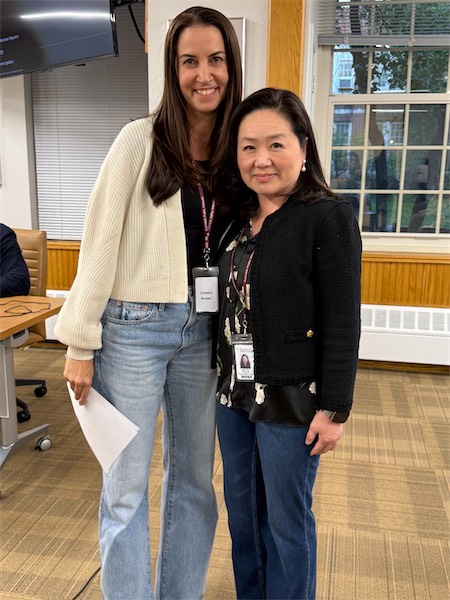 Suzie Hahn was sworn in as School Board President by VP Colleen BrowSuperintendent Drew Patrick made a statement to frame the discussion, expressing empathy, a commitment to listening and a new community wide initiative to address the issues. Read his statement here:
Before opening the floor to comments, speech guidelines that limited speaking time to four minutes, barred obscene language, libelous or defamatory statements, and threats of violence were distributed.
When they opened the floor, commenters raced to the mic, vying to speak. Here are excerpts from some of the comments: Watch the full meeting here.
First up was Gabriel Green, the cofounder of the Israeli Culture Club, that was at the center of the conflict. Referring to the placement of the Culture Club flyers for an Israeli Independence Day Celebration in urinals, he said, “There is a myth that this was an isolated event… it has been anything but. The posters were shoved into a urinal. The intent was to humiliate…. And it wasn’t the vandals that were held to account- it was the club. You cannot condemn an act and then suggest that the club invited it. It was never the flyer. We are fair game for harassment. What does it tell students when those who follow the rules are forced to defend themselves.” He then asked the board to fund ways to fight antisemitism in the upcoming school budget, saying “It is time for the board to show us that all students actually means all students.”
Green’s comments were echoed by several students. One said, “When posters were thrown into urinals it was a message that Jewish student identity can be mocked…. That we are dirty, disposable and shameful. When hate is not named clearly – students learn what is tolerated, what gets excused, and which students are protected immediately. … We should not have to hide our pride while adults look for the right words.”
Sophia Kahan said, “I have concerns about curriculum and the A-School. I am not advocating a pro-Israel point of view. The curriculum characterizes Jews as colonizers without the mention of the genocide that shaped the history of Israel. Such teaching sews division. It frames Jewish history as colonizers and oppressors. I advocate teaching about the Middle East with nuance, that disagreement is acceptable. Let us foster an environment that promotes peace and goodwill. I am asking the board to do a full review of all teaching materials about the Middle East.”
Junior Eli Zagari said, “Taking a poster of the Jewish state celebrating the independence of our nation and pissing on it in the urinal is antisemitic because it was targeting Jews. It was antisemitic not because there's a war going on but it is antisemitic because they are targeting a people…. that's our homeland. If the Chinese Culture Club took a picture of a map of China, and they put it in the urinal and they pissed on it, would that not be anti-Chinese? … I shouldn't have to be careful about what I say, what I repost, what symbol I wear around my neck, what opinions I express to my own teachers. No student at Scarsdale High School should feel unsafe, whether they're wearing hijab or Magen David. As someone who transferred from Leffell, a private Jewish Day School to Scarsdale in 10th grade, the past couple of weeks have been so incredibly disappointing for me. … I didn't come to Scarsdale to convince people that my people deserve to have their own state, or that anti-Zionism is antisemitism. I came here to learn. I came here to make friends. Adults, not students, need to recognize the warning signs before an incident becomes public. Teachers need to know how to respond when comments are made in classrooms, hallways or online. Teachers need to be taught how to be unbiased. The district must treat antisemitism with clarity and urgency….”
Several other speakers spoke in defense of former Board President and now Board Member Jim Dugan. One said, “I was deeply disappointed to see Mr. Dugan stepping down as president… I'm very concerned that he had been forced to step down in his role without any due process being followed. I was under the impression that under the New York education law, a board member cannot be removed from the role simply because of a petition or a community outcry. Mr. Dugan himself has done no violation and neglect of duty. To my knowledge, it's a prime example of guilt by association, that too, because of something a child liked on someone else's social media account. If we all had to pay for what our teenagers do, none of us would have a job. A minor's social media post is not official misconduct by a parent in their official capacity and more pressure.”
Rokaya Hassabala said, “I am speaking today in support of Jim Dugan as a long-time volunteer in this community. I feel a responsibility to speak when something does not reflect who we are. I have known the Dugan family for many years. Our children have grown up together, attended the same classes, went to each other's birthdays and shaped the everyday moments that define a community. I know them to be kind, inclusive and deeply respectful, people who welcome everyone. It is deeply troubling to see a dedicated volunteer who has given countless hours of service to this district being judged in a way that is not fair, measured or consistent with who we aspire to be, it is certainly not neighborly or proportional. The level of reaction extends beyond the initial situation and it is affecting an entire family, a person's professional life and their ability to continue serving. There were even calls to his daughter's school to have her expelled. This raises serious concerns about perspectives and fairness. We are also talking about a situation involving a young person who has already taken responsibility and apologized. As a community, we should be asking ourselves, what is the purpose of our response? Is it to teach, guide and improve, or is it to punish beyond measure and destroy the person for doing a mistake? We have to respect that teenagers need space for learning and growth, not escalation to the point where consequences extend far beyond what is reasonable. This is about who we are as a community and what we choose to model for our children. Will we allow moments like this to divide us and push us towards extremes, or will we live by the philosophy that it takes a village to raise a child? Jim, I am truly sorry for what you and your family are going through.”
A woman wearing a keffiyah stepped up and said, “I'm the mother of a middle schooler. I would like to address the recently published guidelines for student expression at school sponsored events restricting obscenity, libel, discriminatory language sections of the policy raise potential First Amendment concerns. In particular, the language around political advocacy and messaging raises First Amendment concerns for several reasons. Firstly, the term political advocacy is open to interpretation. My daughter regularly wears a kafir hijab to school. This is not inherently a political symbol. It's a cultural garment with deep roots in Arab life, worn for generations by people all over the Middle East. Yet several Scarsdale residents have weaponized this garment, treating it as a political tool, and even going so far as to offensively characterize it as a symbol of terrorism within the context of a school sponsored event. Who decides if wearing a keffiyah is a form of political advocacy versus what it actually symbolizes: appreciation of Middle Eastern culture and Muslim culture?
Secondly, political advocacy encompasses a very wide range of student expressions, everything from I stand with Ukraine, stand with Israel to free Palestine. It would include the recent anti ICE protest held at SHS….
Finally, how will you define disruption? Just because a point of view is controversial or unpopular does not mean it is also disruptive. My daughter wearing a sweatshirt with a watermelon, a dove and the statement “no one is free until everyone is free” was not disruptive. … My middle schooler has been the subject of cyber bullying for the last year and a half. She has been photographed, her picture widely circulated on social media without consent by adults in this town, there have been calls on Facebook to deport her, an American citizen who has the same rights as every person in this room, threats have been made to find out where she lives so that her family can be taught a lesson. She has been shamefully called out in a district wide email saying she has caused harm to her community. By sending this email, the administration has put a target on her back, threatening her safety, her well being and her educational experience… by failing to stand up for my daughter, the school administration has failed not only our family, but its broader duty to safeguard all the students entrusted to this care.”
Leora Wexler implored the Board to protect Jewish children.
She said, “I remember the first time I was the target of antisemitism. I was in second grade. There was a dispute over one President's Day that fell that year. The boy who disagreed with me told me that I couldn't possibly know when it was because I was Jewish. Those words are something that even now I will never forget, not that it matters, but I happen to be correct. What our children are facing and have faced over the past few years is much larger and much scarier, and whether it is antisemitism, anti-Zionism, or any other form of discrimination, it will stay with each of them too.”
“The breadth of antisemitic events that have occurred in Scarsdale this year are as apparent and terrifying. It is all really unsettling that, especially because when we move to Scarsdale, we anticipate a certain level of cultural safety, no matter who we are, and a welcoming of diversity, diversity of thought, diversity of background, ethnicity, religion and culture, maybe not socioeconomic diversity, hopefully some of that too... I think back again to when I was a seven-year-old in second grade facing antisemitism for the first time. …. Ask yourself, are we doing enough?”
Some residents gave a historical perspective.
Jay Cannell said, “I grew up in Scarsdale, attended Scarsdale High School and moved back to town in 2006. I have to say that I'm shocked and disappointed by the recent number of antisemitic events in the high school. Growing up in Scarsdale, I can't recall any antisemitic incidents in Scarsdale or any school that I attended, and although we now live in different times, I can't believe that I'm seeing this here. The reason why I stand here today is to make sure that you're doing enough to put an end to these antisemitic acts. I really believe that you must think long and hard to make some serious changes that are actually going to do something to stop this heinous behavior, and the punishments must be more severe and handled in the same way that it would be handled if it were done to other minorities in the communities, and not just the Jewish community.”
Long time educator Michael Krasner said, “The current controversy over alleged incidents of antisemitism raises many of the same issues I encountered during 50 years of teaching political science at Queens College and 30 years of working with high school students and teachers. As the Director of the Taft Institute for Government and Civic Education, the great danger in the current situation is conflating criticism of the Israeli government with antisemitism. This indiscriminate usage threatens our freedom of speech, inflames passions and polarizes and divides communities…The incident that has been referred to several times tonight, where posters were torn down and thrown into a urinal, is a case in point. Was this offensive? Absolutely. Was it wrong? Definitely. Was it reprehensible? Of course. Was it antisemitic? Not so clear, because the map on that poster was itself provocative. It included Israel, the West Bank, the Golan Heights and parts of Lebanon, all denied to Israel by international law. So we can say for sure that the actions of throwing those posters into the toilets, into the urinals, were the actions of angry teenagers, but were they antisemitic? I doubt it. Antisemitism means a pervasive hatred of Jews. We can't know what the motivation of those students were unless we do an in depth investigation, but my hunch is that they are not that kind of antisemite. Similar points apply to other incidents. They show the difficulty and the danger of this conflation.”
Alissa Baum and Lloyd Katz said, “Like just about everyone of the Jewish faith, we have experienced antisemitism firsthand in the form of negative comments and concern long term for our personal safety and security. Antisemitism is a threat to us, and we believe the board and other governmental institutions need to take harsh action against this and other forms of racism and prejudice. … I am not so naive as to believe that there is not some number of people whose criticism of Israel derives from their personal antisemitism. However, it is also wrong to believe that any and all criticism of Israel is antisemitic. Sometimes criticism of Israel is just that people have a right to criticize Israel, even if I don't agree. And most importantly, when it comes to young people, people in high school and college, hyperbole, intemperate remarks, foolish actions and a certain moral certitude of the correctness of their positions are to be expected. We've been here before. We owe it to our future to make it clear to condemn their excesses or certainly their bigotry, but not take away their right to make a statement or their ability to learn from their mistakes.”
Christine Weston spoke about the Scarsdale Alternative School. She said she had a long standing connection with the alternative school where she and her husbands attended and her two sons attended. She said, “Over the past several weeks, I've been struck by the contrast between the way many adults reacted publicly and the way the alternative school community approached these conversations. Internally, on social media, many of us adults were reactive, angry and at many times deeply unkind. Conversations quickly became accusatory and divisive. I think it's important that we acknowledge that honestly, because our children are watching us. What impressed me so deeply was hearing from my son about the way the alternative school handled these conversations. Teachers created space for students to talk openly, listen to one another, ask difficult questions and process complicated emotions respectfully. The focus was on dialogue, accountability, empathy and understanding. To me, that should be the model, not just for students, but for all of us.”
More questions arose over the proposed new guidelines governing student expression at school sponsored events which you can see here.
Jordan Copeland said, “The district has both the authority and the responsibility to preserve order, prevent harassment and threats and ensure that school sponsored activities remain focused on their intended purpose. My concern is that the proposed guidelines as written, permit and even encourage infringement of students' first amendment rights. The Supreme Court has made it clear since the landmark Tinker case 1969 that schools may not restrict student expression, particularly political speech, because it's uncontroversial, unpopular or uncomfortable. And the proposed guidelines, however, specifically seek to keep school sponsored activities, quote, free from controversy, and explicitly restrict political messages that may create division or controversy. This creates First Amendment concerns and places administrators in a risky and difficult situation. Determining which political or social messages are controversial is obviously subjective, and it's likely to result in inconsistent or view point based enforcement. And the guidelines, these guidelines, give authority to limit student speech, not just to administrators, but to quote adults responsible for supervising school sponsored activities. So whether a student's message is protected by the First Amendment could be decided on the fly by teachers or coaches or staff, any of whom could unconstitutionally restrict student expression and open the district up to liability.
So is a student football player kneeling during the national anthem too controversial or divisive, or a student wearing a Black Lives Matter button or a Blue Lives Matter button? ICE out, protect trans kids, my body, my choice, free Palestine, I stand with Israel? District employees will have to look at the content of the messages and then try to gauge community sentiment, to decide what political messages are permitted in school…
So I urge the board to revise the guidelines to focus on the categories of student expression that schools may lawfully regulate material and substantial disruption, targeted harassment, threats, conduct that infringes on the rights of others, and where school sponsored speech is involved, unauthorized use of time, equipment or official materials….”
Reverend Kelly Rogers of Scarsdale Congregational Church and Rabbi Adam Baldachin of Shaarei Tikvah spoke, and said they were also speaking for Rabbi Jonathan Blake from Westchester Reform Temple. They read from a statement previously published on Scarsdale10583.
They said, “As clergy, parents and community leaders, we believe deeply in the value of public education and in the importance of our students learning in diverse environments where they encounter different cultures, histories and perspectives, that learning is essential to fostering empathy, civic responsibility and understanding of both other stories and experiences and our own what has transpired in the Scarsdale school district is not an isolated incident confined to one classroom or one school. Rather, it reflects a series of events and situations that have created a growing sense of unease among students, parents and faculty, and a concerning erosion of trust between families and district leadership.”
Jewish students and their families in particular have good reason to feel concerned these days, given the alarming rise in antisemitism across the world and a widespread hostility to Israel, which is often cloaked in the language of social justice, but whose proponents too often seem blind to every other conflict zone in the world and focus their outrage predominantly or exclusively against The Jewish state. Our classrooms are for learning. They are safe spaces where trust must be built between educators and students. Families must feel confident that complex and sensitive subjects are taught with professionalism, viewpoint diversity and intellectual rigor grounded in facts rather than activism or political ideology. Teachers must foster critical thinking and civil discourse while recognizing the responsibility that comes with the inherent imbalance of power in the classroom. Students are young and impressionable while teachers hold authority given the challenges that concern us, curriculum and supporting materials must be assessed and training conducted for our educators, repairing damaged trust will require thoughtful, courageous and sustained work, but it can and must be done…”
Several speakers offered hope and solutions:
Jesse Lee said. “This is the first time I've seen so many people here that a lot of people don’t have a seat. That really sort of shows people really care about the community, care about an identity group, care about our views, and care about the First Amendment… I really see the promise here, because I do believe the first step to solve any conflicts is dialogue.”
“…I want to begin by saying clearly that no student should feel targeted, intimidated or welcome, unwelcome because of their identity, religion, your point. The recent incident at high school affects real students and real families, and they should concern all of us at the same time. I hope we remember that high school students are still in one of those most formative stages of their lives. Adolescence is exactly the period when young people are developing judgment, empathy, critical thinking and understanding of consequence…. Teenagers can act impulsively, thoughtfully or emotionally, especially in today's social media driven environment. This doesn't excuse harmful behavior, but it does mean our response should prioritize education, dialogue and growth, not simply labels and punishments. Schools are not only places where students learn math and history, there are places where students learn how to live in a diverse society, how to disagree without dehumanizing one another, how to engage difficult global issues thoughtfully and how to understand the impact their actions have on others. I hope we can approach this moment in a way that lowers fear and division rather than dampening it. We should create space for honest conversations, for accountability with learning, and for the belief that young people are capable of growth when guided with both firmness and humanity.”
Student Dylan Lemberg gave a plea for civil discourse and respect. He said, “I have spent the last three years traveling around the state meeting with students, teachers, administrators, community members, state officials and educators on how to practice civil discourse. I feel that three years later, we are in the same place. We have witnessed a lot of tension here tonight between so many different groups, and it is so clear that not only in our community are we divided and fractured, but that we are paralyzed by our polarization. You can see it at Thanksgiving dinners or in presidential debates, and we have witnessed it here today. We have witnessed the effects of not talking about civil discourse, of not teaching our students and preparing them to be citizens of our community.”

Comments