







Village Authorizes Matching Funds for Three Stormwater Remediation Projects
- Wednesday, 10 June 2026 14:54
- Last Updated: Wednesday, 10 June 2026 15:46
- Published: Wednesday, 10 June 2026 14:54
- Joanne Wallenstein
- Hits: 119
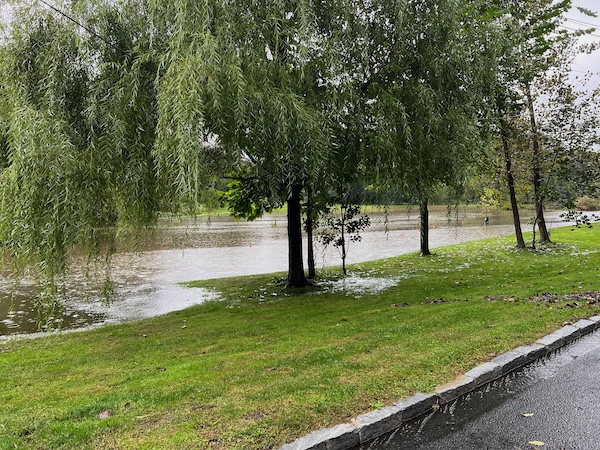 George Field ParkAfter years of discussion, the Village of Scarsdale is moving forward with three long awaited stormwater remediation projects, using a 50% fund matching program from Westchester County.
In order to qualify for the matching funds, the Village was required to make a commitment to fund 50% of the proposed work. With a June 19 county deadline approaching, the Scarsdale Village Board unanimously approved resolutions to authorize the issuance of bonds to underwrite the Village share of the expenses.
The three projects are as follows:
-Authorization for the issuance of $3,669,640 in bonds for the Village’s share of the cost of stormwater and drainage improvements around Cushman Road, Garden Road, Willow Lane and Sheldrake Road, including installation of new surface inlets, upsizing of storm sewer pipes and replacement of piping, and any incidental expenses. The total cost of the project is estimated to be $7,339,280.
-Authorization for the issuance of $4,236,680 in bonds for the Village’s share of the cost of stormwater and drainage improvements around George Field Park, Rugby Lane and Cambridge Road, including improvements to piping and bio-retention pond and regrading, and any incidental expenses. The total cost of the project is estimated to be $8,473,360.
-Authorization for the issuance of $373,750 in bonds for the Village’s share of stormwater and drainage improvements around Griffen Avenue including construction of a culvert system, removal of pipes, widening and stabilization of stream bank, and removal of debris and sediment within the system, and any incidental expenses. The total cost of the work is estimated to be $747,500.
Another proposed project on Brite Avenue and Chesterfiled Road near the tennis courts, estimated to cost $3,380,000 was not included.
Several residents from the affected areas wrote letters and came to Village Hall to speak about the projects after the Mayor raised the question of funding stormwater improvements by creating special tax districts to assess affected residents for the cost of the work at a work session on May 28, 2026.
Subsequently, further details about special tax districts were provided in two memos issued by the Village on June 5.
A memo titled, “Village Considering Funding Options for Stormwater Hazard Mitigation Improvements” says: “The Village has previously identified potential local funding sources for these projects, including assigned fund balance and future debt financing. During its May 28 work session, the Village Board discussed project funding strategies, broader stormwater management considerations, and various financing tools available to municipalities under New York State law, including special tax districts. No action was taken or decision reached regarding any specific funding mechanism.”
Another titled, “Understanding Special Tax Districts and Infrastructure Funding” said the following:
"Infrastructure projects can vary significantly in both cost and the scope of benefits they provide. Some projects provide benefits that are shared broadly throughout the community, while others may provide more direct benefits to particular areas or groups of properties……Local governments may consider funding tools such as grants, reserve funds, debt financing, general Village revenues, and other mechanisms authorized under New York State law.
One such tool is a special tax district, which allows certain public improvements or services to be funded, in whole or in part, by properties that receive a particular benefit from them. Special districts are commonly used throughout New York for infrastructure and services such as sewer systems, drainage improvements, water systems, and lighting districts.” … The Board discussed a variety of funding options as part of its deliberations on how best to finance these significant and costly projects…. These discussions were conceptual in nature, intended to explore potential approaches and better understand the implications of various funding mechanisms. No decisions were made, no actions were taken, and no consensus was reached regarding how to proceed…. The discussion of special tax districts does not mean that properties within a particular neighborhood would necessarily be responsible for the full cost of a project. Under New York law, special districts can be structured in different ways depending on the nature of the improvement, the public benefits provided, and the applicable legal requirements.”
During public comments residents objected to underwriting the cost of stormwater improvements through the creation of special tax districts.
Shari Beckman of 75 Garden Road said, “It has come to our attention that you are considering levying a tax for residents around Cushman Road to pay for stormwater remediation…. That strikes us as totally unfair and inappropriate. The Village has never advocated for the costs of a project to be born by those who receive the primary benefit… We live in a town where the residents support one another – not only those that benefit themselves. A targeted tax is a slippery slope – and one we should never go down.”
Helen Maccarino read a letter from Andrew Rodman of 77 Cushman Road. It said, “It has been suggested that the Mayor may propose a special tax on neighborhoods where flood remediation projects are undertaken. This would be unprecedented and could have serious long-term consequences for the town. It would set one project against another and create ongoing disputes over who should bear the cost.”
“Rather than adopting a short-term solution with unintended consequences, the town should continue to fund infrastructure projects that benefit all residents through shared responsibility. Reducing flood risk benefits the entire community. The headwaters in our area are regional, so this issue extends beyond our neighborhood. A special tax would allow those who contributed to the flooding problem to benefit from the improvements without sharing the cost. Our neighborhood should not be singled out to pay for a project that benefits many others, including residents of White Plains.”
“I moved to the Cushman area in 1991, and since then the number of approvals for larger new homes has been striking. The increase in impervious surfaces and changes to drainage patterns have worsened flooding throughout Scarsdale. Residents who did not tear down and rebuild their homes should not bear the consequences of poor planning decisions. These approvals should not have been granted, especially given the long-standing awareness that these areas are prone to flooding.”
“Likewise, residents should not be separately charged for projects like Georges Field if earlier flood-control efforts failed due to engineering mistakes. We should address these issues as one community. When Greenacres School was renovated, only Greenacres residents were not asked to pay for it, because the whole town shared the benefits of a better school in Greenacres. This special tax would be bad for the town and would depart from both the principles of community and past village precedent. Please approve the debt authorization without imposing a special tax.”
And Maccarino added, “Scarsdale is a soggy village. Flooding is a hazard in many neighborhoods. We are all vulnerable to the next big storm. Infrastructure funding is in the budget because it is long overdue. We all pay because we benefit us all – I don’t use the pool or have kids in the schools but I pay for it all. This would penalize our neighborhood for a problem that is not our fault. If White Plains is not asked to help, you are asking us to pay for the run-off. It is like a bad gangster movie. If you want to be safe from flooding, pay up.”
Barry Abramson of 98 Garden Road said, “I agree totally with the Beckmans and Helen. I have lived there for 28 years. The neighborhood has been neglected for years – We have been here…. We have suffered. Don’t impose an extra heavy financial burden upon us. Scarsdale has a non-partisan policy – a special tax district is a partisan policy.”
Andrew Fein of Greendale Road said, “Residents are being asked to fund a project without access to the details. We have not been able to review detailed plans. If the Village is considering a special tax district, residents should have access to these plans. Visual representation would help residents understand. Make detailed plan available.”
Responding to the comments the Mayor seemed to equivocate on whether or not the Board was seriously considering the creation of special tax districts. He said, “I hope there is a recognition that we are trying to address stormwater.” Regarding the creation of special tax districts he said, “I am sorry that there was a feeling that it was happening… It did come up at that meeting but a lot more would have to happen. I think it is an interesting conversation about how we use our resources…..it is a discussion about a cost benefit analysis…. We are moving forward (with the bond authorizations) but I think it is an interesting concept. There is a lot that needs to be discussed about funding projects that we have to pay for.”