








Letter to the Editor: Support Democratic Judicial Candidates on the Ballot
- Details
- Written by: Joanne Wallenstein
- Hits: 401
 (Submitted by the Scarsdale Democrats)
To the Editor, In addition to the election for executive and legislative offices, there are three state Supreme Court judgeships on this year’s ballot. The Supreme Court is New York’s trial court which handles both civil and criminal matters. There are three Democratic candidates running for these three Supreme Court positions—all are pro-choice and have broad experience and sound judicial temperament.
Maria Rosa
Judge Rosa is a current New York Supreme Court Justice running for reelection. She has served for 30 years in the New York State Unified Court System, including the last 13 years as Supreme Court Justice. Prior to her election to the bench, Judge Rosa served as the Principal Court Attorney to a Supreme Court Justice and Dutchess County Family Court Judge. She began her career as a trial attorney and then partner of the Satz, Kirshon & Rosa, P.C. law firm in Poughkeepsie.
George Fufidio
Judge Fufidio has served as an acting Supreme Court Justice since 2022 and a Westchester County Court Judge since 2018. Previously, Judge Fufidio served as an Assistant District Attorney in Westchester before transitioning to private practice, where he spent nearly 30 years as a law partner specializing in criminal defense. He is also a former director of the Legal Aid Society of Westchester.
Alden Wolfe
Mr. Wolfe has been a Rockland County Legislator since 2006 and has served as the legislature’s Majority Leader since 2022. Mr. Wolfe also serves as a court-appointed Evaluator, Guardian, and Examiner, overseeing guardianship matters throughout the 9th Judicial District. He has more than 30 years of experience in private practice.
Your vote matters! The Scarsdale Democratic Town Committee urges voters to support these three outstanding Democratic New York Supreme Court candidates.
Respectfully submitted,
Alissa Baum and Myra Saul
Delegates to the Democratic Judicial Convention for the 9th Judicial District
Letter to the Editor: Decision to Award the Nobel Peace Prize to Navi Pillay Undermines the Moral Compass of the Institution
- Details
- Written by: Cynthia Samwick
- Hits: 1168
 The following letter was submitted by Cynthia Samwick of Scarsdale:
To the Norwegian Nobel Committee,
I am writing to express my profound outrage and disappointment at your decision to award the 2026 Nobel Peace Prize to Navi Pillay.
I have always regarded the Nobel Peace Prize as one of the world’s most prestigious honors, representing moral leadership, humanity, and a genuine commitment to peace. A few years ago, I visited your beautiful Nobel Peace Center in Oslo and left feeling inspired by its mission and by the individuals whose courage and accomplishments had been recognized.
Today, I feel profoundly disillusioned. Your decision has left me questioning the judgment, credibility, and moral compass of the very institution that once inspired me.
The Wall Street Journal editorial, “A Nobel Prize for Hating Israel,” raises deeply troubling questions about Ms. Pillay’s record, including her leadership of a UN commission that accused Israel of genocide following the October 7, 2023, Hamas massacre. The editorial argues that her approach has distorted the meaning of genocide and has been marked by persistent hostility toward Israel. These are serious concerns that should give any institution claiming to champion peace pause for thought.
Israelis were murdered, brutalized, and taken hostage in the most horrific terrorist attack against the Jewish people since the Holocaust. Any credible commitment to international law and human rights must acknowledge the victims of October 7, the atrocities committed by Hamas, and the right of the Jewish people to live in security. Justice cannot be selective. Human rights cannot depend on whose suffering is politically convenient to recognize.
As the daughter of a Holocaust survivor, I find this decision especially painful. My father survived the horrors of the Holocaust in Hungary. I grew up understanding that antisemitism is not simply prejudice or an abstract political issue. It is a hatred that, when normalized, excused, and left unchallenged, can have devastating consequences.
I do not believe that criticism of Israel is inherently antisemitic. But I do believe that applying standards selectively to the Jewish state, minimizing Jewish suffering, or lending legitimacy to narratives that demonize Israel demands serious scrutiny. At a time when antisemitism is rising around the world, the Nobel Committee should be especially conscious of the moral responsibility that comes with its extraordinary influence.
A Peace Prize should help build bridges, encourage dialogue, and bring people closer to a future in which Israelis and Palestinians can live in peace and dignity. It should not deepen divisions or reward a record that so many people view as fundamentally one-sided. The committee’s own stated commitment to international law and justice makes the questions surrounding this choice all the more consequential.
I am disgusted by this decision, and I believe it is a profound mistake that risks undermining the credibility of the Nobel Peace Prize itself. You have a responsibility not merely to honor individuals, but to uphold the principles that give this honor meaning.
I ask you to reflect seriously on the message this award sends to Jews around the world, to Israelis who long for peace, and to all those who have looked to the Nobel Peace Prize as a symbol of moral integrity.
I left Oslo inspired by your institution. It pains me to say that this decision has done the opposite. You have squandered some of that trust, and you should be deeply concerned about the damage to your reputation and to the cause of peace that you are meant to serve.
Peace requires moral courage, consistency, and the willingness to recognize the humanity and suffering of all people. Without those principles, the word “peace” becomes an empty label attached to a decision that does little to advance it.
As the daughter of a Holocaust survivor, I cannot remain silent when I believe an institution of such stature has failed this responsibility.
I hope you will take these concerns seriously.
Sincerely,
Cynthia G. Samwick
Scarsdale, New York
Scarsdale Takes Win Over Arlington in Homecoming Game
- Details
- Written by: Jeremy Gorrin
- Hits: 739
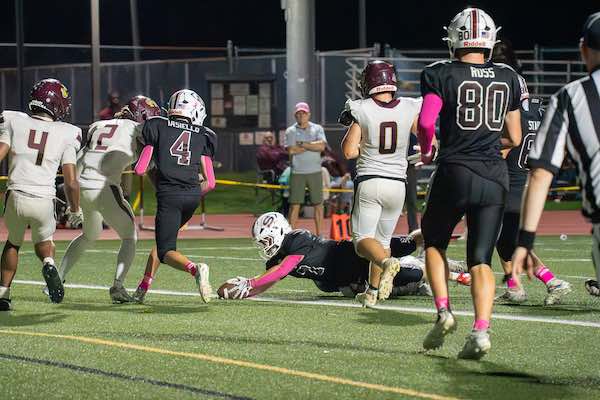 Lucus Handwerger Diving in for a Touchdown.The Scarsdale Raiders Football team had a 2-1 record going into Friday’s Homecoming game vs Arlington. Scarsdale took the 22-13 win over the Arlington Admirals improving to 3-1.
The first quarter was not very eventful, with Scarsdale getting the ball first, and getting down all the way to the 20 yard line, but unable to get a touchdown. Arlington was also unable to score a touchdown on their first drive. Contrary to the first, the second quarter was more exciting. Halfway through the quarter, Lucas Hanwerger picked off a pass and ran it to the 50 yard line. Unfortunately, on the next play, Scarsdale fumbled the ball on the snap, and turned the ball over. After a few drives, Patrick Simon was able to also get an interception, and he ran it back to midfield. This interception led to Shane Kelly getting a 15 yard running touchdown with 5:39 left in the half. Scarsdale was unable to get the extra point, but the Raiders entered the half up 6-0.
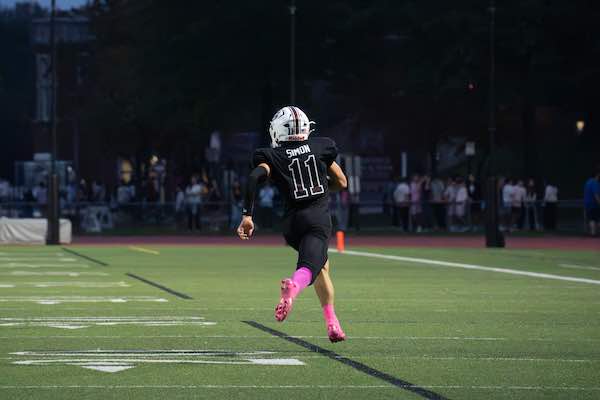 Patrick Simon Running the Ball Down the Field.The third quarter started out with quarterback Patrick Simon throwing some good passes, but ultimately not enough for a touchdown. Toward the end of the third quarter Arlington was able to score a touchdown, and the extra point, putting them up by 1. The score was now 7-6, with 3:21 left in the quarter, and Arlington in the lead. After the touchdown, Simon threw a long pass down to Hunter Ross, who ran it to the 35 yard line. Scarsdale advanced to the 23 yard line on 4th down with 30 seconds left in the quarter. Scarsdale, while trying to go for a touchdown for the lead, fumbled it. The Raiders recovered it, but did not get a first down so it was Admirals possession for the start of the 4th quarter. Arlington had possession near their own endzone on a fourth down at the start of the 4th quarter. They went for a pass on fourth down, but they snapped it over their quarterback’s head and into their own endzone, giving the Raiders a safety. This safety put Scarsdale in the lead, with a score of 8-7, with 10:33 left in the game. When the Raiders received the ball, with the help of the offensive line blocking the defense, Simon got a 12 yard run, putting them on the 23 yard line. A few downs later, Simon got another run, putting them on the 3 yard line. This set the Raiders up for a touchdown, scored by Handwerger. Scarsdale scored the extra point and were now up 15-7 with 6 minutes left in the game. Arlington had a good drive, giving them a touchdown with 1:39 left. They went for the two point conversion to tie the game, but with good defense, Ross blocked the throw, keeping Scarsdale up by 2. Arlington tried an onside kick, but it did not go well for them, as Jordan Jahrmarkt picked the ball up and ran it all the way down for a touchdown. Scarsdale scored the extra point, which made the score 22-13, finishing the game with a big Homecoming win.
Photos and game recap by Jeremy Gorrin.
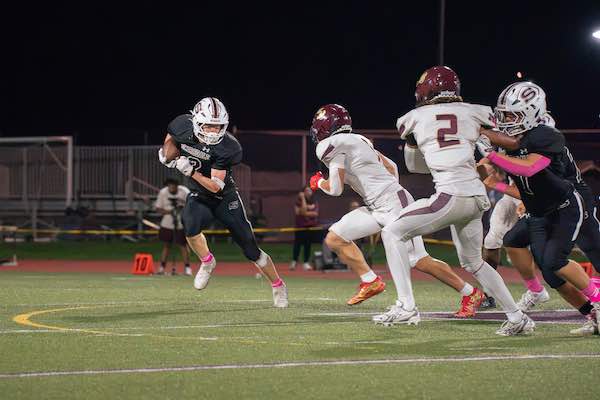 Shane Kelly Driving to Get Past Defenders.
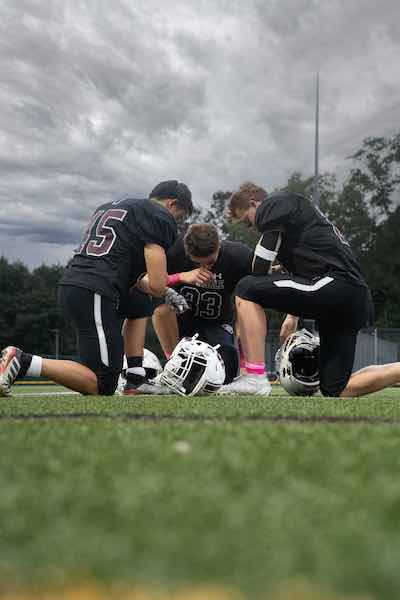 Scarsdale Players Huddled Before Game.
Scarsdale Varsity Football Team Opens Season 2-1 After Loss to Mamaroneck
- Details
- Written by: Bill Doescher
- Hits: 811
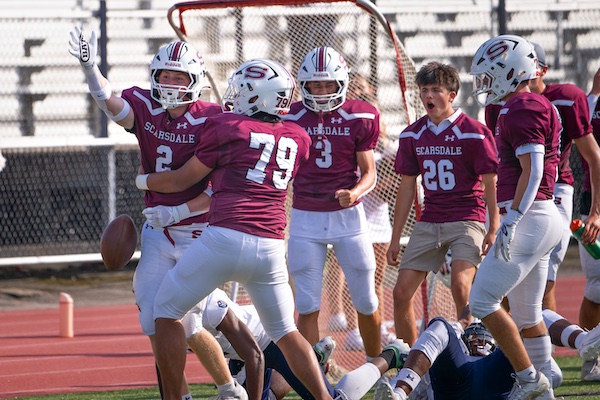 The Scarsdale Raiders varsity football team opened the 2026 season with two impressive home victories before suffering its first loss Friday night, September 25, in an away game against Mamaroneck High School. The Raiders are now 2-1 on the season.
The first two games showcased a potent offensive combination in senior quarterback Patrick Simon and junior halfback Shane Kelly. The two speedsters have provided the Raiders with a formidable one-two punch in the backfield, repeatedly finding holes and breaking away from opposing defenses.
Scarsdale opened the season on Thursday, September 10, with a 40-14 victory over Yonkers Guardian at Butler Field. The Raiders followed that with a 42-13 win over John Jay on Friday, September 18, also under the lights at Butler Field.
Simon and Kelly Lead the Raiders' Offense
Simon and Kelly were at the center of Scarsdale's offensive success in the first two games.
Simon ran for three touchdowns in the season opener. Against John Jay, he added another rushing touchdown, bringing his total to four for the season after two games. He also threw two touchdown passes in the John Jay game — a 60-yard pass to wide receiver Luke Iasiello and an 18-yard pass to tight end Hunter Ross.
Kelly matched Simon's three-touchdown performance in the second game and had an extraordinary night against John Jay. On just eight carries, he rushed for 226 yards and three touchdowns, including a 69-yard touchdown run.
Simon carried the ball 13 times for 59 yards and a touchdown, with his longest run covering 31 yards. He also completed two of seven passes for 78 yards and two touchdowns, including the 60-yard scoring pass to Iasiello.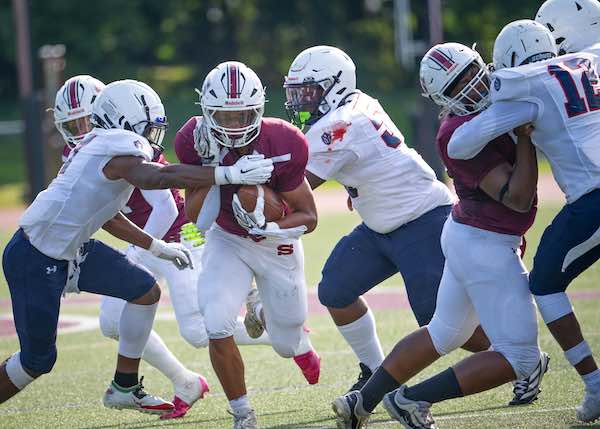
Simon is one of four team captains, along with fellow seniors Lucas Handwerger, Lars Burrows and Winston Schwartz.
While the Raiders' offensive success clearly centered on Simon and Kelly, the team's offensive and defensive lines also deserve credit. The lines consistently gave Scarsdale's backs room to run while keeping opposing offenses in check.
A First for the Senior Class
The victory over John Jay also marked a memorable milestone for Scarsdale's seniors: it was the first time any of the current senior football players had defeated a John Jay football team.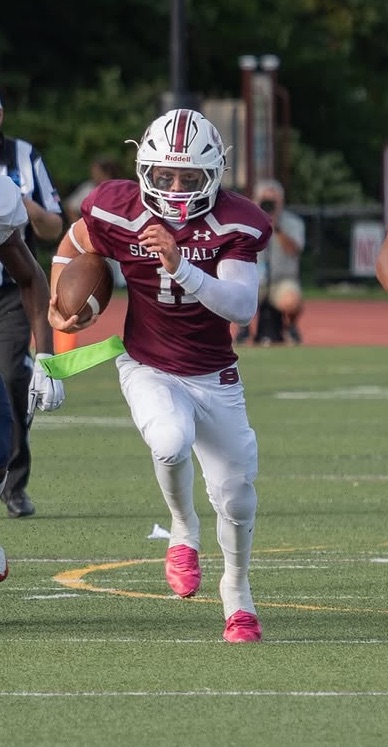
During timeouts and halftime, the Scarsdale crowd was energized by 10 SHS student cheerleaders dressed in white, who incorporated gymnastics into their routines. A Scarsdale student pep band also performed at a football game for the first time this season. The band was led by Brian Zeller.
The Raiders' speedy backfield duo repeatedly carried the ball downfield, with Simon and Kelly using their quick, track-team-like feet to evade defenders and find the end zone. It may be difficult to determine which is faster, but both have proven difficult for opposing defenses to catch.
Coach-to-Quarterback Communication
Another notable feature of the Raiders' first two games was the communication between Simon and head coach Andy Verboys, who is in his 20th year as Scarsdale's varsity football coach.
Before virtually every offensive play, Simon and Verboys communicated about the play call before the ball was snapped. The coach-to-quarterback communication appeared to serve the Raiders well during their first two victories.
After the season opener, Verboys praised Burrows, Handwerger and Kelly for their performances.
Following the John Jay victory, the coach again praised Simon and Kelly, while emphasizing the contributions of the entire team. Among the other players he singled out were Lucas Kowalski, Noah Dembitzer and Gavin Costello.
All 42 players on the roster saw action during the first two games.
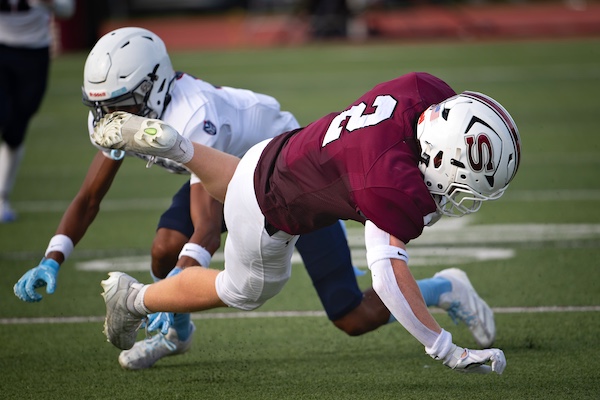
Raiders Fall to Mamaroneck
The Raiders' winning streak came to an end Friday, September 25, when Scarsdale traveled to Mamaroneck High School.
On a cold and windy night ahead of the nor'easter, the two teams battled to a 14-14 tie until late in the fourth quarter. With 4:48 remaining, Mamaroneck connected on a long pass for the go-ahead touchdown and held on for a 21-14 victory.
The loss leaves Scarsdale with a 2-1 record as the Raiders continue their 2026 season.
Photos by Dave Taber. See more and buy yours here.
Mamaroneck Game Recap:
It was cold and windy outside last Friday evening, Sept. 25, before the Nor’easter in Westchester County. Nonetheless, the Mamaroneck home-team fans still remained calm and enthusiastic and somewhat loud, throughout the game. They were led in the cheering for the home team by the public-address announcer and what seemed like more than the normal number of Tigers’ Cheerleaders.
Even some of the Tigers’ alumni, while supervising their little children, wanted no more than a quiet child or two and a smooth Mamaroneck victory for a team that seemed heavier and taller than its counterparts from Scarsdale from the moment they ran onto the field to do some calisthenics and overall warm-ups prior to the kickoff.
They seemingly got both rewards towards the end of the game when the Tigers scored on a late 24-yard, game winning pass play into the end zone from the Tigers’ James Fitzgerald to Sam Mehler with only 4:58 minutes left on the big clock in the back of the end zone. Mehler also kicked the PAT and the score was 21-14, Mamaroneck.
After that, nothing exciting seem to happen on both sides of the ball. Time ran out, and the game was over.
Scarsdale Scored First
There was hope from the very beginning for the Raiders, however, when Scarsdale scored first and the score was 7-0, Scarsdale on a 3-yard run by Scarsdale Junior Halfback Shane Kelly. Senior Eduardo Lima kicked the extra point.
After that, Mamaroneck’s James Fitzgereld’s ran successfully for 7-yards to tie the score at 7-all. After Patrick Simon’s 24 yard pass to Kelly and Lima’s PAT kick the score was 14-7, with Scarsdale in the lead. A long pass of 62 yards from Fitgerald to Mehler and Mehler’s PAT kick and the Tigers and Scarsdale were tied at 14-14 at halftime.
No scoring took place by either side in the third quarter.
Mamaroneck then seemed to wait until not much time was left on the clock, 4:58 minutes to be exact, to make the winning touchdown play. Fitzgerald tossed the spiral to Mehler for the victory. But did he? To some it seemed Mehler may have dropped the ball before he hit the ground. The Referee let the play and the touchdown stand.
Stand-outs for Scarsdale on defense in the game, included Luke Iasiello, Noah Dembitzer, Lucas Kowalski and Lars Burrow.
The Raiders will now face Arlington on Friday, Oct 2, at home at Butler Field in Scarsdale starting at 6pm with a two-wins and one-loss record. It could very well be another toss-up battle on who wins even though the future game is on the Raiders’ home Butler Field under the lights in Scarsdale.
Arlington at home defeated visiting Mamaroneck, 34-7, in an earlier game this season.
Go Raiders.
Please Respect Crane Berkley Ponds
- Details
- Written by: Joanne Wallenstein
- Hits: 862
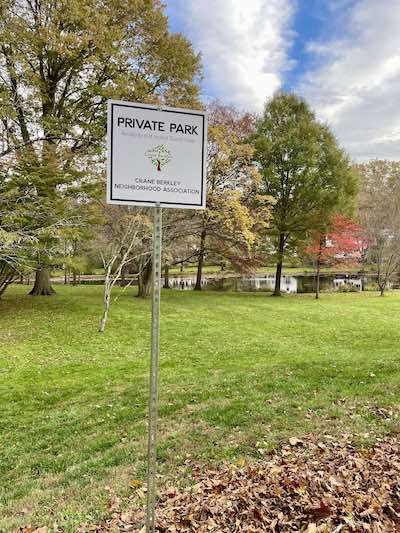 The following letter was written by Christine Weston, President, Crane Berkley Association
To the Editor:
The Crane Berkley ponds have long been a beautiful part of our neighborhood, enjoyed not only by the families who live around them, but also by members of the broader Scarsdale community who walk through, enjoy the wildlife, and occasionally fish. We are happy to see people appreciate this special place, and we want our neighbors to continue to feel welcome—as long as the property and its wildlife are treated with care.
Recently, however, we discovered an unexpected challenge: one of our ponds is listed on the Fishbrain fishing app under the incorrect name “Zynabon Lake.”
The listing doesn't simply identify the pond on a map. It presents it as a fishing destination, with hundreds of logged catches, ratings and information about fishing there. We believe this may be contributing to an increase in young people coming to the pond specifically to fish, many of whom may have no idea that they are entering privately owned and maintained property or that there are rules intended to protect the pond.
The Crane Berkley ponds and surrounding parkland are private property, owned and maintained by our neighborhood association. Our residents fund their upkeep and work hard to preserve what is a surprisingly rich little ecosystem in the middle of Scarsdale.
Our concern isn't about keeping respectful neighbors away. It's about making sure everyone who enjoys the ponds understands that they need to be treated with care.
Unfortunately, we've recently seen some troubling behavior. A neighbor reported witnessing kids taking live fish and using them as bait to catch other fish. Fishing line and hooks have been left behind around the pond. Most upsetting, discarded fishing line resulted in the death of one of our snapping turtles.
Those incidents are why we are asking for the community's help.
Fishing at the ponds is catch-and-release only. Nets should not be used, and fishing line, hooks and other materials need to leave with you. Please don't disturb or remove the wildlife, and please leave the park exactly as you found it.
We've contacted Fishbrain and asked them to correct the listing so that users understand that this is private community property and not an unrestricted public fishing location. We have also shared documentation confirming the private status of the ponds.
But an app can only do so much. Parents can help by talking with their kids about responsible fishing and reminding them that finding a fishing spot online doesn't necessarily tell you who owns it or what rules apply there.
And to our neighbors throughout Scarsdale: we hope you'll continue to enjoy this beautiful corner of our community. If you come by, please respect the property, the people who maintain it, and especially the animals that call it home.
If you see something concerning—wildlife being mistreated, fishing line or hooks being left behind, nets being used, or damage to the park—please let us know so that we can address it.
We don't want to put up barriers between our neighborhood and the larger Scarsdale community. We simply want to make sure that sharing this special place doesn't come at the expense of the place itself.
Christine Weston
President, Crane Berkley Association
- Neighbors Ask Trustees to Address Neglect of Historic Woods Lane Home
- Architectural Historian Recommends Preservation of 26 Circle Road, Saying, "Don't Throw Out the Baby with the Bathwater"
- Despite Inventory Shortage, Homes Continue to be Razed in Scarsdale
- Letter to the Editor In Support of Code Changes Regarding Wetlands, Watercourses and Buffers