










Your Letters: In Support of the SBNC Slate
- Details
- Written by: Joanne Wallenstein
- Hits: 3167
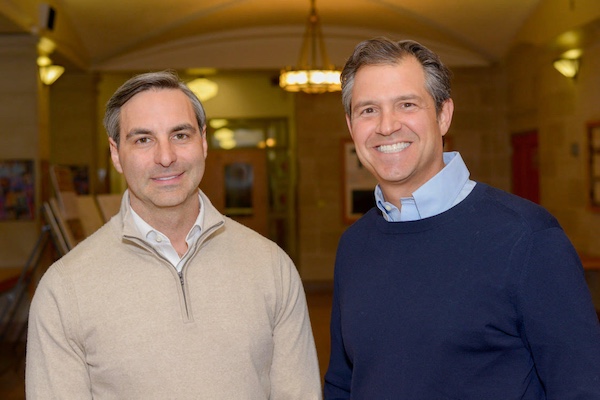 Here are letters in support of Omer Wiczyk and Kevin Ziegler for Scarsdale School Board. The election is on May 19, 2026.
(From the SBNC Chair and Vice Chair)
School Board Nominating Committee (SBNC) plays an integral role in shaping the excellence of the Scarsdale Schools
As current leadership Chairpeople of the Scarsdale School Board Nominating Committee (SBNC), we wanted to express to the community the true mandate and value that SBNC brings to Scarsdale with its non-partisan approach to candidate selection for the Board of Education trustees (BOE).
As a group totaling 30 individuals elected from all 5 neighborhoods serving staggered 3-year terms, the SBNC plays an integral role in shaping the excellence of Scarsdale schools through recruiting, vetting, and selecting the most qualified nominees for the BOE from amongst a pool of candidates self-selecting to choose to come before this committee. This includes a rigorous process that starts with an open call to the public encouraging all eligible community members to consider applying to the SBNC for consideration. Candidates then present to the SBNC, expressing their motivations, relevant experience, background, and skills through a three-part method of presentation, differentiated questions unique to each candidate, and finally any additional follow up clarification questions. The SBNC carefully vets all candidates in confidential, respectful, and thorough deliberations. The committee conducts thorough interviews with multiple references for each candidate by committee members in pairs, ensuring parity, accuracy, and confidentiality in this due diligence. By offering candidates a confidential evaluative forum, the non-partisan system can foster greater participation. Each candidate knows that their full application is given consideration. Decisions made to suggest slated names for a limited number of open seats is one of the most challenging aspects for SBNC members, but ultimately, as per the SBNC Resolution, the slate can only put forth to the Scarsdale Community the exact number of candidates as there are BOE seats open for election. This means that in any given year, there can be strong candidates that do not get chosen because SBNC has determined that different candidates make the most sense with the composition of the current BOE.
Below are characteristics that the New York State School Boards Association provides as guidance for evaluating effective board members:
Effective Communicator: Can describe what he or she wants and describe what others want; a good listener
Consensus Builder: Capable of working toward decisions that all can support and willing to compromise to achieve goals
Community Participant: Enjoys meeting a variety of people, can identify the community’s key communicators and reaches out to the community
Decision Maker: Is comfortable making decisions and can support group decision-making
Information Processor: Can organize priorities and schedules to handle large amounts of verbal and written information
Leader: Willing to take risks, be supportive of board colleagues, district staff and community
Team Player: Helps promote the board’s vision and goals
Noticeably missing from this criteria framework is a background based on certain professions or prerequisites around prior experience with and active engagement in the School District. In fact, limiting the pool of candidates to only those that fit this specific background prioritization would significantly hinder the robust composition of the Scarsdale School Board which is meant to be a balanced collaboration of trustees representing many stakeholders in the entirety of the Scarsdale Village.
SBNC has always highly prioritized PTA/PTC experience on our BOE trustees, as demonstrated by its nominations of Suzie Hahn and Colleen Brown in 2022 and again in 2025, Leah Dembitzer in 2024, and Laura Liu in 2025. With Amber Yusuf ending her 6th year as BOE member, this perspective has clearly been and will be well represented on our Scarsdale Board of Education for many years and will be for many more into the future. This is not, however, the only priority.
As SBNC deliberations are confidential, neither the discussions nor the reasons for the decisions are made public. However, year after year this staggered-term committee with new members each session represents a range of views to enhance discussion of and deliberation about the merits of each candidate, both as an individual and as a potential member joining an existing body of trustees already serving on the BOE. Beyond first-hand experience hearing from the candidates, SBNC members also speak to others in the community to learn about the nominees and identify candidates that are the best fit for the board in a given year. This additional level of due diligence is often absent from election campaigns. This provides critical, confidential insight into candidates from people who know and have worked with the candidates. The Scarsdale community should have confidence that the two candidates SBNC selected to run for the BOE will represent all constituents and uphold the responsibility of being stewards of the excellence of the Scarsdale Schools.
We encourage you to learn more about all the candidates and think about the current composition of the BOE and vote on Tuesday, May 19th at Scarsdale Middle School between 7am – 9pm.
Jenny Simon Tabak and Jennifer Zola
26 Myrtledale Road and 12 Carstensen Road
SBNC 2025-26 Chair and Vice Chair
(From Amanda Zaitchik)
As a longtime member of the Fox Meadow community, I have had the opportunity to volunteer across all three levels of our school system. I’ve served multiple terms on the executive boards of the Fox Meadow PTA and Scarsdale Middle School, and I currently assist with hospitality at Scarsdale High School. In these roles, I work closely with educators, administrators, and parents who care deeply about our schools and our community.
This year, Fox Meadow elected me to serve on the School Board Nominating Committee. I took that responsibility seriously. What stood out most throughout the process was the thoughtfulness and diligence of the committee itself. Thirty residents from across the community, most of whom had not previously met, came together with one shared goal: identifying the strongest possible candidates to serve our schools.
The process was extensive and thorough. Candidates participated in multiple rounds of interviews and questioning. References were carefully reviewed, including both those provided by candidates and others identified independently to ensure a broad range of perspectives. Each individual was evaluated using the New York State School Boards Association’s identified characteristics of effective board members, while also considering the current composition and needs of the Board of Education. It was deliberate and, at times, challenging work.
At the conclusion of that process, the committee reached a clear and confident decision to nominate Kevin Ziegler and Omer Wiczyk.
Kevin and Omer each bring distinct personal and professional experiences that complement the current Board. They are active listeners who ask thoughtful questions, value academic achievement, and work collaboratively across differing viewpoints. They are engaged, measured, and committed to serving the district in a thoughtful and constructive way. Based on my direct participation in the SBNC process, I strongly support their election as Trustees to the Board of Education.
For decades, Scarsdale has entrusted community volunteers through the SBNC process with the responsibility of carefully vetting and selecting candidates for the Board of Education. While no process is perfect, this nonpartisan system has served our district well by prioritizing thoughtful evaluation over campaigning and helping to minimize the division, expense, and politics that can distract from the real work of supporting our schools while strengthening our community.
I encourage residents to support that process and to vote for Kevin Ziegler and Omer Wiczyk on May 19.
Sincerely,
Amanda Zaitchik
Fox Meadow Resident and SBNC Member
(From Jennifer Kahan)
Dear Neighbor,
I write to enthusiastically endorse the School Board Nominating Committee (SBNC) selected candidates, Kevin Ziegler and Omer Wiczyk and I encourage you to vote for them on Tuesday, May 19 at SMS from 7am-9 pm. I urge you to take this election seriously.
The SBNC is a community-elected, nonpartisan, 30-person Committee representing each of our five elementary school neighborhoods, that has an important and respected 96-year-old history in Scarsdale. I currently have the honor to serve on this committee.
Scarsdale voters have a history of supporting SBNC’s nominated Board of Education candidates because this system prioritizes qualifications, temperament, and a commitment to community over politics or popularity.
When I joined the SBNC this year, I took on my role with integrity and focus. The SBNC utilizes guidelines recommended by the NYS School Boards Association (NYSSBA) in assessing candidates, as well as reviewing the current composition of the Scarsdale BOE. The SBNC undertakes a detailed and thorough vetting process of all candidates who run before our committee, and partake in extensive due diligence interviews with references as well as listen to candidate presentations and their answering of questions.
A review of our current Board indicated a need for greater diversity of professional and civic skill sets, and community representation. A vote for Kevin and Omer collectively ensures that the Board will be gaining two Scarsdale parents with combined civic and professional expertise in the fields of law, finance, corporate executive leadership, public relations, civil rights, athletics, communications, negotiations and grant allocation. These are vital gains for our Board, especially now.
Kevin holds an MBA and as a Corporate Executive, currently oversees a global team across multiple offices and is accountable for high-stakes negotiations with substantial value. Prior to this, Kevin worked for a decade in public relations, including in roles in media and crisis management. Kevin also has extensive civic board experience. He served for five years on an appointed committee for the allocation of millions of dollars annually of federal grant dollars to a combination of community agencies and infrastructure priorities.
Omer has practiced law dedicated to the public sector for the past 20 years as a prosecutor in New York City and now at the Brandeis Law Center, which focuses on education and civil rights. Omer has been active in the community, serving as Chair of the Citizens’ Nominating Committee and as President of the Scarsdale Forum. Much of his work has been in group settings—bringing people together, hearing different perspectives, and building consensus. He would be the only attorney on the board once Jim Dugan’s term expires next year.
Given Kevin and Omer’s credentials and the extensive SBNC vetting and nomination process they both went through, I strongly endorse their candidacy and hope that you will join me in voting for them.
Jennifer Kahan
54 Butler Road
(From Toby Milstein-Schulman)
To the Editor,
Scarsdale’s civic tradition has long emphasized thoughtful, nonpartisan leadership grounded in judgment, public service, and a commitment to the broader good. The School Board Nominating Committee process is not incidental to that tradition—it is central to preserving it. For more than half a century, since its governing structure was first established in 1965, the SBNC has provided a deliberate, community-driven process to identify and vet Board of Education candidates based on their qualifications, judgement and readiness to serve the entire community.
That standard matters. The SBNC’s role is not simply to fill seats, but to evaluate who has the judgment, temperament, and wide-ranging experience to govern well on behalf of the entire district. The Committee’s own process asks candidates to demonstrate not only why they seek to serve but also what qualities, civic experience, and past judgment prepare them to contribute effectively to the work of the Board.
The SBNC is not a closed body appointing its successors. It is a representative committee elected by all of us Scarsdale residents, with members chosen by voters from each elementary school district. Those members are our neighbors, selected by the community to do the hard work most voters cannot realistically do alone: recruit broadly, interview meticulously, deliberate extensively, and seriously assess which candidates have what it takes to represent us on the Board of Education.
And importantly, the SBNC does not decide the election. It recommends a slate. Voters still decide whether those candidates earn their support.
What the SBNC provides is the benefit of a serious, structured, community-based vetting process before that vote is cast. It is one of the few remaining civic mechanisms designed not simply to reward visibility or past volunteerism, but to assess who is best prepared to govern this particular board at this particular moment.
Kevin Ziegler and Omer Wiczyk emerged from a thorough vetting process as candidates with complementary backgrounds, deep commitment and experience with Scarsdale schools, and the ability to work collaboratively with fellow Board members and district administration in service of students and families. They also bring the qualities the SBNC process is meant to surface. They understand that effective school board leadership requires listening before reacting, balancing competing priorities, and making decisions not for applause or ideology, but for the long-term health of the district and the continued excellence of Scarsdale’s schools.
On a personal level, I have seen both Kevin and Omer as kind, thoughtful, and deeply considerate parents, as well as generous volunteers in the life of this community. Those qualities matter not because they are valid personal virtues alone, but because they reinforce the judgment, character, and sense of responsibility that public service demands.
This election is an opportunity to affirm two exceptional candidates based on their valuable experience and strong character, and at the same time, the enduring civic process that produced them. I am voting the SBNC slate because it produced two candidates that only strengthen my trust in the process Scarsdale has built—and sustained—for decades.
This is why I am voting for Kevin Ziegler and Omer Wiczyk on May 19th at Scarsdale Middle School.
Toby Milstein-Schulman
(From Rupa and Viral Juthani)
To the Editor:
We are Fox Meadow parents writing in strong support of Kevin Ziegler and Omer Wiczyk for the Scarsdale Board of Education.
As Fox Meadow parents, we know Kevin personally through our children and school activities. He is approachable, collaborative, and deeply engaged. He listens carefully, asks thoughtful questions, and is consistently present. His desire to serve is rooted in a sincere commitment to strengthening the educational experience for all students.
We have also been impressed by Omer’s calm, measured approach and his clear appreciation of the responsibilities of public service. He brings intelligence, integrity, and a collaborative mindset to every conversation.
Over the course of this campaign, we have followed both candidates closely. We watched the League of Women Voters forum, attended community events, and have seen Kevin and Omer engaging thoughtfully and respectfully with residents throughout Scarsdale. What stands out most is their genuine commitment to our schools, our children, and our community.
We respect both the process and judgment of the 30 community members who serve on the Scarsdale Board Nominating Committee. It is clear that this year’s thoughtful and thorough process yielded two outstanding candidates whose professional experiences and perspectives complement one another in meaningful ways. Kevin brings significant business and financial experience, along with a practical and strategic approach to problem-solving. Omer contributes deep legal expertise and a strong understanding of governance and policy. Together, they offer skills that will be highly valuable as the district navigates increasingly complex educational and financial challenges.
Kevin and Omer are prepared, thoughtful, and committed to preserving the excellence of Scarsdale schools. We encourage our neighbors to support them for the Scarsdale Board of Education.
Sincerely,
Drs. Rupa and Viral Juthani
29 Church Lane
(From Allison Zolot)
To the Editor:
I am writing in support of Omer Wiczyk and Kevin Ziegler for the Scarsdale Board of Education.
I have had the opportunity to work with Omer through the Scarsdale Forum and the Citizens Nominating Committee. In both settings, I have seen his strong judgment, professionalism, and deep respect for civic responsibility. Omer approaches complex issues carefully and thoughtfully, and he understands the importance of balancing differing viewpoints while keeping the broader interests of the community in focus.
As a participant in the Citizens Nominating Committee process, which vets candidates for Village Board positions through Scarsdale’s long standing nonpartisan system, I also strongly value and support the similar process used by the School Board Nominating Committee. These systems depend on thoughtful community participation and careful evaluation of candidates, and I believe that process worked well in identifying strong candidates this year.
As a Fox Meadow parent and Kevin’s neighbor, I have also seen firsthand the kind of person he is and how he engages with the community. Kevin is thoughtful, practical, and genuinely invested in Scarsdale schools. He listens carefully, values different perspectives, and approaches issues with a steady and collaborative mindset. In addition to being deeply engaged in the community, Kevin brings significant business experience through his work at a global company and his MBA background — exactly the kind of practical financial and strategic perspective that is valuable for the district at this time.
Omer and Kevin bring complementary professional experience, sound judgment, and a collaborative approach that will benefit the district as it navigates increasingly complex educational and financial challenges. I encourage residents to support them for the Scarsdale Board of Education by voting on May 19 at Scarsdale Middle School.
Allison Zolot
17 Circle Rd
Scarsdale NY 10583
(From Jon Lemle)
In Strong Support of the Non-Partisan System – Omer Wiczyk and Kevin Ziegler
Letter to the Editor:
I hope the community will join me in voting for Omer Wiczyk and Kevin Ziegler for the Board of Education. They received the nomination from the non-partisan School Board Nominating Committee, and their experience encompasses the attributes necessary to be an effective board member from the start. Included in everything the board undertakes is the need to be an effective communicator, consensus builder, decision maker and information processor.
My family moved to Scarsdale when I was 4 years old, I went on to attend Fox Meadow, graduating from SHS in 1997. My two siblings and I loved growing up here and benefiting from the education that we received. I proudly moved back with my wife, to raise our three daughters. My parents (who still live here) were consummate civic volunteers and instilled in me the value of the non-partisan system.
This system has served our community well for decades. In an unfortunate era of increasing hyper-partisanship, our system is an asset to our community, as it provides the space to assess and nominate candidates based on their qualifications/experience and not based on some rigid one size fits all criteria. Further it obviates the need to pander to certain constituencies, or pledge fealty to rigid ideology. The system fosters social cohesion amongst our community, by removing politics from our most sacred public institution, our schools. The confidentiality, that is the bedrock of the nominating process, allows for prospective candidates to experience a dignified vetting process. It is almost certain that every year not every member of the School Board Nominating Committee had their candidate(s) of choice nominated, but what is certain is that a democratic process, without the interference of partisanship, is serving our community well.
This year there is a contested election, and while this is a sanctioned part of the non-partisan system, we can feel confident that Omer and Kevin are the right fit for Scarsdale right now.
Having spent over two decades as a prosecutor in New York City, Omer handled complicated investigations, in a pressure filled environment, where he excelled at synthesizing large amounts of complex information and effectively building consensus with his own colleagues and juries of community members he didn’t know, in both written and verbal mediums. Omer’s current role is as an attorney and leader in a non-profit focused on advancing civil and human rights. These skills will provide a unique and needed complement to the existing board. Omer has utilized these skills to gain insight in the Scarsdale community in civic roles as the president of the Scarsdale Forum and Citizens Nominating Committee.
As an executive in a multi-national corporation with over 200,000 employees, Kevin oversees a global team where he leads strategic planning, budget formulation, talent management, and contract negotiations. His success is in large part the ability to build consensus across a global platform, by being an effective communicator and leader, by bringing together a large culturally diverse team in a shared vision to achieve the goals of the organization. A decade of professional public relations and communications experience will benefit the board in sharing their vision and work with the Scarsdale community. Prior civic experience allocating and overseeing a multimillion-dollar budget will be well utilized along with his professional budgeting experience in enabling our schools to maximize how its funds are spent.
With children younger than many of the current board members, they will be able to offer additional firsthand perspective as decisions are made on the board. Omer will have children in middle and high school, while Kevin will have two children in elementary school with a third that will join them before his board term is complete.
A community’s cultural and intellectual diversity makes it stronger, by bringing unique and varying perspectives. Kevin and Omer will complement the existing board by bringing their unique expertise.
Their opponent in this campaign publicly acknowledged that she submitted for nomination to the SBNC but was not selected. A confidential process, she posited that the only possible explanation for her not being nominated is that the process is somehow broken. Maybe it was as simple as the committee thought that Omer and Kevin could better serve the community right now. Or that the committee quietly and without public embarrassment. found problematic aspects to her experience and temperament. To impugn a time-honored process and the elected volunteers that serve it is divisive and unbecoming of someone who wants to represent our community and children.
I urge everyone in support of the non-partisan system and the quality of our children’s education to vote for Kevin and Omer on Tuesday May 19, at Scarsdale Middle School from 7am - 9pm.
Jon Lemle
Kent Road
(From Carmen Facciolo)
In Support of Omer Wiczyk and Kevin Ziegler for the Scarsdale Board of Education
I am writing to enthusiastically support Omer Wiczyk and Kevin Ziegler for the Scarsdale Board of Education.
I know Omer personally and professionally. We worked together at the Bronx District Attorney's Office, where he was one of the most honest and hardworking people I have ever encountered. He never shied away from the hardest cases, and he never wavered from doing what was right—even when it wasn't easy. He acted with class, integrity, and respect. That's who Omer is when no one is watching.
Over the years, we became close friends. What strikes me most is how deeply he cares—about his family, his community, and the people around him. He is always there, no matter the day or the time. That kind of person is rare and the one you want overseeing your child's schools.
I say this with some perspective. Over my career, I have counseled politicians, advised elected officials, coordinated domestic policy portfolios including education, and helped run campaigns at the local, state, and federal levels — including two presidential campaigns. I know what leadership looks like and what character looks like. Omer has both. From the moment I met him, I thought he should run for office. He always told me the same thing: he cared about public service, not politics. That answer says everything. After 20 years of public service as a prosecutor, Omer could have walked out the door and taken a corporate law job making millions, instead, he went to work in the non-profit space to protect democracy and civil rights. That is not a résumé decision. That is a values decision.
Kevin Ziegler brings a different but equally valuable set of skills. With an MBA from Northwestern's Kellogg School of Management and a background in journalism, he has built a career at the intersection of strategy, communications, and global partnership—most recently as VP and Global Head of Distribution at Hyatt, and before that in senior roles at Marriott International. He knows how large, complex organizations work, how to communicate clearly, and how to build consensus across competing interests. Those are exactly the skills a school board needs. And from what I understand, the moment Kevin moved to Scarsdale, he dove headfirst into the community. That instinct—to show up and get involved—matters.
As a former Scarsdale resident—my wife and I only moved back to Washington, DC for work—I still care deeply about this community. I would encourage every Scarsdale voter to support Omer Wiczyk and Kevin Ziegler for the Board of Education on Tuesday, May 19.
Carmen Facciolo
Washington, DC
Letters in Support of Wiczyk and Ziegler for Scarsdale School Board
- Details
- Written by: Joanne Wallenstein
- Hits: 1740
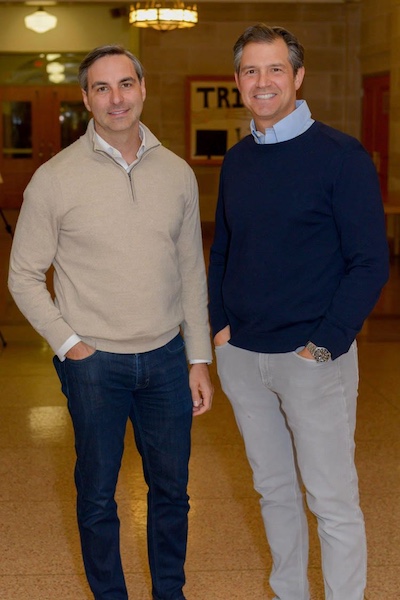 The following letters in support to Omer Wiczyk and Kevin Ziegler for Scarsdale School Board were sent from Nkita Singhal, Jon Mark and BK Munguia, Jill Spielberg, Joanne Wright and Dan Amato and Mike and Rebecca Berry.
(From Nikita Singhal)
I am pleased to offer my wholehearted support for Kevin Ziegler’s candidacy for our school board.
As Kevin’s immediate neighbor, I can attest to his character in a way that goes well beyond a resume. He and his family are genuinely good neighbors - present, warm, and invested in the people around them. What has impressed me most is the quality of the conversations we’ve had about our schools. Kevin doesn’t just have opinions. He has a genuine ability to advocate for what makes sense while remaining open to reconsidering his assumptions when presented with new perspectives. We’ve had substantive discussions about school curriculum and the real challenges families navigate across different grade levels, and each time, I’ve walked away with the sense that he had actually listened, and that it registered.
With three kids spanning different ages and stages in our schools, he has direct, lived experience with the issues that matter to families and his commitment to this community goes beyond his own household. He believes in civic engagement as a real responsibility, and that comes through in how he shows up.
Our school board would be well served by someone with Kevin’s thoughtfulness, humility, and genuine investment in our community. We support him as a family, without reservation.
Warm regards,
Nikita Singhal
26 Fenimore Road
(From Jon Mark and BK Munguia)
To the Editor:
We are pleased to support Omer Wiczyk and Kevin Ziegler, the School Board Nominating Committee slate for the Scarsdale Board of Education.
We have had the opportunity to work with Omer over many years through the Scarsdale Forum and the Citizens Nominating Committee. In his role as President of the Forum, and in his service on the CNC and other civic bodies, Omer has demonstrated a rare ability to bring people together, especially in moments when opinions differ and the stakes are high. He approaches issues with intellectual rigor, careful listening, and a genuine respect for differing viewpoints—qualities that are essential for effective school board leadership.
What stands out most about Omer is not just his thoughtfulness, but his effectiveness. He does not allow important issues to stall in discussion. Instead, he works to move conversations toward clear, practical outcomes. He has a steady temperament, a strong analytical mind, and the skills to build consensus and help a group move forward. In our experience, people trust Omer because he is fair, even-handed and focused on what is best for the community as a whole.
Omer’s nomination by the School Board Nominating Committee reflects the strength of Scarsdale’s non-partisan process. The SBNC conducts a thorough and thoughtful vetting of candidates, selecting individuals based on their qualifications, experience and commitment to public service. Omer’s record of civic involvement and leadership makes him exceptionally well-suited to serve in this role.
We also met with Kevin Ziegler and support his candidacy He impressed us with his professional background and training. As the father of two children attending Fox Meadow, he displayed a depth of knowledge of our schools, issues they are grappling with and underscored his commitment to devote the time needed to make a meaningful contribution to the Board.
In our view, Omer and Kevin represent a balanced and capable slate, prepared to work collaboratively with each other, with the Board, and with the broader community to support Scarsdale’s schools. We therefore encourage Scarsdale voters to vote for Omer Wiczyk and Kevin Ziegler on May 19 and to support the non-partisan system that has served Scarsdale so well over many decades.
BK Munguia
Jon Mark
(From Jill Spielberg)
Leadership matters. The Scarsdale School District and its community stand at a pivotal moment—one that will shape outcomes in lasting ways, and one we cannot afford to get wrong. Omer Wiczyk and Kevin Ziegler are the right choice for the Board of Education.
Every decision the Board of Education makes affects students in a real way - their academics, their mental health, and their overall experience in our schools. Right now, we need leadership that is clear, responsive, and willing to take responsibility. In my view, Omer stands out as exactly that kind of leader.
I write this letter not as empty praise, but from experience. I write as someone who values the future of Scarsdale and as someone who has volunteered in our community in an effort to chart a better course for Scarsdale. In my capacity as a volunteer, I have worked with Omer. I served as his Vice President when he was President of the Forum, and I also served on the Citizens Nominating Committee while he was Chair. In both settings, I saw how he operates as a leader. I experienced firsthand how Omer balances open dialogue with decisive action and how he creates space for input while ensuring that discussions lead somewhere - consistently turning ideas into results.
What sets Omer apart is his approach to leadership. He brings composure, discipline, and focus to complex issues, taking the time to fully understand situations rather than reacting to noise or distraction. When he acts, it is deliberate and purposeful.
Just as important is his ability to listen. In a community where opinions are often strong and divided, Omer engages with different perspectives openly and respectfully. He asks thoughtful questions, challenges ideas constructively, and ensures that everyone’s perspective is heard - leading to better, more informed decisions.
Omer does not stop at discussion. He is fundamentally solution-oriented. Too often, important issues get lost in lengthy, unclear communication, leaving families waiting for direction. Omer cuts through that. He identifies what matters, sets priorities, and turns conversation into action. He understands that leadership is not just about explaining problems - it is about solving them and communicating those solutions clearly to the community. The Scarsdale community is desperate for this type of leadership.
At a time when much of public life feels increasingly politicized, Scarsdale’s non-partisan SBNC process stands out. It brings together community input and thoughtful vetting to identify candidates prepared to serve. Supporting the SBNC slate is not simply about individual candidates—it is a vote for a system built on due diligence, collaboration, sound judgment, and broad community representation.
As a former Chair of the Citizens Nominating Committee (the committee which selects nominees for Village Trustee and Mayor in a manner similar to the SBNC), I have seen firsthand how carefully candidates are evaluated based on the qualities that matter most for effective leadership. Voters should understand that those who run outside the SBNC slate have either been considered by the SBNC and not selected, or have not gone through this rigorous process at all. For that reason, the SBNC slate reflects a level of review, screening and preparation that is essential for representing the Scarsdale community and that does not apply to all candidates.
For these reasons, voters in the Scarsdale community would be best served by supporting the SBNC slate and voting for Omer Wiczyk and Kevin Ziegler on May 19, 2026, between 7a and 9p at the Scarsdale Middle School gym.
Scarsdale needs leadership that is thoughtful yet decisive, open-minded yet focused, and capable of delivering real outcomes. Omer Wiczyk and Kevin Ziegler will bring that balance.
For these reasons, I strongly support their candidacy for the Scarsdale Board of Education.
Sincerely,
Jill Spielberg
(From Joanna Wright and Dan Amato)
We endorse Kevin Ziegler for Scarsdale Board of Education
We are writing in support of the School Board Nominating Committee slate, Kevin Ziegler and Omer Wiczyk, and to share with you our experience with Kevin.
For the past several seasons, our children have been teammates in Scarsdale Little League. Dan and Kevin have coached together. Little League has been a great place to see Kevin's character and leadership on display, with a very important audience, our young student athletes.
Kevin is an active and engaged coach, who clearly loves children, and who knows our team members individually. He pushes them to learn the fundamentals, to stay focused, to demonstrate good sportsmanship and to have fun. He is patient, which is a requirement in our elementary age group, and a steady presence who the boys have gotten to know and trust. He is responsive and easy to collaborate with, and he finds enjoyment in the time spent together.
In addition to his professional experience, which would bring valuable business and communications skills to our board, he is an advocate for Scarsdale schools and our non-partisan process. Even on the sidelines, in free moments, he is often speaking with parents, to explain current board agenda topics in a factual and unbiased way, to allow more parents to be informed and engaged.
We appreciate Kevin's involvement in our community, and we encourage our neighbors to vote for Kevin and Omer on May 19 at SMS.
Sincerely,
Joanna Wright and Dan Amato
56 Church Lane
(From Mike and Rebecca Berry)
Dear Neighbors,
We are Fox Meadow parents writing in support of Kevin Ziegler and Omer Wiczyk, the School Board Nominating Committee slate for Scarsdale Board of Education.
Our endorsement is also informed by our time spent over the past three years coaching baseball and basketball with Kevin, for both of our children.
Kevin is an active volunteer in our community. As many parents know, many of our sports programs are powered by the time and effort of parents, and Kevin is one who shows up, consistently.
He is easy to collaborate with, and knows the focus is on supporting our children in building skills, being active, having fun, and making friends.
We appreciate that he has stepped up for a leadership opportunity, and we trust that he will represent our community well. We encourage our Scarsdale neighbors to vote for Kevin and Omer on May 19 at SMS.
Sincerely,
Mike and Rebecca Berry
92 Popham Road
(From Diane and Marc Greenwald)
Letter to the Editor;
We are delighted to support Omer Wiczyk and Kevin Ziegler for the board of education, nominated by the SBNC, the non-partisan 30-person committee elected by Scarsdale residents to thoroughly and confidentially vet candidates.
We trust this system and find Omer and Kevin will each bring fresh perspectives to the existing board composition. They are both prepared for board service, dedicated to quality public education, and committed to civil and robust community dialogue.
Over the next month, you will hear about Kevin’s professional talents, and the value they will bring to the board of education. He has significant strategic, financial and communications skills, from leadership in public relations and corporate roles, and a volunteer spirit. He has dived into the Scarsdale civic community, he studies the issues, listens intently, and we are confident he will represent our entire community, especially families with young children. We'll also tell you about his character, on display when no one is watching. Last summer, our college-aged son, Eli, and a few of his friends joined an existing rec league men’s softball team, composed mostly of 40-something dads our family didn’t know, including Kevin. This combination could have been awkward, but Kevin and his teammates welcomed the college ‘ringers’ (and their young knees!) with enthusiasm. Eli described Kevin as “super friendly and a genuine guy.” Their multi-generational team had a great season! It’s a small story with a lot of meaning, because we value board members who show up for other people’s kids. Kevin is that stand-up guy.
“Stand-up guy” also describes Omer. Omer has volunteered in some of the most important community institutions, like as president of the Scarsdale Forum and as a leader on CNC. We have seen that Omer facilitates consensus with grace and gentle humor. Marc served on the Citizens Nominating Committee with Omer a decade ago during a contentious time in the Village. Omer, always affable, displayed an ability to hear all sides and contribute to an outcome that all were happy with. We have observed that people listen to Omer because he seeks the best outcomes, without an agenda. He is even-tempered and whip smart, which are great qualities for the School Board.
We hope Scarsdale voters will also join us to support the school budget and the bond referendum. Our grown children were well prepared by Scarsdale schools, and we believe investment into kids and their education is the right thing for everyone.
Contested elections are a part of the non-partisan system and this community has several times had the opportunity to weigh in on candidates to make their own decisions, hopefully without rancor. We believe in the value of our non-partisan nominating committees, and we know how hard the members of those committees work to identify and nominate candidates. We trust members of the community will take the time to get to know SBNC nominated Kevin and Omer and join us in supporting them. We look forward to everyone working together in service to our community.
Vote Omer and Kevin, and Yes to bond and budget!
Tuesday May 19, 7am – 9pm, SMS Gym.
Candidate for School Board Kevin Ziegler: Listener, Strategic Thinker and Bridge Builder
- Details
- Written by: Joanne Wallenstein
- Hits: 2560
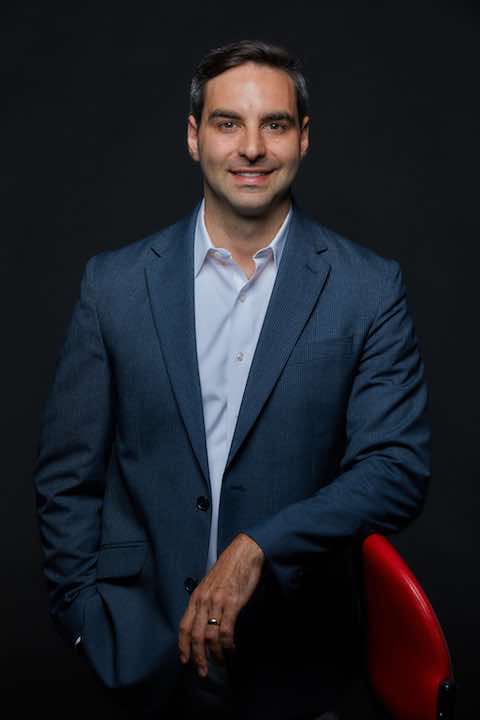 Kevin Ziegler has been nominated by the Scarsdale School Board Nominating Committee to serve on the Scarsdale School Board. The election for school board – as well as a vote on the proposed 2026-27 school budget and bond referendum will be held on Tuesday May 19, 2026.
In order for residents to learn more about Ziegler, we posed a few questions – and here are his responses:
Please introduce yourself to Scarsdale residents.
My name is Kevin Ziegler and I'm a proud parent of three boys, along with my wife, Dr. Danielle Eytan, a facial plastic surgeon at NYU Langone Health. We live in Fox Meadow, our oldest will be in 3rd grade in the fall, our middle in Kindergarten, and our youngest in preschool in the Village. Professionally, I work for Hyatt Hotels Corporation. I lead a global team that oversees distribution partnerships, those that allow you to book travel with online sites, travel agents and others. I earned a journalism degree and started my career in public relations before going back for an MBA at Northwestern University, and entering the travel industry, so I have a combination of experience in communications and business leadership.
Our family enjoys playing on the playgrounds, frequenting the library and village pool, attending our children’s music recitals, and participating in community sports.
How long have you lived in town and what do you value about the community?
We moved in 2023 and it has felt like home right away, and we’re excited for our kids to grow up here. My family is like many others, we were attracted by our excellent school system, we have loved Fox Meadow School, and we are committed to Scarsdale. We enjoy the culture of community involvement, our neighbors, and the number of social and recreational opportunities for our entire family. We think the perspective of families like ours, more recent arrivals and with younger children, is very important to our district and on our board of education.
What professional skills do you bring to the Board of Education?
The first chapter of my career focused on public relations and communications. It's a valuable skillset in business and civic life. I like to distill complex issues for others, to foster engagement. Community engagement matters in public education. Our district, and the board, have to be a bridge between the administration and families on topics from funding to curriculum to technology. I want to support this priority.
After business school, I joined Marriott International, and then was recruited to Hyatt for a leadership role. I've gained a global perspective from this work. I lead a team that requires experience with strategic planning, talent management, budgeting, negotiating complex contracts and partner relationship management on a large scale. I have the perspective needed to bring value to this experience in our education environment, and I also bring a lens into how the career landscape for our students is evolving.
Tell us about your volunteer experiences.
Volunteerism and community involvement is part of who I am. It brings me joy and connection. It started early. As an undergraduate, I led an effort to create a community cleanup day to bridge town-gown relations that lives on today. I created an adult water polo club in Cleveland that still thrives today, and I hope to support something similar, and at the interscholastic level, at the to-be-built Scarsdale natatorium. I served for five years on an appointed committee in Cleveland Heights to distribute several million dollars annually in federal funds to infrastructure and community organizations. And I’m coaching baseball and basketball in our community. I get very attached to my surroundings, and Scarsdale, as much as any place, encourages that. I notice how many of our friends grew up in Scarsdale, and have come back. My wife predicted I would get involved, and of course, she was right.
As a parent, what do you feel are the strengths of the Scarsdale schools? What, if anything, would you like to see changed or improved?
The thoughtfulness and strategic focus that goes into the student experience at all levels shines through in many places. Even the administration’s budget development process starts with a look at our district’s mission and values to frame the process before jumping into numbers.
We prioritize talented, responsive educators, research-backed instructional delivery, from our focus on small class sizes to house structure at the middle school, and the depth of curriculum at the high school. And to wrap around that we have deep parental involvement and community support.
I’d really like to invest my energy in the complex topics on the agenda, where my communications and business experience can add value. I see that especially in areas such as budgeting in a rising cost environment, or facilitating dialog on curricular matters that our families are talking about, across subjects, that also come with the complexity of a rapidly changing technology and media environment.
Why did you decide to run for school board at this time?
I’m a product of public education myself, and a strong believer in the importance of it as an American institution. Scarsdale is a model, and what we do matters for us, and can also benefit others. I also love our community and want to contribute to it. In this next term, I think our district will face important issues, including those related to the outcomes of our bond and budget votes, both of which I support. On these and others, an engaged, collaborative board, is a valuable asset.
Share any thoughts about Scarsdale’s non-partisan election system.
I am proud and appreciative of the endorsement of me and Omer Wiczyk to serve Scarsdale residents from the 30 elected members of our School Board Nominating Committee. The endorsement came from a rigorous process that includes interviews and reference checks. That process is an illustration of our non-partisan system at work. This system is one of the pillars that makes Scarsdale special because it focuses attention on what is most important in our community, and for our schools it’s the experience and preparation our children receive.
The non-partisan system ensures our school and village representatives are committed to Scarsdale, and that they are well vetted to be skilled, critical thinkers who lead with civility, are able to collaborate, to be flexible, and responsive to feedback.
In your view, what are the biggest challenges facing the Scarsdale Schools?
In the next few years, I’d like to see us on a healthy and stable long-term financial footing, as we potentially navigate major investments. I'd like us to have a clear vision for how we will guide and educate students, and maintain inclusivity, in a landscape shaped by evolving technological, social and economic currents. And I'd like to see that we have continued to strengthen our district's role as a model for public education.
The high quality that our community values requires investment to maintain and grow. The funding environment has gotten more challenging for public education, really across the state and country. The board also serves a critical oversight role throughout.
On the curriculum side, technology is continually evolving, with AI being a major driver, and screens play a larger role in the day. We also now live in a media and information environment that necessitates students are equipped with new levels of critical thinking and fact checking skills. These topics will continue to pose new, important questions for curriculum, instructional delivery and social development, that we must navigate together, to ensure we are delivering an experience that positions our children to thrive in adulthood.
Please provide your thoughts on the recent antisemitic incidents and the response from the school district and the Board of Education.
Antisemitic behavior is unacceptable in any form. Our school district leadership and Board of Education are accountable for establishing policies, taking action and providing oversight to ensure a safe and inclusive learning environment – spaces where bridges can be built and sustained across our community.
As a board member, I would engage directly with fellow members, our administration and our community to keep these as top agenda items, clearly define necessary actions on an ongoing basis, and to promote understanding and respect throughout the district.
If you do serve, what are your hopes for the schools in the next six years?
We have an incredible institution in our schools. I’d be honored to serve our community in support of them and our children, and I’d come prepared to use my skills as a listener, strategic thinker, and bridge builder. The board of education is a team, along with the administration, and my hope is to be a valuable member of it, who brings diversity of skill and thought, who asks good questions, who respectfully represents the voices of our community, and that I am able to do it with care. My hope is by doing that, we continue to enjoy the strong trust and appreciation of this community, and that we continue to view quality education, specifically a Scarsdale education, as among the most transformational and positively influential experiences in our children’s lives.
Two Undefeated Flag Football Teams Meet and Tappan Zee Comes Out on Top
- Details
- Written by: Dave Taber
- Hits: 1158
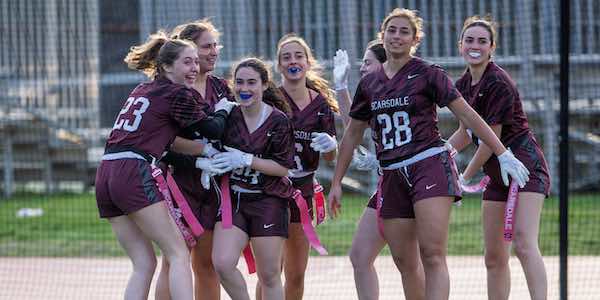 Scarsdale players celebrate Eliza Wechsler’s touchdown.The Scarsdale High School Varsity Girls Flag Football Team hosted Tappan Zee at Butler Field on Thursday, April 10th, in a matchup that had all the makings of a marquee early-season game. Both teams entered undefeated — Scarsdale at 2-0 and Tappan Zee at 3-0 — but it was the visitors who dominated the game throughout and took away a 32–12 victory.
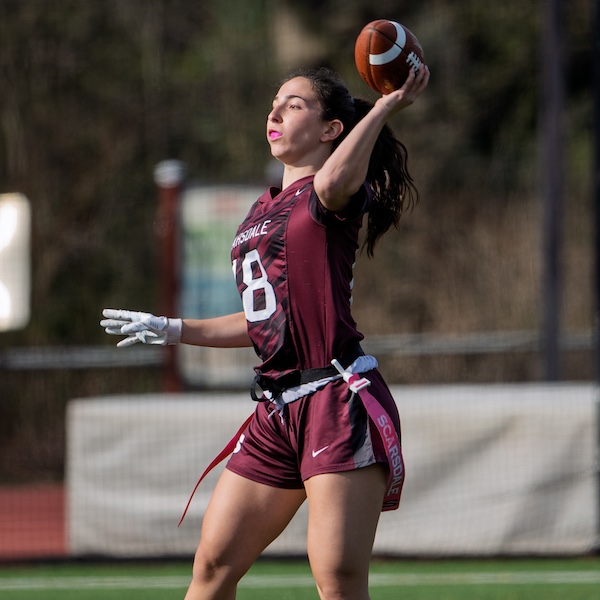 Senior Reese Newman (#18) winds up to deliver a pass.
The Raiders will try to bounce back quickly; they return to Butler Field on Monday, April 13th, to face Clarkstown, a combined squad drawing players from both Clarkstown North and Clarkstown South.
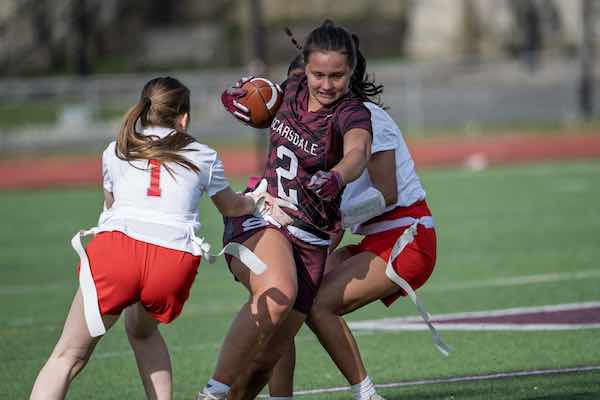 Senior Gia Asen (#2) tries to run through two Tappan Zee defenders.
Photos by Dave Taber of Shots of the Game. To see more game photos and/or download photos, please visit https://www.shotsofthegame.com/
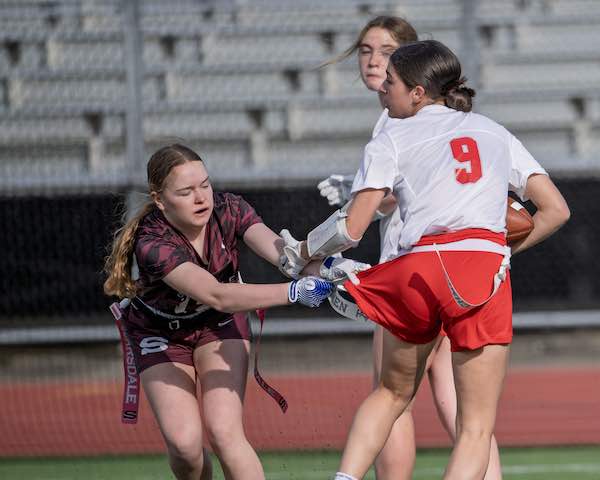 Senior Stella Van Arsdale (#17) reaches in to pull the flag on a Tappan Zee ball carrier.
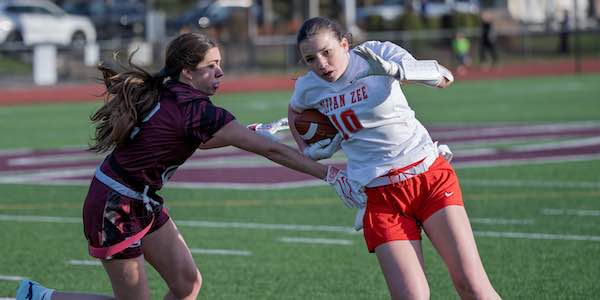
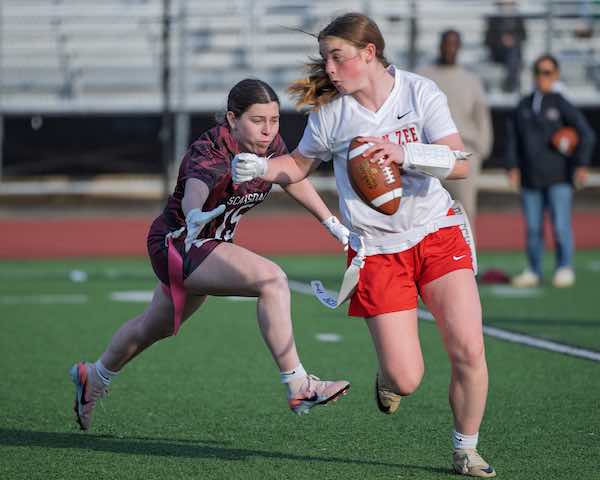 Sophomore Talia Koenig (#15) pursues a Tappan Zee ball carrier.
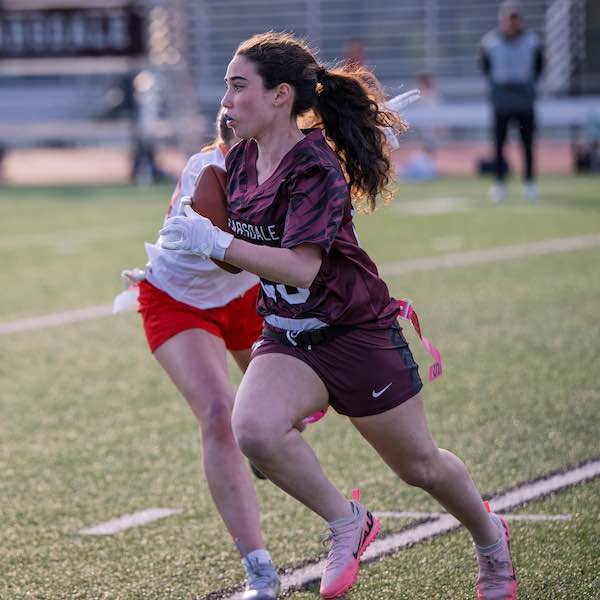 Freshman Eliza Wechsler (#29) advances the ball upfield.
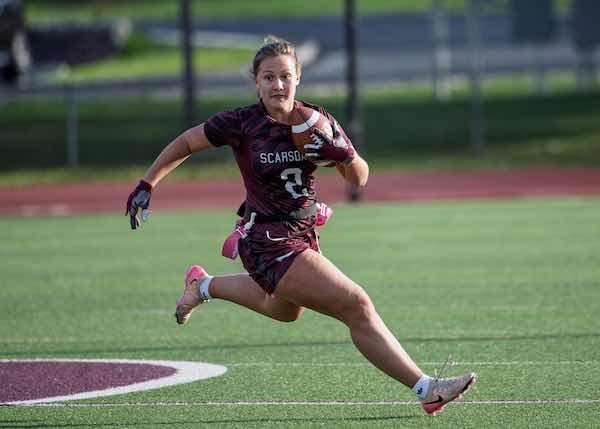 Gia Asen (#2) races through the open field. Junior Lucy Stern (#12) tries to grab the flag of a Tappan Zee runner.
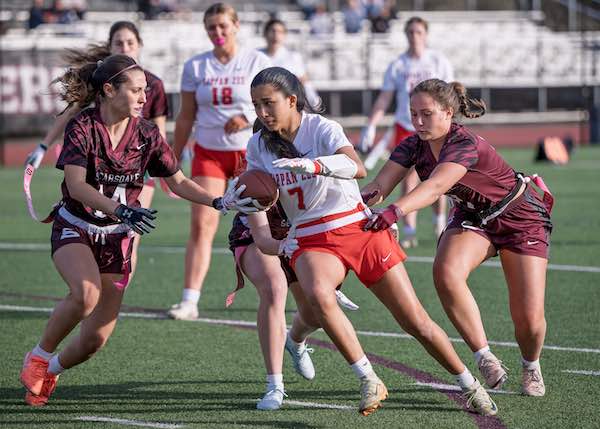 Senior Talia Arovas (#14) and Gia Asen (#2) close in on Tappan Zee's ball carrier.
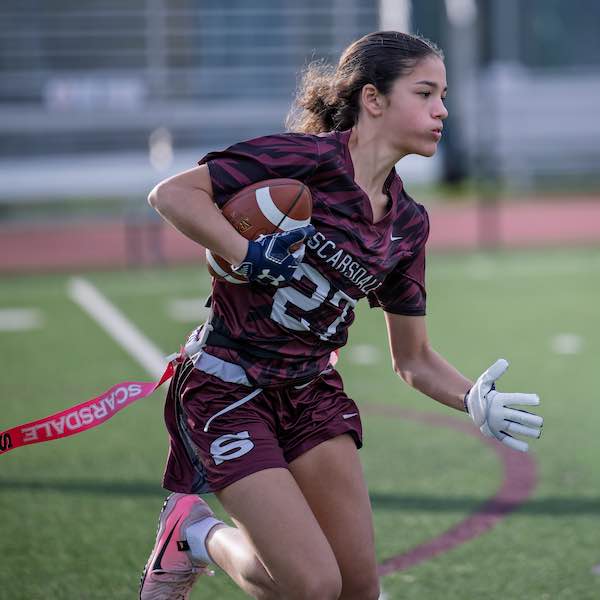 Freshman Emme Sanders (#27) carries the ball down the field.
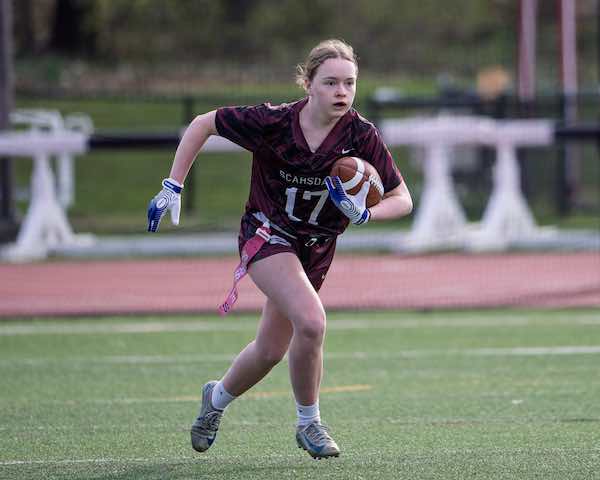 Stella Van Arsdale (#17) breaks into the open field.
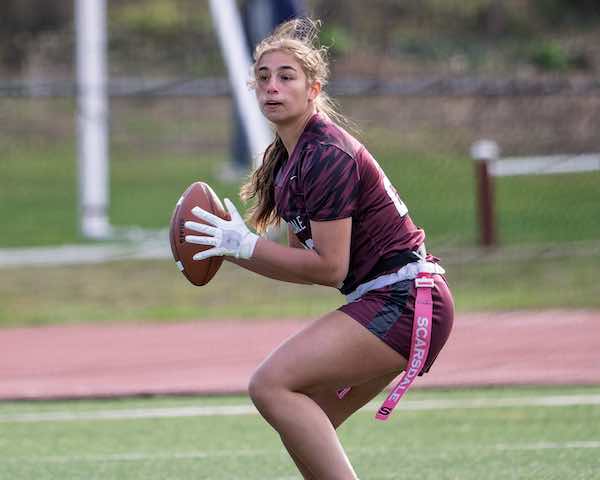 Junior Jordana Esterman (#28) gets ready to make a pass.
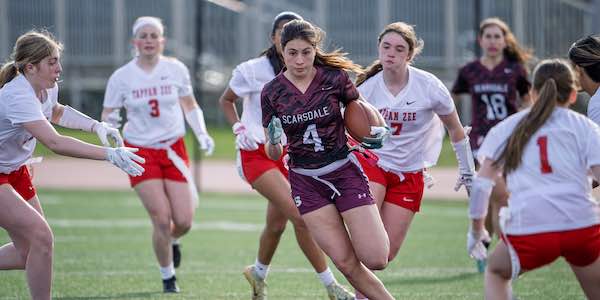 Senior Leah Brown (#4) turns upfield through a crowd of Tappan Zee defenders.
Scarsdale Democrats Protest on No Kings Day
- Details
- Written by: Joanne Wallenstein
- Hits: 1644
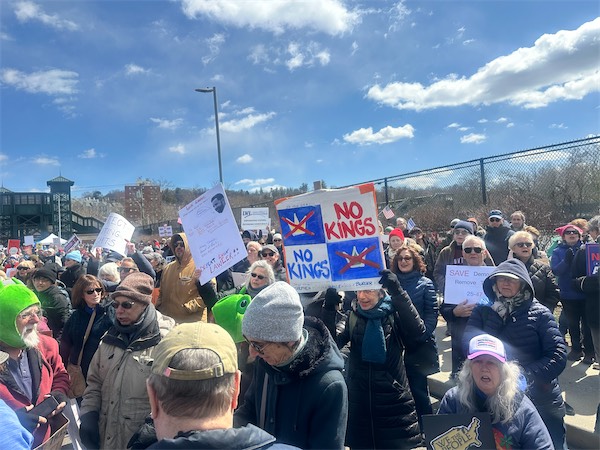 Thousands came out to protest in Tarrytown.Protesters from Scarsdale, including the Scarsdale Democrats, joined thousands of others at the No Kings Day protest in Tarrytown on Sunday March 28, 2026.
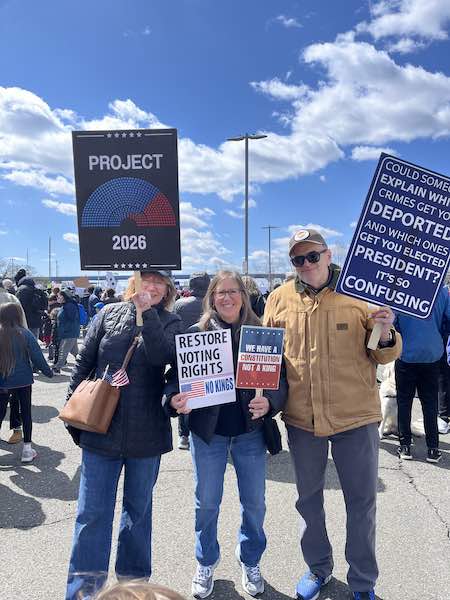
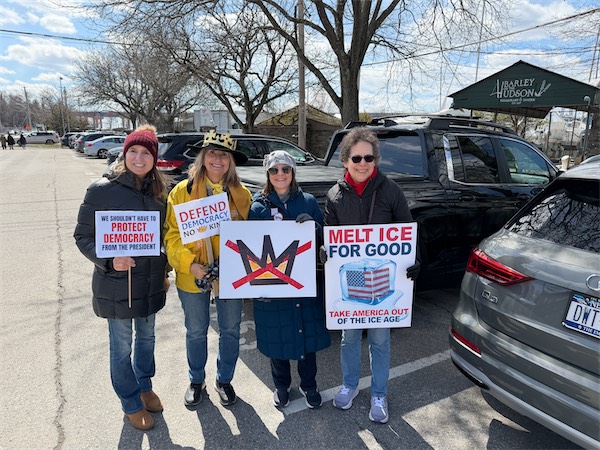 Michelle Sterling, Michelle Lichtenberg, Alissa Baum and Myra Saul display their signs.
The spirited crowd stretched from the Hudson River to the Tarrytown train station. County Executive Ken Jenkins and County Legislator Mary Jane Shimsky were just a few of the speakers who addressed the group.
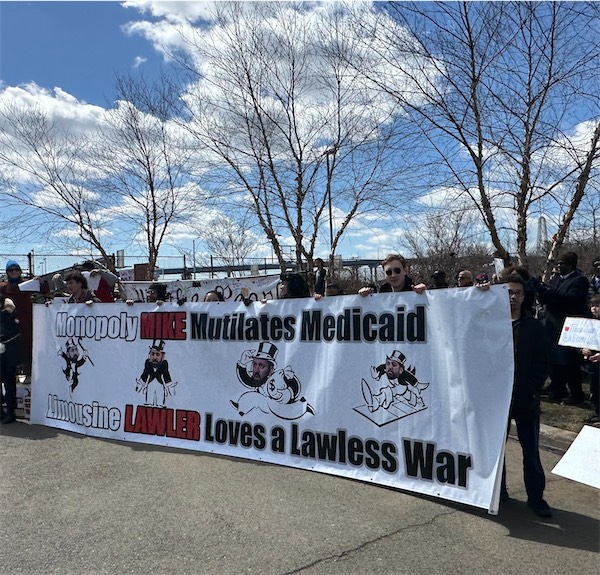 A group of millennials started their day at the rally in Nyack and walked across the Tappan Zee bridge to Tarrytown carrying this banner. Though millennials were largely missing from the vote last time, Democrats are actively seeking younger voters to participate in November 2026.
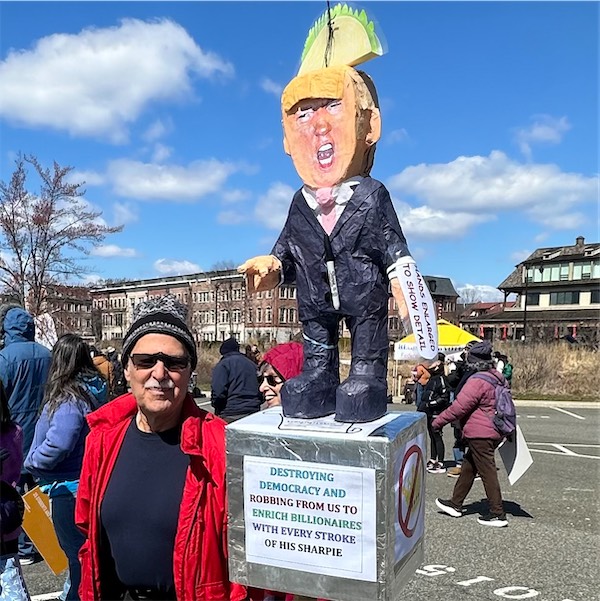 The man in the picture ordered this pinata online during Trump’s first term of office and is making use of it again.
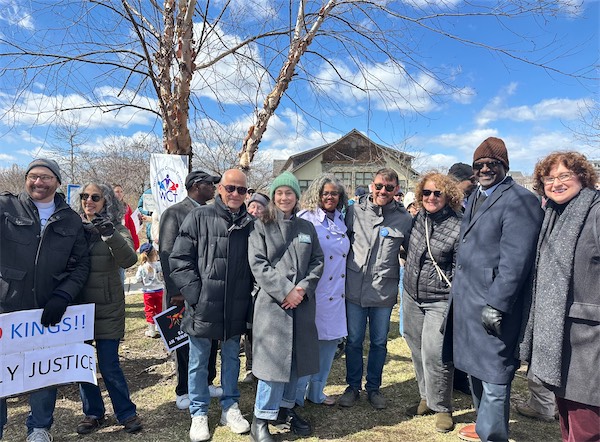 The event drew a long list of speakers.
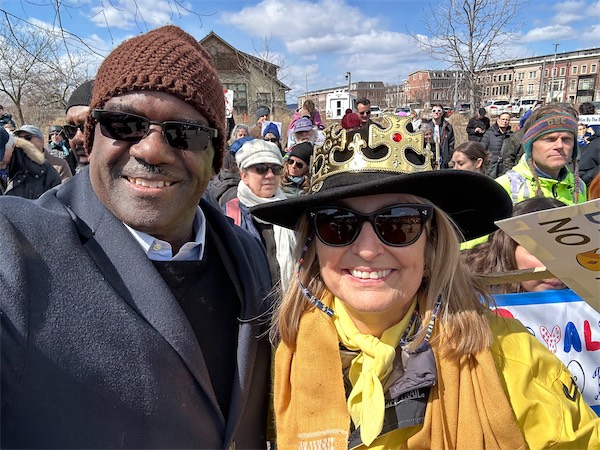 County Executive Ken Jenkins with Michelle Lichtenberg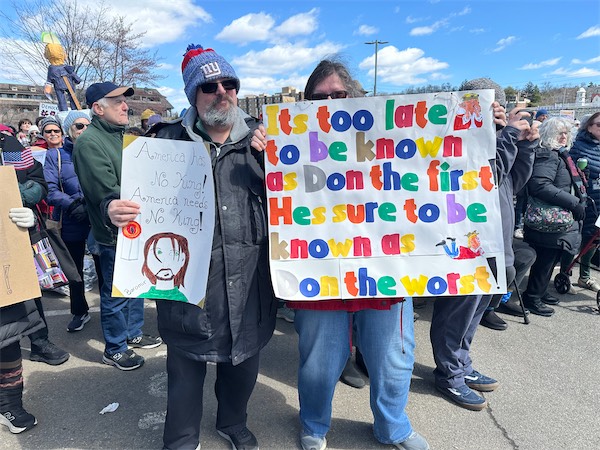
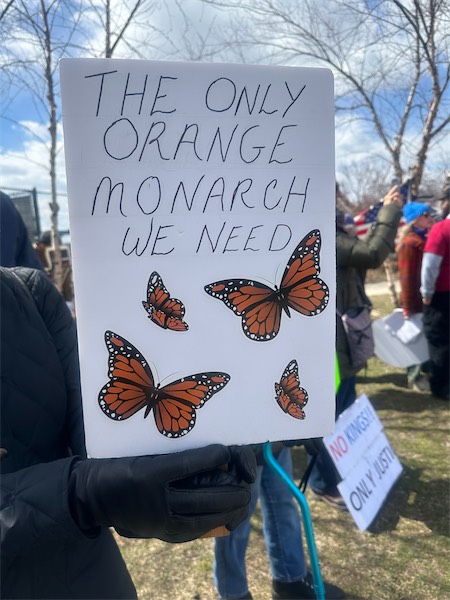
Did you protest? Send your photo to scarsdalecomments@gmail.com.