








District Announces New Grading Policy at SHS and Tactics to Address Concerns About Reveal Math
- Details
- Written by: Wendy MacMillan
- Hits: 4716
 If you have been tuning in to the Board of Education meetings over the last several months, you’re most likely aware that folks have had a lot to say about the newly adopted Rolling Gradebook at Scarsdale High School and the Reveal Math curriculum at the elementary school level. Administrators have devoted special time to these topics at several recent meetings and, in an effort to maximize communication, transparency, and understanding, did so again in their Education Reports at the BOE meeting on Monday, May 12th.
But at the meeting on Monday, the district did more than listen – the administration announced changes to address feedback about high school grading policies and the Reveal Math curriculum.
Superintendent Andrew Patrick surprised many with his “top down” decision to institute a common online gradebook portal for the 2025/26 school year at Scarsdale High School, which will allow students to access their current grades online. Addressing parent’s complaints about Reveal Math, the district unveiled plans several measures to improve “Fact Fluency,” to assist children with word problems and to introduce complementary resources to help those struggling with the curriculum.
Here are the details:
Before delving into the reports’ details, Superintendent, Dr. Drew Patrick took a moment to address the community.
In a rare but thoughtfully prepared statement, Patrick shared: “Before jumping into either of those, I want to ask for your indulgence, just to articulate some broader thoughts about public engagement and change, as both topics covered in tonight's Education Report have been touchstones for significant public comment and faculty input. A vast majority of that input has been constructive and representative of important and valid stakeholder’s voices and opinions. Public comment, emails, phone calls and in person, meetings with school staff are all meaningful ways to express opinions about the work of our schools, including curriculum policies, practices and approaches.
I want to say unequivocally that I understand how much the parents in our community care about their children and the education they receive. I also want to say unequivocally that our teachers and leaders are passionate and caring professionals and dedicated experts. Each is operating from a single driving force, the desire to do what's best for our students…Thus our work requires a partnership in which we are able to listen and to ask questions, to trust one another and remain open to compromise, to give and to take and to assume good intentions, even when the outcome isn't exactly what we want.
I firmly believe the track record in this school community to do just that is strong. It's one of the things that sets Scarsdale apart from many, if not most, other school districts. Decisions aren't made haphazardly, rather, they reflect thoughtful consideration of relevant information from a variety of perspectives and sources. Tonight's updates on elementary math are an example. Math education is in the midst of a shift in this country. Our approach has been responsive to, and reflective of that shift. However, the input from educators and parents signals to us that we have some work to do to get it right. We won't throw the baby out with the bath water, but we will make smart, responsive adjustments to support our educators to implement those changes and monitor student progress in the moment to make sure they are the right changes.
The journey with high school grading has followed a similar path with one notable divergence, I will confess, the advocacy for changes to the Rolling GradeBook approach took me by surprise. I didn't anticipate it, and when the feedback from parents started coming in, it took me some time to digest and understand exactly what was being communicated. The High School Assessment Committee and faculty have been responsive to that feedback, though, opinions on the Rolling Gradebook remain somewhat mixed.
However, what also became clear is that some of the outpouring of feedback wasn't about the rolling grade book at all, but about other practices, including the degree to which students are able to know where they stand with respect to their grade at any given point in a quarter. As I listened and came to better understand this particular concern, I determined that I needed to make an uncharacteristically blunt, top-down leadership decision. I directed the high school administration to move to a common online, Gradebook for the 2025/26 school year. This decision has justifiably been called into question by some of our faculty, not as a matter of practice, indeed, this is already the practice of a significant number of our faculty, but for its notable lack of process, which is a sacred component of our school culture. I think it's important to publicly own this decision and acknowledge that while I believe it's the right way forward, the concerns raised by our faculty about the lack of process are legitimate, have been thoughtfully articulated, and raise justifiable concerns about unintended consequences of the decision. I look forward to continuing to listen to those concerns and to further explain my rationale over time.”
Rolling Gradebook
Patrick then introduced Laura Weiss, High School Assistant Principal, who shared the results from a recent survey designed to garner community feedback in regards to the new Rolling Gradebook at SHS.
Weiss conveyed that the survey, given in early March of this year, received responses from 825 students, 260 parents, and 87 teachers and noted that 56% of the total student body participated in the survey. The survey found that there was a modest increase in preference among student responders for the rolling grade book, up from 46% last year to 54% this year.
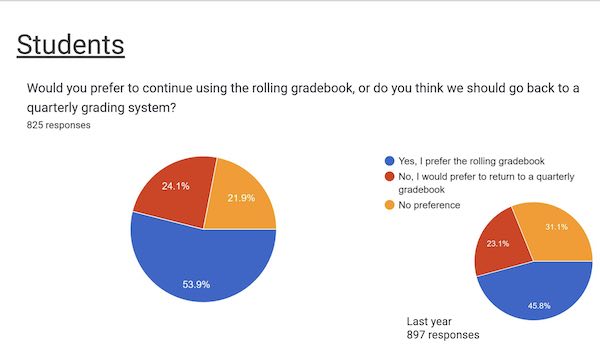
The survey also revealed that 58% of SHS teachers participated in the survey, offering a strong representative voice from across disciplines. Here too the percentage of respondents preferring the Rolling Gradebook increased over five points from 66% to 71%.
According to another slide, the survey garnered 260 responses from parents with a bit more than half indicating that they would prefer a return to the Quarterly Gradebook and a quarter indicating no preference. Here Weiss noted that feedback from parents was considered, not only from the survey, but also from the emails and conversations that SHS has received since last summer.
In considering parent feedback, Weiss explained, “It became clear that the questions around turnaround time, early notification of a change in [student] performance, and overall transparency, were more salient than the choice between the Rolling Gradebook and the Quarterly Gradebook. We have now focused our efforts on these major themes.”
Weiss then outlined some of the changes made in response to parent feedback. She related, “As presented to you by Mr. Bonamo in November, we issued guidelines for homeschool communication regarding changes in student performance. In January we published expectations for turnaround time on student work. We also held information sessions for students and parents about the Rolling Gradebook and administered this survey that I just presented to address issues of transparency. It was decided, as Dr Patrick just outlined, that we will introduce an online student grade portal next school year. Student grades on individual assessments will be posted on Infinite Campus within one week of being returned. Students will have daily access to the portal, while parents will continue to receive information aligned with progress reports and report cards.”
Weiss went on to add, “We believe that this is developmentally appropriate and honors the student's role in managing information about their performance. Parent access to the portal will be based in the context of the continued availability of how they've always been able to communicate with teachers. And the key point here that we want to underscore is that we want the student and parent to have a conversation about student progress before there's communication with the parent and the teacher.”
Before concluding, Weiss clarified that they are exploring guardrails for the new student portal to minimize notifications and working hard to support teachers in making this change in time for the fall. See the Rolling Gradebook Survey Results here.
Reveal Math
In Dr. McIntosh’s absence, Dr. Patrick delivered a detailed report with updates about Reveal Math, the elementary math curriculum, based on feedback first from educators that came through a survey and discussions, and also from feedback received from parents over the last several months.
Patrick used a slideshow to communicate educators’ feedback on growth, gaps, resources and professional development. Starting with some of the positive feedback garnered from faculty, he explained that teachers have noted growth in their students’ ability to explain their mathematical thinking and conceptual understanding. Patrick added, “I concur with that. Having focused my classroom visits on math classes when possible, [students] have been able to explain their thinking both verbally and in writing, using appropriate academic math vocabulary, and engage in math discourse. The program encourages students to discuss and collaborate on problem solving, fostering deeper engagement and confidence in math.”
Patrick went on to share, “Our teachers are also observing improvements in students ability to understand and apply their math concepts, particularly in problem solving, number decomposition and distributed and the distributive property, and then increase flexibility with numbers. And I'd say that's what I really notice. When I'm talking to the students, they’ve become more comfortable using multiple strategies to solve the problems that they're encountering and to have a stronger number sense.”
The presentation then addressed some of the challenges faculty are working through and the approaches being taken to respond to these challenges.
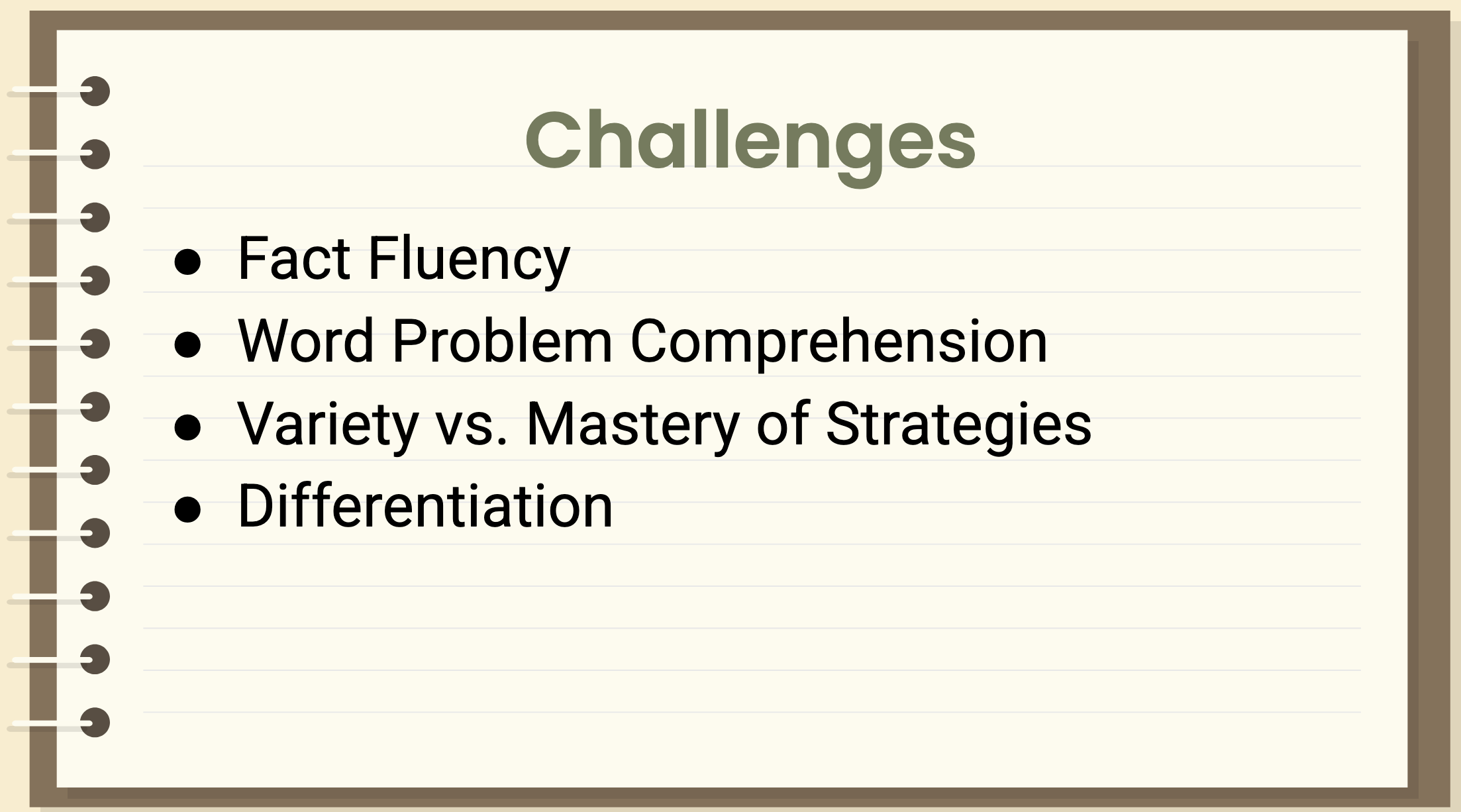
One of the first challenges identified was in regard to some students’ deficiencies with Fact Fluency and with basic math facts such as addition, subtraction, multiplication and division. Patrick recognized that educators worry about a lack of automaticity as impacting students’ ability when they get to those more complex concepts.
Patrick explained that in response to this concern, faculty will work toward math Fact Fluency benchmarking that will work in concert with the fluency checks students currently find in the Reveal Math book. He further explained that during professional development programs over the summer, teachers will work on a process to create benchmarks around appropriate levels of fact mastery in grades one through five. In addition, faculty will create Fact Fluency assessments in a recording system which Patrick describes as “An exciting opportunity for teacher professional development, especially since none of our previous math programs had any specific or formal fact assessment.”
Word problem comprehension was another challenge outlined in the presentation. Patrick recognized that the language is rigorous and students can struggle with understanding and solving word problems, particularly multi-step problems, and this can be exacerbated by those who experience difficulties in reading comprehension. To address this concern, Patrick shared that, “Our team will spend time looking at kindergarten and first grade curriculum and refine the language there and adapt problems as appropriate.”
Teachers have also expressed concerns about introducing students to multiple strategies up front without allowing sufficient time for mastery and believe that this can confuse some students. Because teachers have communicated a need for deeper focus on the success of individual strategies before moving on, Patrick revealed that the Math Coordinators and Math Committee have identified a range of complementary resources which will be embedded into the Reveal Math units. Patrick also explained that these teams are creating a K-2 Enrichment Application Station in Padlet. After exploring these additional resources, teachers will be asked to weigh in to identify what works best for them.
During the presentation, Patrick made sure to acknowledge parental concerns as well. In response to some of the feedback they received, he noted that the team has launched a math parent-facing math website with curated resources such as videos, the math replay videos, and the letters for every unit.
In addition to the website, the team is planning the first District Workshop this June that will be a single event for all five buildings, with representation from all five buildings of teachers and administrators creating the opportunity to experience Reveal Math and deepen the understanding of how the program works. Patrick also conveyed that a program slated for the fall will be responsive to a forthcoming family survey and will provide opportunities at each school to allow parents to engage with the educators.
While Patrick outlined the steps being taken to respond to constructive criticism, he also highlighted the fact that not all of the feedback the District has received from parents has been negative. Rather, parents have also taken the time to express some of the positive outcomes experienced with Reveal Math, some of which includes seeing noted improvements in their children's math understanding and confidence, an appreciation for the opportunities for their child to try different strategies and explain their thinking, and an appreciation that the curriculum puts an emphasis on the real world connections and inquiry based learning, which they feel helps deepen their child's understanding of the math concepts.
Though many of the BOE members related their appreciation for the District’s responsiveness to community feedback and their commitment to the importance of transparency, one parent spoke about Reveal Math during the Public Comment period. Oana Papazoglu said her concerns are not about communication, but rather about the curriculum itself and noted that the challenges outlined in the presentation, fact fluency and word problem comprehension, are at the heart of what math is all about. She went on to share her experience of growing up in a communist country in a small town of coal miners saying, “None of those people, including my own parents, had the time or resources to help their kids in math and yet, that small town produced national Math Olympiad winners. The same is true for all these Math powerhouses, China, former Soviet Union, Korea, Singapore, nations from which the US keeps, to this day, importing mathematicians. None of the parents follow their kids' elementary math curriculum. International Olympian winners do not have resources for parents behind them. They don't have websites, research and so on. What they have in common is a love of math, developing in school due to a rigorous curriculum and dedicated teachers. No iPads, no smart boards, no presentations, no parent coffees, none are present or take place in any of these places where math is taught successfully. Math is math. The beauty of it is that it is a universal language, and if taught this possibly can be the greatest equalizer.”
To review the full slideshow see here.
And to watch the video of the entire BOE meeting see here.
A New Assistant Principal for Fox Meadow School
- Details
- Written by: Wendy MacMillan
- Hits: 5157
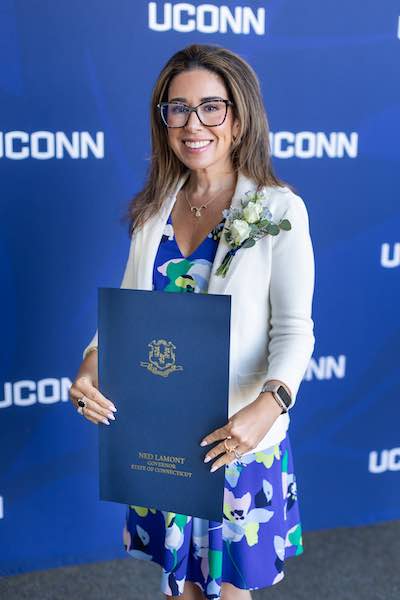 Dr. Lori LiebowitzAfter a joyful Tenure Conferral Ceremony on May 12, the Board of Education held a Statutory Budget Hearing where they gave a brief overview of this year’s proposed budget and reminded the community of the upcoming budget vote on May 20 at the middle school gymnasium from 7am to 9pm. Budget details are available on the Scarsdale Schools website and voting information can be found under the voter information icon.
New Assistant Principal at Fox Meadow Elementary School
Assistant Director of Human Resources, Meghan Troy announced that Dr. Lori Leibowitz will be appointed as the next Assistant Principal of Fox Meadow Elementary School. Troy explained that “Dr. Leibowitz is currently the Assistant Education Administrator for Gifted and Talented Programs in the Norwalk Public Schools. Prior to this role, she spent many years as an elementary school educator and teacher in the Greenwich Public Schools. Dr. Leibowitz holds an EDD in Learning and Organizational Change from Baylor University, a master's certificate in Gifted Education from the University of Connecticut, an MA in Elementary Education from Sacred Heart University, and a BA in history from George Washington University. We've had the privilege to get to know Dr. Leibowitz throughout the thorough and lengthy process. At every turn, she demonstrated a strong commitment to the students, and her care highlighted the importance of relationship building with faculty, staff, parents and students. Her warmth and compassion and ability to listen will serve her well in this role, combined with her strong academic and curricular background, Lori will be set up for success. I look forward to seeing all that she brings to Fox meadow in the future.”
Electronic Devices in School
The meeting included a robust discussion of the Draft Policy for Students and Personal Electronic Devices. On May 8, 2025, the New York State Legislature passed a bill that adds a new section to the Education Law requiring Boards of Education to adopt a policy prior to the 2025-26 school year prohibiting the use of internet-enabled devices by students during the school day anywhere on school grounds. Though the Board had already done a lot of work drafting a policy in anticipation of this new bill becoming law, there were still several questions and concerns that were thoughtfully addressed during the discussion.
Many Board members wondered what exceptions will be made for students with IEP and 504s and whether or not students will be able to use their laptops during their free periods to do work. Noting the legislation is pretty strict, Leah Dembitzer expressed that she would prefer to keep as much local control as we can at the building level and for the high school administration to be able to use their judgment. Dembitzer added, “They see the day to day life of high schoolers, and they would know what's best.”
Dembitzer also expressed her discomfort with having to report an Enforcement Plan at the state level, accounting for the number of disciplinary actions associated with this policy, and break that down demographically.
The state law reads: “Thereafter, each school district, charter school and Board of Cooperative Educational Services shall publish an annual report on its website detailing enforcement of the policy within the district charter school, including non identifiable, viable demographic data of students who have faced disciplinary action for non-compliance, and analysis of any demographic disparities in enforcement of the policy.”
The Board agreed with Dembitzer that this language feels like a big overreach, and agreed to advocate for change at the beginning of the next school year.
Air Conditioning
During public comments an SHS senior and varsity captain for the girls volleyball team addressed the lack of air conditioning in the gyms and cited the safety and comfort issues. She described the increasing heat in the gyms, an issue that has even seen a student going home ill due to the heat. She emphasized that the issue affects not just sports teams but all students and staff who use the gym and encouraged the Board to consider the concern in their Budget. A third community member chimed in via Zoom and reinforced the need to address the air conditioning in the gym.
Later in the Business portion of the BOE meeting, the Board heard from Kevin Walsh who is heading the Capital Project Steering Committee and he assured them that air conditioning in the gym is on his list of considerations.
Student Member of the Board of Education
The Board reviewed the selection process for the inaugural Ex Officio Student Member of the Board of Education for the 2025-2026 school year. Four juniors and four sophomores have been vetted by the high school student government and will be slated for a general student election on May 20th. The Board looks forward to welcoming the new student members, who will begin their terms on July 1st, 2025.
Food Service
Andrew Lennon provided an update on the Food Service Program, saying that after a bumpy start to elementary food ordering and credit card payment processing at the beginning of the school year, the District is prepared to transition back to My School Bucks for K-12 meal orders starting in September. Parents will not have to wait for a confirmation or a funding confirmation, as they did prior to last school year with My School Bucks and Nutrislice. It'll be an immediate order through Nutrislice.
Lennon also addressed the recent announcement of the NY State budget's “Free Meals for All" component and the need for the district to join the National School Lunch Program. Though the budgeted program is not a state mandate, Lennon shared that, “We are not there yet. There's a lot of work that is involved if we were to pursue this. First and foremost, we would need to be on the National School Watch Program, which we are not. We would need to really look closely at what that means for us, including perhaps participation in the breakfast program that doesn't exist today. We're working with our food service consultant to understand better what's in the state budget, and if there would be an opportunity for one or all, or some of our schools to participate in that program. We will do that over the next few months and come back with an update when we have more information with the recommendation or approach if we were to proceed with that plan.” Lennon added, “This is likely a material change to the food service contract, which would require a new bid for the food service company…It's really an involved process. We want to do it right.”
EV Bus Contract
During Public Comments, Howard Weinberg, representing his company, took the opportunity to share his concerns about the District's $6.1 million electric vehicle (EV) charging infrastructure plan and encouraged the District to obtain a second quote. Weinberg claimed the true cost could exceed $10 million and that his company proposed a solution at half the cost, promising $5 million in savings over eight years.
Later, Lennon responded to Weinberg’s concerns by saying, “I'd like to clarify the cost component of the $25.6 budget. To be very clear, as the Board is aware, Highland Fleet is a supplier of a fleet as a service program that was competitively bid through a sourcewell, a cooperative bid program. That's where we made our contract to them for this fleet as a service program. There are four budgeted buses intended to be in our fleet next year, one purchase this year and three next year. Highlands' proposal in place to $64,000 in next year's budget for the infrastructure, training and charging systems and software related to just those four vehicles.”
Lennon went on to note that the District is currently in contract negotiations with Highland Fleet and has been utilizing the school’s attorney to help vet both the RP process as well as the draft contract agreement with Highland. Lennon closed with, “Highland Fleet has been negotiating back and forth with us, with very meaningful changes.”
Later in the meeting, two Education Reports were shared which will be highlighted in a separate article. To watch the BOE meeting in its entirety see here.
Maroon and White Celebrates Athletes at Signing Day
- Details
- Written by: Sharon Higgins
- Hits: 3099
 Girls Wrestling TeamMaroon and White recognized signed athletes and winter Sectional Champions at a celebration in the gym on Wednesday May 8, 2025.Cindy Parrot, Scarsdale Athletic Director along with Jeff Weigel, Assistant Athletic Director warmly greeted the many athletics, parents, relatives, and friends that came out to cheer on and support the 11 senior students athletics who will participate and compete on the college level in the NCAA Division 1, Division 3 and also USports RSEQ conference in Canada next year.
Ms. Parrot began the program by first honoring the Scarsdale High School athletes and teams that won their winter sports sectional championships. At the first ever sectional tournament for girls wrestling, the SHS girls wrestling team brought home the championship. The team, Daisy Bennett, Felicity Bennett, Jaqueline Goldberg, Grace Liebman, Iman Maroof, and Emma Steggall were the first to be honored with applause and photographed in front of the SHS Raiders logo step and repeat. Daisy Bennett and Iman Maroof were also named sectional winners in their respective weight classes.
 Tommy Iasiello
In Boy’s Wrestling, senior Tommy Iasiello was named sectional champion and won his weight class for the third consecutive year in a row. Ms. Parrot mentioned that he was honored at the Fall Signing Day when he committed to wrestling and lacrosse at Roger Williams University.
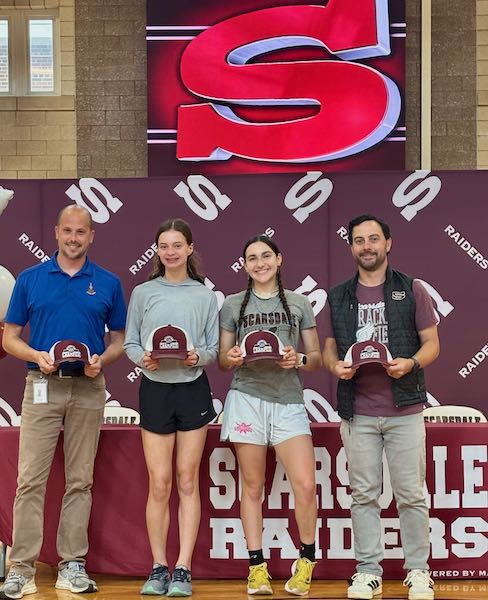 Indoor Track - Julia Scheffler and Adriana Pettinelli
There were three section champions named for Indoor Track. Julie Scheffler won the 1500 meter race walk. Maria Roberts won the 300 meter race and Adriana Pettinelli won the 1500 meter event. Ms. Parrot called up the last sectional champions from the Boys Swimming and Diving team. Avi Stahl who won the 200 meter freestyle and Kieran Lee who won the individual medley.
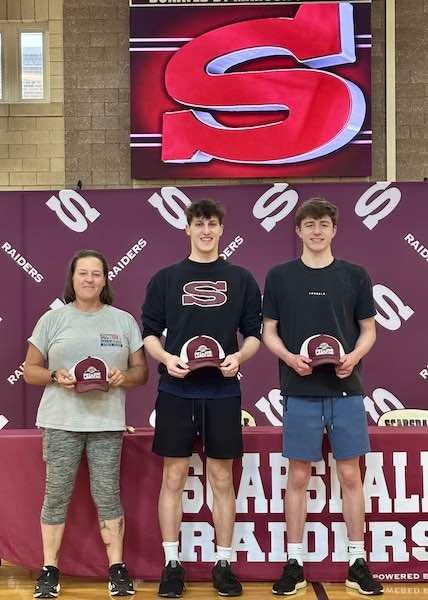 Boys Swimming and Diving: Avi Stahl and Kieran Lee
Calling up the Division 1 senior athletics first, Ms. Parrot named Varvara Mankova who will be fencing at The Ohio State University as well as Hannah Wasserman who will be playing basketball at Yale University.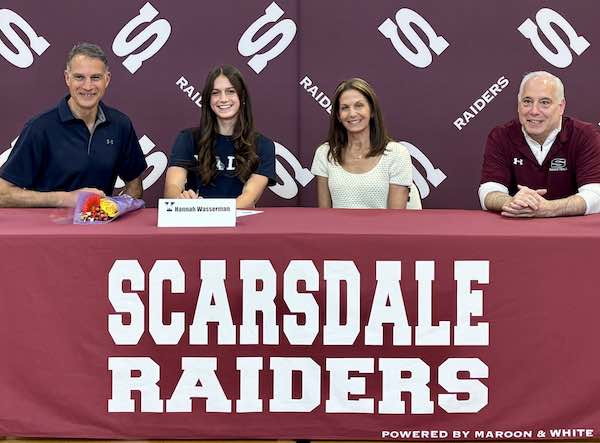 Hannah Wasserman
 Varvara Mankova
She then continued to honor the senior athletics signing at Division 3 universities and called up Rishi Shadaksharappa who will be competing in Cross Country and Track and Field at Washington University in St. Louis. Rishi Shadaksharappa
She also named Lilsa Hambazaza who will be fencing at NYU next year.
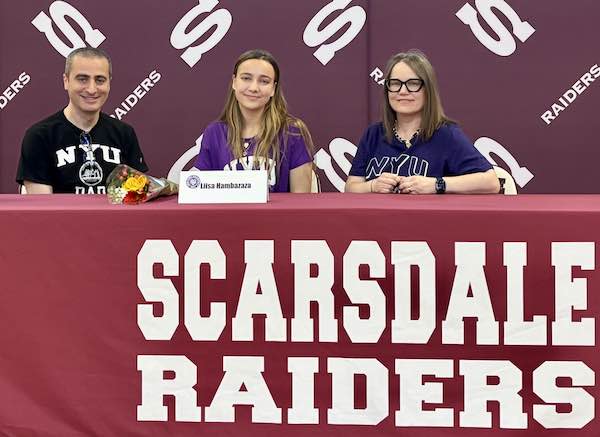 Lilsa Hambazaza
Zane Kohn will be playing squash at MIT and Giana Marks will be playing tennis at Carleton College. Zane Kohn
 Giana MarksEmma Lee will play D1 Golf at Yale University
 Emma Lee
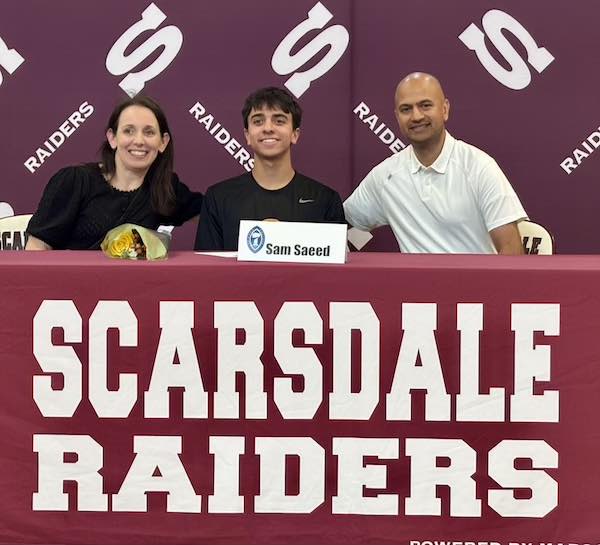 Sam SaeedSam Saeed will also be playing tennis for Pomona College.
 Leo UmanskyLeo Umansky will be playing tennis for the University of Rochester.
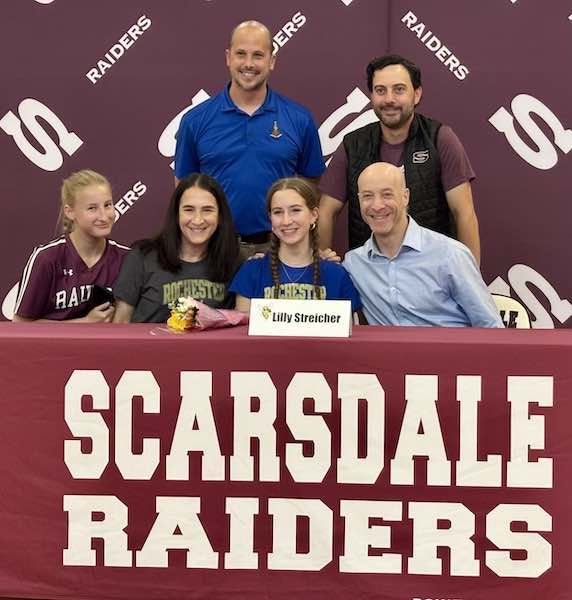 Lily Streicher
Lilly Streicher will be running Cross Country and Track and Field at the University of Rochester.
 Dugan
Dugan
Dugan who will swim at Bryn Mawr College.
 Yusuke Sato has committed to McGill University in Canada. Though McGill is not part of the NCAA in the US, Canada has their own collegiate conference, the USports RSEQ. At McGill he will be playing soccer.
Ms. Parrot closed the ceremony with congratulations to all the athletes on their amazing accomplishments and future wins and success as well as a reminder to the parents, friends and family that they should “enjoy every minute of it!"

Flag Football Teams Bests New Rochele 14-7 on April 24
- Details
- Written by: Joanne Wallenstein
- Hits: 1941
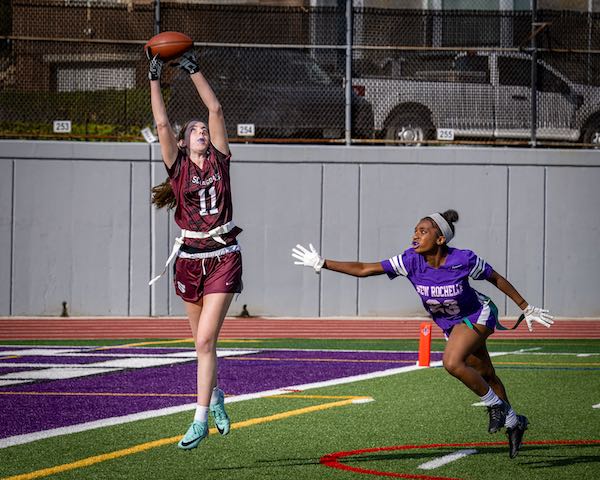 Senior Chloe Paquin (#11) reaches high to grab a pass for the 1-point conversion.The undefeated Scarsdale Flag Football traveled to New Rochelle on Wednesday April 24 to take on a tough New Rochelle team. The Raiders scored two touchdowns in the first half and held on for a 14-7 win in a hard-fought game. The Raiders next play Yonkers City at home on April 25th.
Photos by Dave Taber of Shots of the Game
To see more game photos and/or download photos, please visit https://www.shotsofthegame.com/
 Junior Leah Brown (#9) breaks free after catching a short pass.
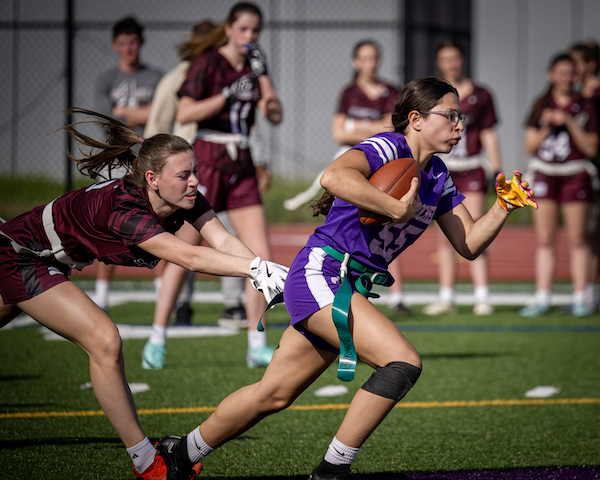 Senior Naomi Fischer (#5) reaches to try and grab the flag of a New Rochelle runner.
 Senior Allison Kahn (#6) scans the field as she starts her punt return.
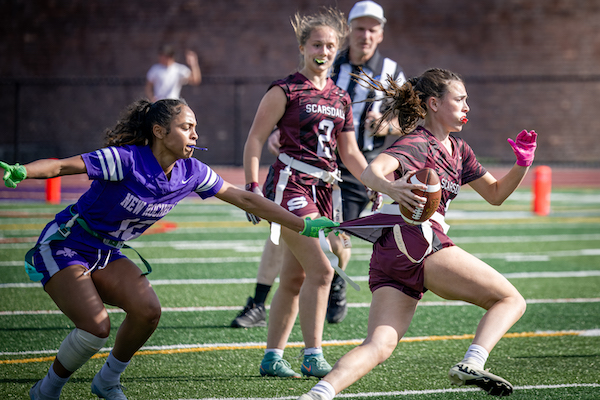 Senior quarterback Lilly Tessler (#4) scrambles out of the pocket.
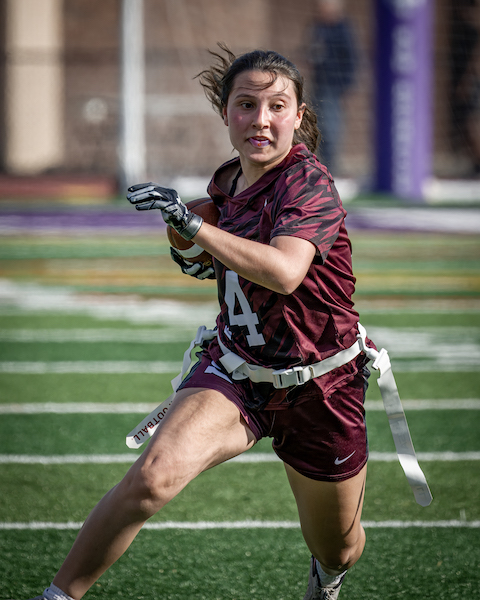 Junior Talia Arovas (#14) runs after catching a pass on a crossing route.
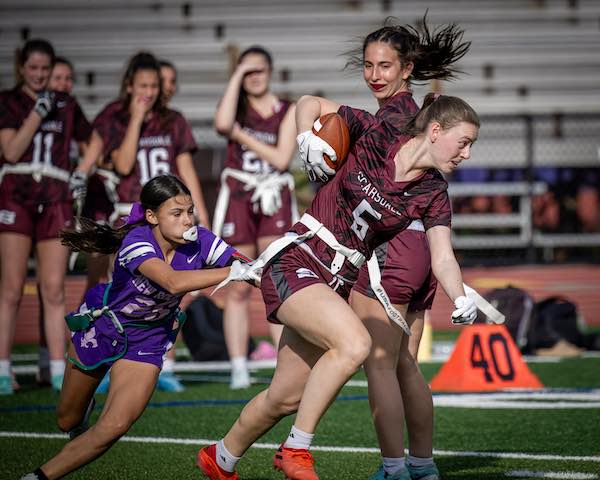 Naomi Fischer (#5) tries to outrun a New Rochelle defender.
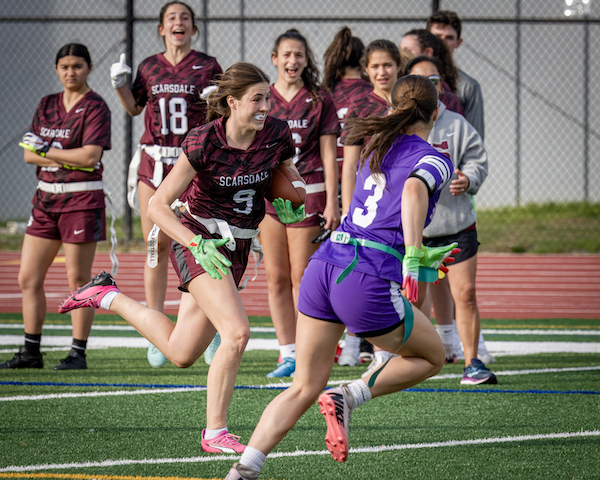 Leah Brown (#9) dances in the open field as part of a long run after her catch.
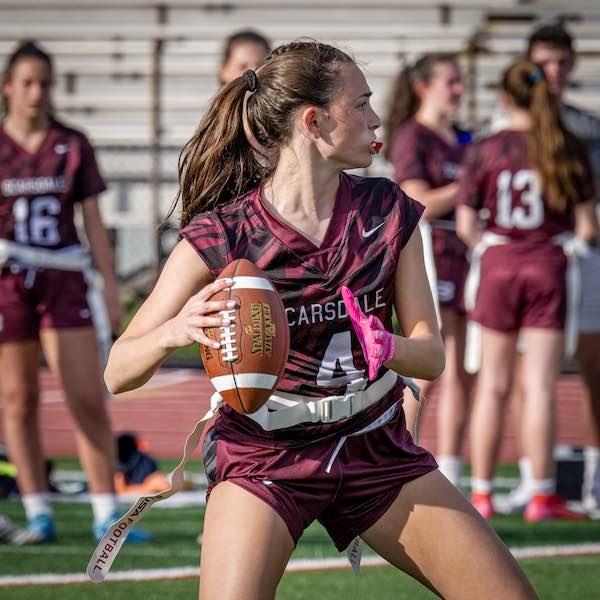 Lilly Tessler (#4) sits in the pocket and eyes the field ready to make a pass.
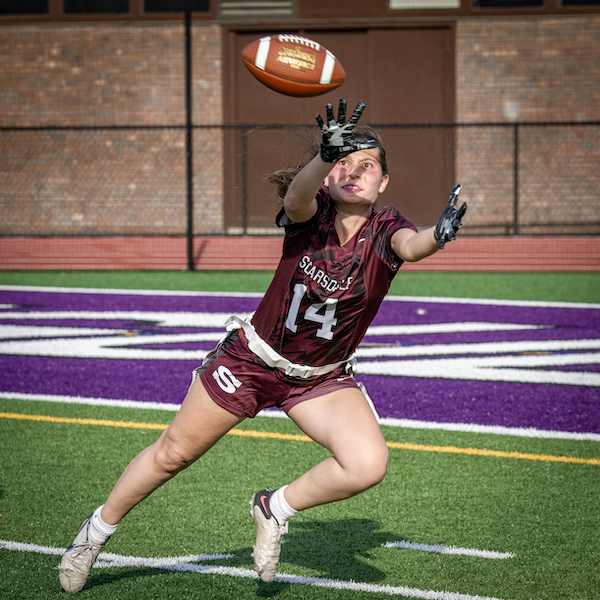 Talia Arovas (#14) makes a valiant effort to haul in a pass.
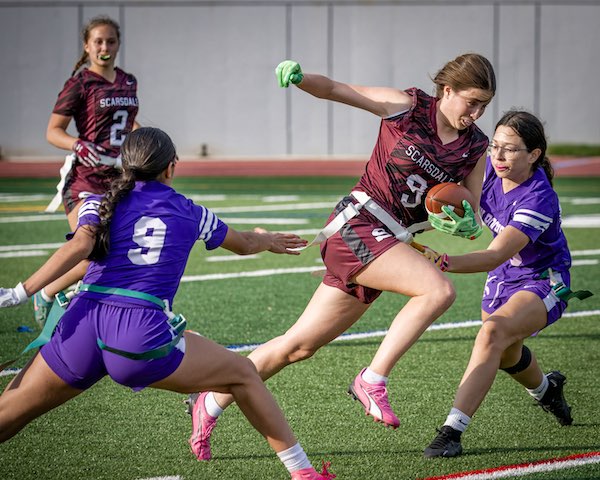 Leah Brown (#9) splits two defenders while running after her catch.
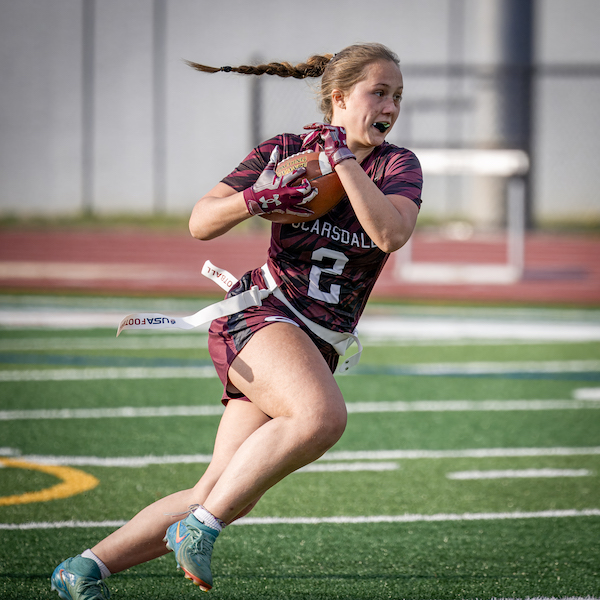 Junior Gia Asen (#2) sprints in the open field after catching a short pass.
A Close Game Vs. Pelham for Scarsdale Boys LAX Team on April 11
- Details
- Written by: Dave Taber
- Hits: 2515
 Scarsdale students brave the weather to cheer on their team.The Scarsdale Boys Varsity Lacrosse team battled a tough Pelham team under cold and rainy conditions on Friday April 11. The hard-fought game was very competitive throughout and finished in a 6-all tie at the end of regulation. The Pelicans came out on top 7-6 by scoring early in the second overtime period.
The Raiders are now 3-3 on the season. Their next game is home against Yorktown on April 25.
Photos by Dave Taber of Shots of the Game
To see more game photos and/or download photos, please visit https://www.shotsofthegame.com/
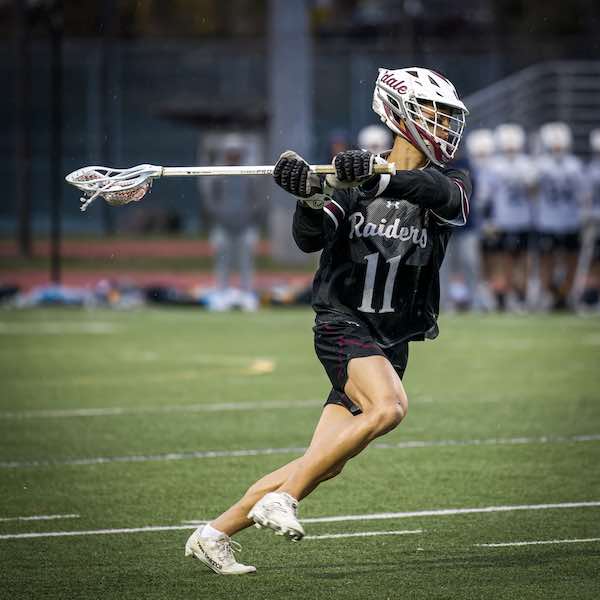 Senior Oliver Chai (#11) looks to make a pass upfield.
 Senior Tommy Iasiello (#24) closely eyes his shot on goal in between 3 defenders.
Senior Jackson Starr (#8) gets ready to shoot and score.
 Sophomore Turner Mauro (#14) breaks free from 2 Pelham players.
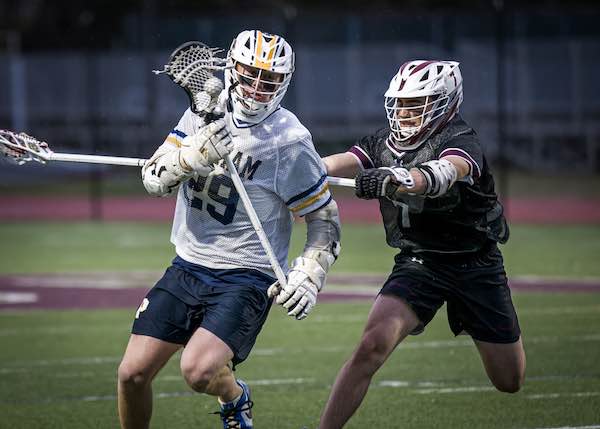 Sophomore Gavin Wellen (#7) tries to apply pressure and stay with his man.
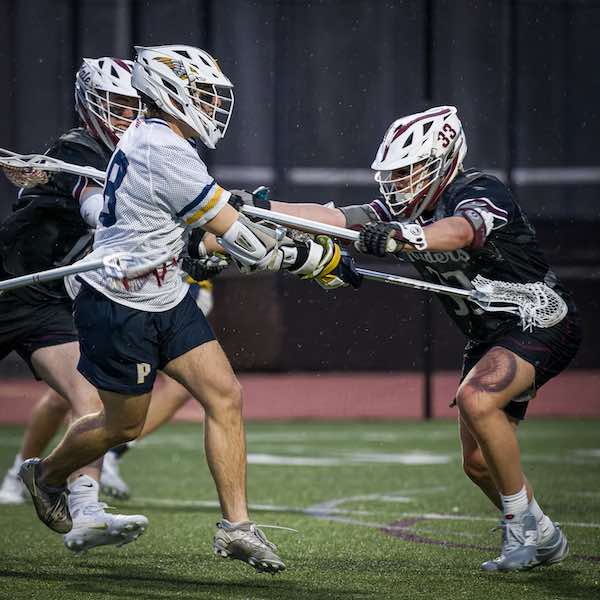 Freshman Sam Stahler (#33) applies pressure while his opponent takes a shot.
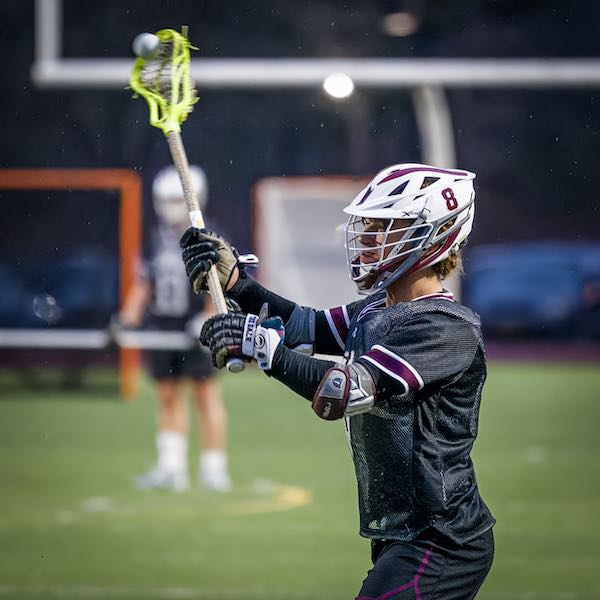 Jackson Starr (#8) makes a pass in an offensive set.
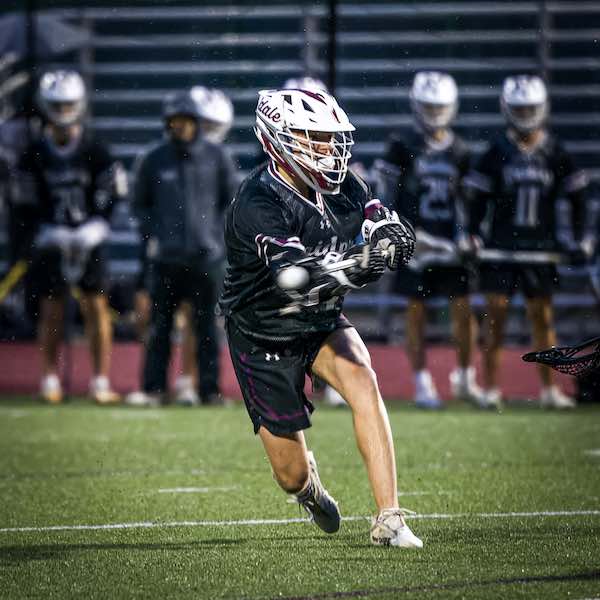 Turner Mauro (#14) fires in a long range shot.
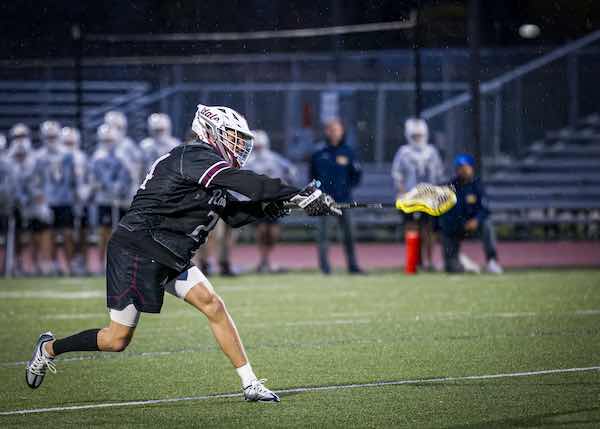 Tommy Iasiello (#24) takes an overhand shot.
 Junior Colin Brennan (#22) breaks free into open space before taking a shot.
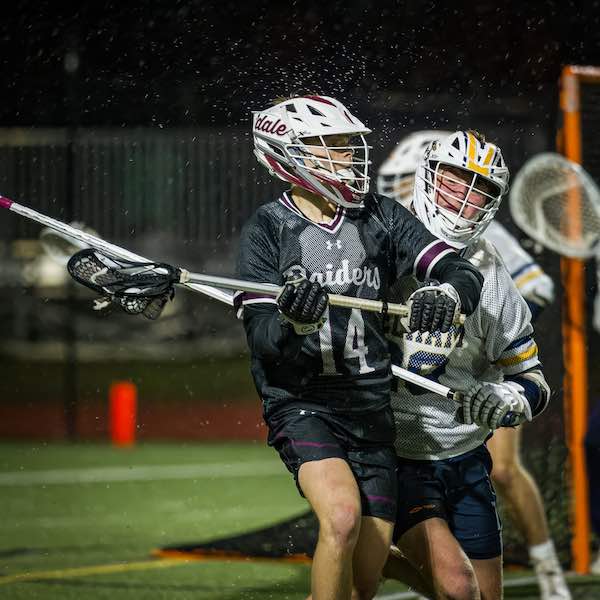 Turner Mauro (#14) tries to make a pass while under pressure.