







Talking Turkey Without Ruffling Feathers
- Details
- Written by: Joanne Wallenstein
- Hits: 263
 With Thanksgiving coming up, here are some tips on a respectful holiday discussion from Scarsdale Grace:
5 Ways to Disagree Without Being Disagreeable This Thanksgiving
Listen to Understand, Not to Win. Give everyone a chance to finish sharing their thoughts before you jump in. You may be surprised by what you learn.
Be Curious, Not Critical. If you hear something you disagree with, try asking, “What makes you feel that way?” A little curiosity can help the conversation feel more welcoming for everyone.
Disagree Without Disrespect. It’s perfectly okay to see things differently. Focus on the idea rather than the person, and remember that different opinions don’t have to get in the way of caring about one another.
Know When to Change the Subject. Not every disagreement has to be settled between the turkey and dessert. Sometimes the kindest choice is to pass the potatoes, take a breath, and talk about something else.
Remember What Brings You Together. Family, friendship, gratitude, and love are worth far more than winning an argument. Let those shared connections have the final word.
With a little patience and kindness, Thanksgiving conversations can leave everyone feeling heard, respected, and glad to gather again next year!
Happy Thanksgiving!
Scarsdale GRACE Committee Invites You to Participate in Community Conversations and to Take a Survey
- Details
- Written by: Joanne Wallenstein
- Hits: 723
(This letter was sent by the The Scarsdale GRACE Working Group)
Dear Scarsdale Community,
Scarsdale is a community that cares deeply about its people. Time and again, we come together with generosity, compassion, and a willingness to support one another during life’s celebrations, challenges, and moments of need.
Several events this past spring reminded us that caring for a community also means being thoughtful about how we treat one another, particularly in moments of disagreement or tension. GRACE is about strengthening how we navigate those moments—with respectful dialogue, constructive accountability, compassion, empathy, and a commitment to moving forward together.
Over the past several months, the Scarsdale Foundation has engaged a diverse group of over 80 community members from over 50 community groups to explore how Scarsdale might build on these many strengths, with this dedicated commitment.
Those conversations led to the creation of Scarsdale GRACE—Growing Respect, Accountability, Compassion & Empathy. Our mission is to explore ways Scarsdale can strengthen a culture of community connection, while fostering an environment in which all community members can learn, grow, navigate differences, and move forward together.
GRACE will partner with schools, faith communities, local government, and other community groups to host a series of facilitated conversations throughout the community.
These community conversations are intended to bring together people with a variety of experiences and perspectives to listen to one another, share ideas, and help shape the future of GRACE.
The ideas and themes that emerge from these conversations will be shared at a community-wide gathering, where all community members will be invited to continue the conversation and help identify opportunities for moving this work forward together.
We warmly invite you to participate in our Community Conversations and our community survey.
How to Participate:
Click HERE to sign up to participate in a Community Conversation.
Click HERE to participate in our community survey.
Communities grow stronger when people listen with curiosity, engage with respect, and remain open to understanding one another.
We hope you will join us as we continue building Scarsdale GRACE together.
With gratitude,
The Scarsdale GRACE Working Group
GRACE FAQ
What is Scarsdale GRACE?
Growing Respect, Accountability, Compassion & Empathy
A community effort to strengthen respectful dialogue, constructive accountability, compassion, empathy, and community connection.
Why GRACE?
Scarsdale is a community that cares deeply about its people. Time and again, we come together with generosity and compassion during times of illness, loss, or hardship.
Several events this past spring reminded us that caring for a community also means being thoughtful about how we treat one another, particularly in moments of disagreement or tension. GRACE is about strengthening how we navigate those moments—with respectful dialogue, constructive accountability, compassion, empathy, and a commitment to moving forward together.
Our Guiding Principles
● Kindness and accountability are not mutually exclusive.
● Every person deserves dignity and respect, even when opinions differ.
● Healthy communities create space for learning, repair, and growth.
● We can disagree without being disagreeable.
Over the past several months, the Scarsdale Foundation engaged a group of community members, faith leaders, and representatives of local organizations, schools, and neighborhood associations. The group includes more than 80 representatives from over 50 community groups, reflecting a broad cross-section of Scarsdale. The group is now seeking input from the wider community to shape GRACE’s priorities and guide its next steps.
The ideas and themes that emerge will be shared at a community-wide gathering this December, where all community members will be invited to continue the conversation and help shape the future of GRACE.
Get Involved
● Attend a facilitated conversation or complete the community survey.
● Participate in the community-wide gathering.
● Share ideas, resources, or suggestions.
● Receive updates about GRACE.
We hope you will join us as we continue building Scarsdale GRACE together.
Learn more here.
Printing Possibilities: How One SHS Teen is Changing Lives Around the World
- Details
- Written by: Shilpa Spencer
- Hits: 1528
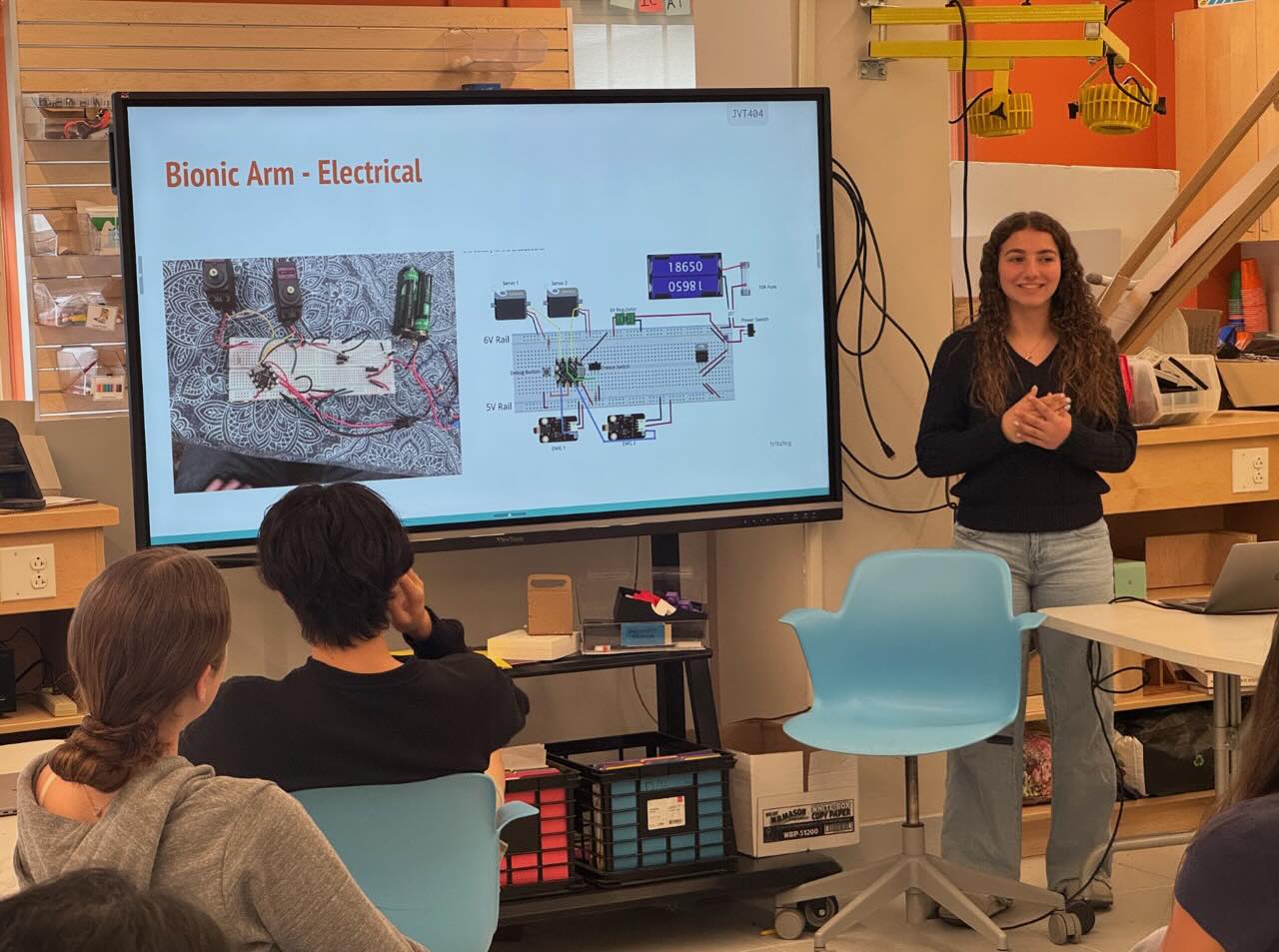 For most teenagers, a 3D printer might be a way to create decorations, gadgets, or small personal projects. But for 17-year-old Scarsdale resident Laila El Moselhy, it has become a tool for changing lives. From her home in Fox Meadow, Laila prints and assembles prosthetic hands and arms for people around the world who might otherwise struggle to access them. What began as volunteer work at just 14 years old has grown into an international effort that has reached more than ten countries, garnered the attention of a documentary being screened at a major film festival, and most importantly, dramatically improved the lives of more than 20 strangers.
A few years ago, Laila's parents purchased a 3D printer, opening the door to what started as a hobby and quickly morphed into one of the most meaningful endeavors of her life. Fascinated by the technology and its possibilities, Laila immersed herself in learning how to use it. But her curiosity was matched by something equally important: a deep desire to use her abilities to make a positive difference in the world.
That combination of tenacity, intellectual curiosity, and compassion eventually led her to e-NABLE, a global community of volunteers who use 3D-printing technology to create affordable upper-limb assistive devices. While commercial prosthetics can cost thousands of dollars, the materials for one of her devices cost approximately $50. Every prosthetic she creates is provided to its recipient free of charge.
Laila started by printing all the different available devices on e-Nable's database. She says this took her 6 months, and the learning curve was steep. She laughs at the quality of her first device when compared to the devices she can make now. "3D printing is something you learn by a lot of practice, there are a lot of settings and what works for my printer wouldn't necessarily work with a different one," Laila recounted. She says she learnt about the different printer settings, the temp of the printing bed, how fast or slow the print head moves, the different materials used for filaments, she even sometime stands by the printer to adjust the height of the printhead in millimeters while it is printing, because this affects the print's adhesion to the bed.
That summer, Laila’s persistent inquires landed her an internship at Hand NGO in Cairo, Egypt. There she saw firsthand the full cycle of producing a 3D printed prosthetic: measurements, 3D scanning of the affected limb, customizing the device on CAD, printing, assembling, and finally delivering the prosthetic to the recipient. This experience gave Laila the confidence to start making the prosthetics for real cases. But behind each device is a person with a unique story.
One of Laila’s first recipients was an 11-year-old boy in the Philippines who had lost his right arm in an electrical accident. After learning about his 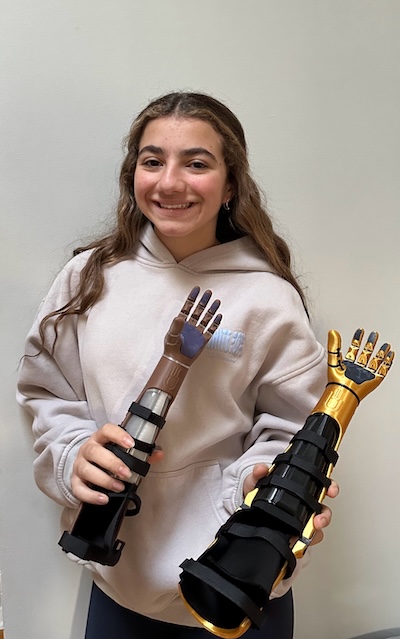 situation, she spent weeks printing and assembling two different prosthetic arms to ensure he would have an option that worked for him. When the devices finally arrived, the boy chose the gold-colored arm. According to Laila's website, 3dprintwithpurpose.com, he was so excited that he sent her a video of him dancing in his house. "Getting this video was so rewarding. It’s incredible feeling to see that you can actually affect someone's daily life across the world", she said.
Stories like his illustrate why Laila's work extends far beyond technology. That school year, Laila did an independent study through SHS, under the supervision of Mr. Brian McDonald, to learn more about 3D printing and prosthetics, which enabled her to work on many more cases.
Each project requires careful planning, communication, and patience. Because many recipients live thousands of miles away, she works with families remotely to collect measurements and photographs. She then adjusts an existing prosthetic design, prints the necessary pieces, assembles the device, and ships it internationally. Even after delivery, she follows up to make sure the prosthetic fits properly and provides replacement parts when needed.
It is a painstaking process, one that can involve setbacks, adjustments, and countless hours of work. Yet it is precisely the kind of challenge that appeals to Laila's nature. Her willingness to dive deeply into a problem, persist through difficulties, and devote herself fully to finding a solution has become one of the defining qualities of her work. And in this case, that determination is driven by something larger than personal accomplishment: the knowledge that her efforts can have a tangible impact on another person's life.
Her dedication has also opened doors to opportunities beyond her home workshop. One of the cases involved a girl from Pakistan, whose residual arm was longer than what would work for the customizable design. Undaunted, Laila reached out to Mat Bowtell, in Phillips Island, Australia, the designer of the Kinetic Arm, asking if they can help. Incredibly, his organization, free3dhands.org, adjusted the design to fit this case specifically. They sent the files to Laila, who printed it and shipped it to Pakistan. This interaction led to Laila interning the following summer at Free3DHands.org. During the internship in Austria with 3DHands.org, El Moselhy was interviewed for a documentary exploring the transformative potential of 3D printing. The film, The Last Inventor: Chuck Hull & The Hope of 3D Printing, focuses on Chuck Hull, a pioneering inventor widely recognized for his role in developing modern 3D-printing technology, and the ways that innovation continues to improve lives.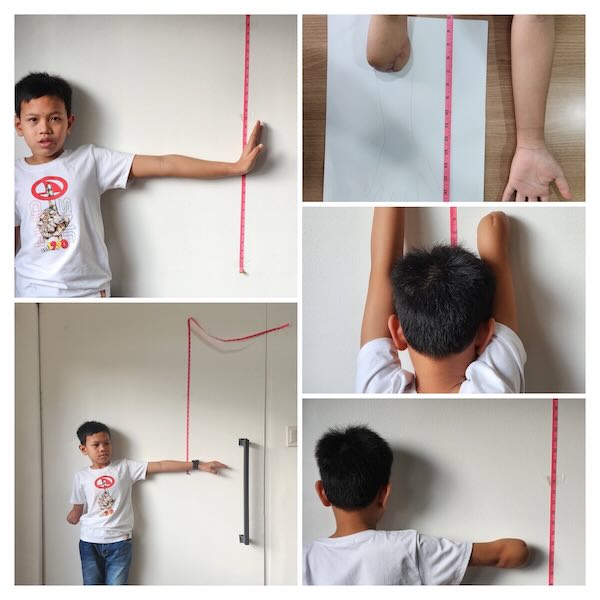 The documentary is scheduled to screen at the 2026 Newport Beach Film Festival, bringing stories about the human impact of 3D printing to a wider audience. For El Moselhy, being included in the film represents an exciting opportunity to share the work she has been doing and the stories of the people she has helped.
More recently, she received another unexpected piece of news: a companion book to The Last Inventor has been written, and her story will be featured in it as well. The inclusion will give readers another opportunity to learn about her story and the possibilities that emerge when innovative technology is paired with a desire to help others.
While Laila's work has attracted attention well beyond her hometown, she has also found opportunities to inspire others closer to home. Recently, she shared her journey with fellow students at Scarsdale High School's Global Citizenship Day, presenting the story of how a personal interest in 3D printing evolved into an effort to help people around the world. Her presentation offered her peers a firsthand example of how curiosity, initiative, and a willingness to commit deeply to a cause can translate into meaningful change.
Her story also demonstrates how accessible technology can help address a much larger global problem. For individuals who cannot afford commercial prosthetics or live in areas with limited medical resources, volunteer-made assistive devices can offer practical assistance and new possibilities in everyday life.
Through her website, 3dprintwithpurpose.com, she continues to document the individuals she helps and the process behind each prosthetic. Her work serves as a reminder that innovation is not defined solely by technological advancement, but also by the purpose behind it.
Make Your Own Hydrangea Wreath
- Details
- Written by: Marishal Gupta
- Hits: 951
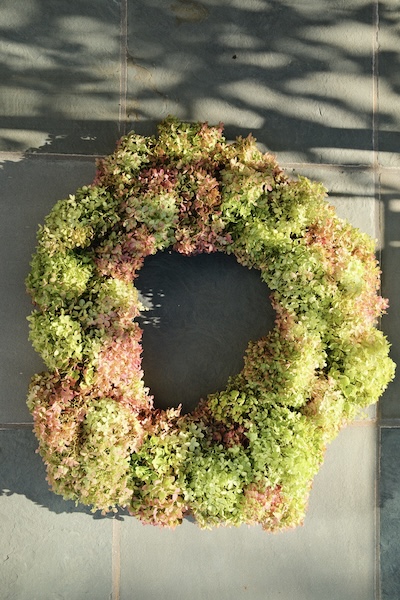 The hydrangeas fading to green and antique rose in your front yard are not spent. For a dried wreath, they are finally ready.
A dried hydrangea wreath takes about an hour to make and the only thing you have to buy is the grapevine form. You are close to the last good chance to cut the blooms, so set aside a free afternoon in the next week or two. It’s a fun activity for kids to help with, and the autumnal tones will carry you from pumpkins to Thanksgiving.
If you don't have hydrangeas in your garden, ask a friend or neighbor who does — most people are glad to have the heads taken off their hands this time of year.
When to cut, and what to look for
Hydrangeas typically bloom in Scarsdale (Zone 7a) from May until September, so by the first weeks of October, the heads have faded and begun to dry on the shrub, which is exactly the right state for this project. You don't want a bloom at its peak, as it is full of water and will wilt and shrivel up within a day.
Judge by touch. Take a floret between your fingers. If it feels slick or faintly rubbery, leave it another week. If it feels more like tissue paper, cut.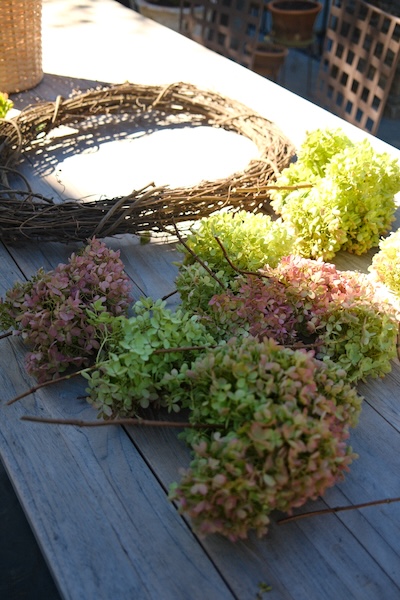
Avoid any blooms that are already brown on the shrub, and do not use hydrangeas that have already been cut and dried, as they will shatter at a touch and the stems won't be pliable enough to slide into the wreath.
Nearly every common variety dries well, so use what is available to you. Bigleaf mopheads and panicle types such as Limelight all hold their shape, and
Oakleaf hydrangeas dry to a deep rust. Smooth hydrangeas like Annabelle are a particular favorite for wreaths: the enormous white heads fade to a soft buff and keep their volume.
Materials
-A grapevine wreath form, easily available online for about eight dollars. Eighteen inches is a standard front-door size; twelve to fourteen suits a wall or a mantel.
-A pair of clean, sharp snips.
-Approximately thirty hydrangea blooms.
-A basket to harvest into (optional).
-Zip ties (optional).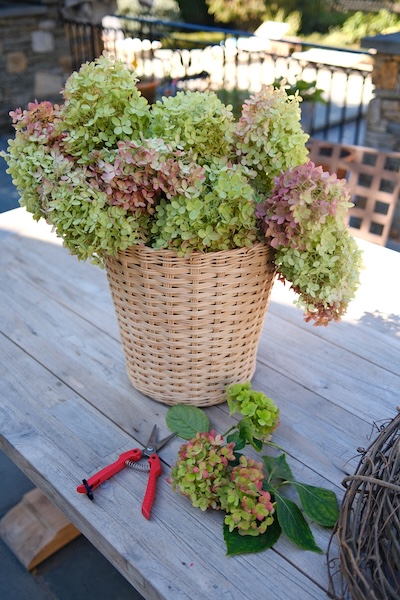 The Method
Cut each stem on the diagonal, twelve to fourteen inches below the bloom. The extra length makes the blooms easier to carry and gives you room to trim later. If you grow mopheads or lacecaps, let the buds decide where you cut instead: they bloom on old wood, next summer's buds have already formed along the stems, and your cut belongs just above them. Leave a fair number of heads on the shrub too, since the spent flowers shelter those buds through the winter.
Gather about thirty heads in a mix of sizes. The range is what lets you build a dense, even wreath. If using a smaller wreath form, you can start with fewer and cut more as needed.
Strip the leaves from every stem.
Trim each stem four to five inches below the bloom. That is the length that slides into the grapevine and anchors the head as it dries and shrinks.
Push each stem into the grapevine so the bloom sits directly against the form rather than floating above it. The twists of the vine do the holding. Place each stem in the same direction for a fuller look. It is sometimes easier to aim the stem against the direction the vine is woven, as it creates a bit of tension. The heaviest heads are the ones most likely to work loose; if one will not stay put, run a zip tie around its stem and a piece of the vine and trim the tail close.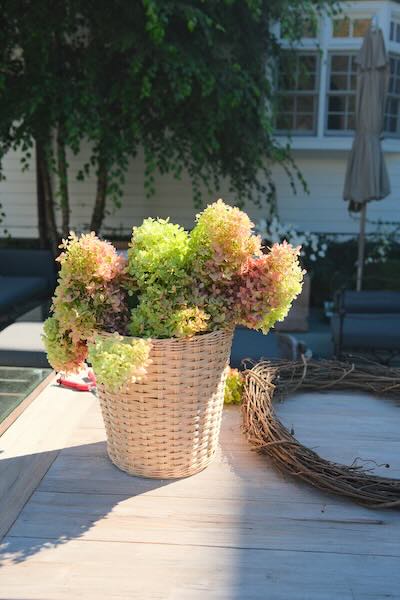
Set the large blooms first, working until the form is encircled. Adding one stem on one side and the next on the opposite side keeps the weight balanced as you go.
Use the medium and small blooms to fill in any gaps, taking care to cover the inner and outer edges of the wreath, not just the face, as they will be visible once the wreath is hanging.
A few notes and tips
Expect it to tighten, and plan for gaps. As the blooms dry they lose volume, and spaces may appear that were not there on assembly day. If this happens, you can slide in a few additional small heads once the wreath has settled.
Let it dry undisturbed. The wreath finishes drying on the form over the following week or two. Handling it while the stems are still shrinking loosens blooms that would otherwise have set.
Hang it out of the sun and weather. A covered porch is ideal. Full afternoon sun will bleach the color within a month, and a heavy rain will reduce the blooms to pulp.
You do not have to cover the whole form. A partly filled wreath — blooms across the top and down one side, bare grapevine showing below — looks deliberate rather than unfinished, and it is the right answer for a young shrub that cannot spare thirty heads. A few sprigs of foliage will soften the transition.
Outdoors under cover, expect a single season. Kept indoors, however, one of these wreaths will last for years rather than months. The color continues to soften over time, settling into the faded palette of an old quilt, and a wreath that has thinned can be  revived each fall by pushing a few fresh heads into the gaps.
Imperfections are part of the charm. A first attempt is almost always a little lopsided. Have fun with it! There will always be more blooms next year.
Marichal grew up in the Berkshires and now lives in Scarsdale with her husband, two kids, and adorable mini Aussie. A former baker, she loves cardamom buns, sungold tomatoes straight off the vine, and hunting for vintage Swedish ceramics.
Food, Wine and People News
- Details
- Written by: Joanne Wallenstein
- Hits: 2882
Lots doing in the Village of Scarsdale this week.
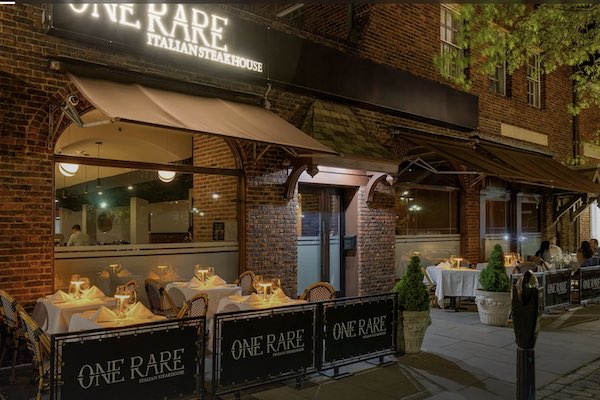
Spotted: Jalen Brunson and the Knicks were enjoyed dinner at One Rare Steakhouse on East Parkway this weekend. Brunson moved to Scarsdale recently and residents are thrilled to have this star in town.

Moved: Also on East Parkway, Scarsdale Wine Merchants has moved from their previous location on Depot Place. The large new location has plenty of wines and spirits and is just a few doors down from the former home of Zachys. Owner Kristie Petrullo Campbell is excited to welcome you to the new store and plans to start weekend tastings soon.
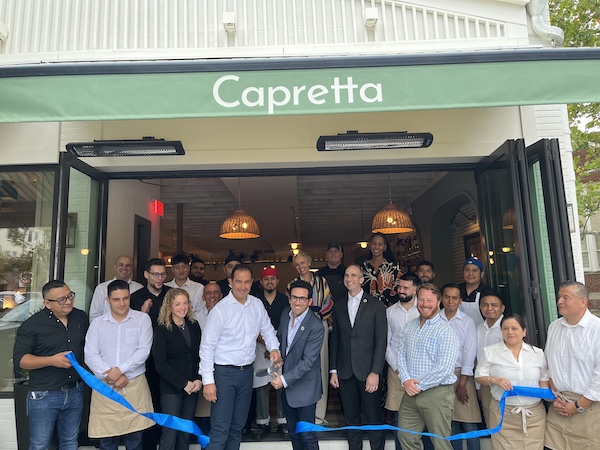
Opened: On Tuesday September 22, Capretta Italian restaurant celebrated their opening in the location previously occupied by Akai. Mayor Justin Arest, Deputy Mayor Dara Gruenberg and Trustee Tim Foley cut the ribbon to make it official. The restaurant is brought to you by the Z Hospitality Group, who also own Mediterraneo, Terra and Eastend in Greenwich, Aurora In Rye and several more eateries in Connecticut. The restaurant has been an instant hit.
Coming Soon: At the September 22, 2026 meeting of the Scarsdale Village Board, Core Burn Pilates received permission to open a 1,539 square foot studio at 100 Christie Place in the space formerly occupied by the Bank of America. Caffe Nero, a coffee shop and cafe will also open at the corner of East Parkway and Chirstie Place.
- Fresh Finds at Sprouts: Why Giving Westchester’s Newest Grocery Store a Second Look Pays Off
- Paper Community Calendar is Back: PTC to Print Calendars After Community Pushback
- Is Scarsdale’s Paper Community Calendar Gone for Good? Residents Want It Back
- Latimer Calls for Detention Centers to be Closed