







Printing Possibilities: How One SHS Teen is Changing Lives Around the World
- Sunday, 25 October 2026 14:40
- Last Updated: Sunday, 25 October 2026 15:02
- Published: Sunday, 25 October 2026 14:40
- Shilpa Spencer
- Hits: 40
 For most teenagers, a 3D printer might be a way to create decorations, gadgets, or small personal projects. But for 17-year-old Scarsdale resident Laila El Moselhy, it has become a tool for changing lives. From her home in Fox Meadow, Laila prints and assembles prosthetic hands and arms for people around the world who might otherwise struggle to access them. What began as volunteer work at just 14 years old has grown into an international effort that has reached more than ten countries, garnered the attention of a documentary being screened at a major film festival, and most importantly, dramatically improved the lives of more than 20 strangers.
A few years ago, Laila's parents purchased a 3D printer, opening the door to what started as a hobby and quickly morphed into one of the most meaningful endeavors of her life. Fascinated by the technology and its possibilities, Laila immersed herself in learning how to use it. But her curiosity was matched by something equally important: a deep desire to use her abilities to make a positive difference in the world.
That combination of tenacity, intellectual curiosity, and compassion eventually led her to e-NABLE, a global community of volunteers who use 3D-printing technology to create affordable upper-limb assistive devices. While commercial prosthetics can cost thousands of dollars, the materials for one of her devices cost approximately $50. Every prosthetic she creates is provided to its recipient free of charge.
Laila started by printing all the different available devices on e-Nable's database. She says this took her 6 months, and the learning curve was steep. She laughs at the quality of her first device when compared to the devices she can make now. "3D printing is something you learn by a lot of practice, there are a lot of settings and what works for my printer wouldn't necessarily work with a different one," Laila recounted. She says she learnt about the different printer settings, the temp of the printing bed, how fast or slow the print head moves, the different materials used for filaments, she even sometime stands by the printer to adjust the height of the printhead in millimeters while it is printing, because this affects the print's adhesion to the bed.
That summer, Laila’s persistent inquires landed her an internship at Hand NGO in Cairo, Egypt. There she saw firsthand the full cycle of producing a 3D printed prosthetic: measurements, 3D scanning of the affected limb, customizing the device on CAD, printing, assembling, and finally delivering the prosthetic to the recipient. This experience gave Laila the confidence to start making the prosthetics for real cases. But behind each device is a person with a unique story.
One of Laila’s first recipients was an 11-year-old boy in the Philippines who had lost his right arm in an electrical accident. After learning about his 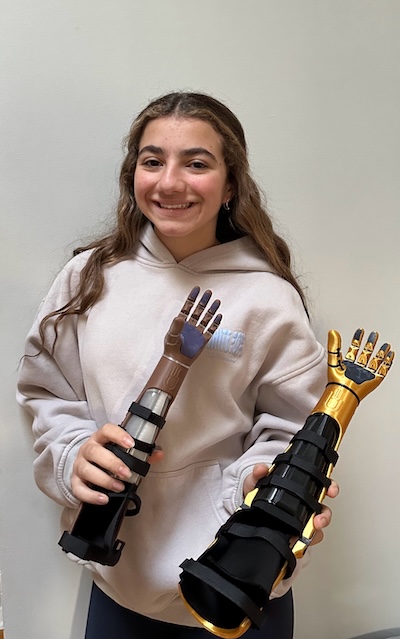 situation, she spent weeks printing and assembling two different prosthetic arms to ensure he would have an option that worked for him. When the devices finally arrived, the boy chose the gold-colored arm. According to Laila's website, 3dprintwithpurpose.com, he was so excited that he sent her a video of him dancing in his house. "Getting this video was so rewarding. It’s incredible feeling to see that you can actually affect someone's daily life across the world", she said.
Stories like his illustrate why Laila's work extends far beyond technology. That school year, Laila did an independent study through SHS, under the supervision of Mr. Brian McDonald, to learn more about 3D printing and prosthetics, which enabled her to work on many more cases.
Each project requires careful planning, communication, and patience. Because many recipients live thousands of miles away, she works with families remotely to collect measurements and photographs. She then adjusts an existing prosthetic design, prints the necessary pieces, assembles the device, and ships it internationally. Even after delivery, she follows up to make sure the prosthetic fits properly and provides replacement parts when needed.
It is a painstaking process, one that can involve setbacks, adjustments, and countless hours of work. Yet it is precisely the kind of challenge that appeals to Laila's nature. Her willingness to dive deeply into a problem, persist through difficulties, and devote herself fully to finding a solution has become one of the defining qualities of her work. And in this case, that determination is driven by something larger than personal accomplishment: the knowledge that her efforts can have a tangible impact on another person's life.
Her dedication has also opened doors to opportunities beyond her home workshop. One of the cases involved a girl from Pakistan, whose residual arm was longer than what would work for the customizable design. Undaunted, Laila reached out to Mat Bowtell, in Phillips Island, Australia, the designer of the Kinetic Arm, asking if they can help. Incredibly, his organization, free3dhands.org, adjusted the design to fit this case specifically. They sent the files to Laila, who printed it and shipped it to Pakistan. This interaction led to Laila interning the following summer at Free3DHands.org. During the internship in Austria with 3DHands.org, El Moselhy was interviewed for a documentary exploring the transformative potential of 3D printing. The film, The Last Inventor: Chuck Hull & The Hope of 3D Printing, focuses on Chuck Hull, a pioneering inventor widely recognized for his role in developing modern 3D-printing technology, and the ways that innovation continues to improve lives.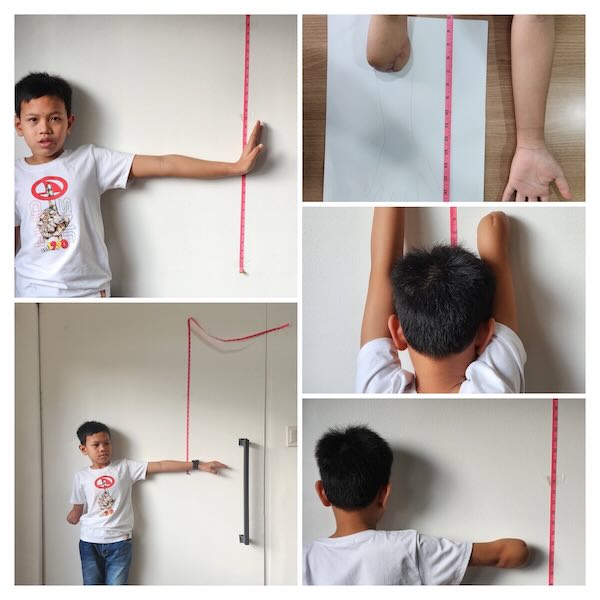 The documentary is scheduled to screen at the 2026 Newport Beach Film Festival, bringing stories about the human impact of 3D printing to a wider audience. For El Moselhy, being included in the film represents an exciting opportunity to share the work she has been doing and the stories of the people she has helped.
More recently, she received another unexpected piece of news: a companion book to The Last Inventor has been written, and her story will be featured in it as well. The inclusion will give readers another opportunity to learn about her story and the possibilities that emerge when innovative technology is paired with a desire to help others.
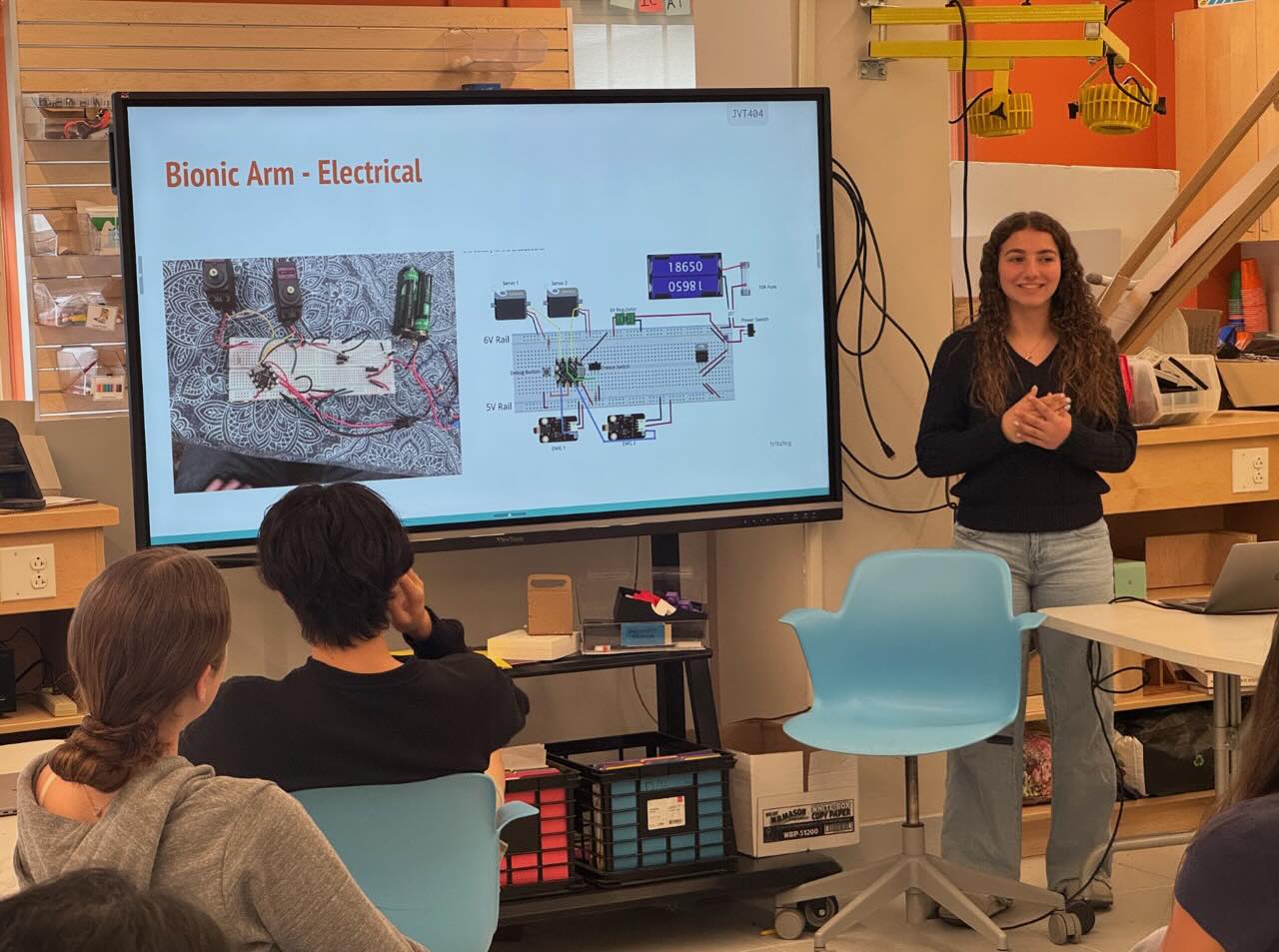
While Laila's work has attracted attention well beyond her hometown, she has also found opportunities to inspire others closer to home. Recently, she shared her journey with fellow students at Scarsdale High School's Global Citizenship Day, presenting the story of how a personal interest in 3D printing evolved into an effort to help people around the world. Her presentation offered her peers a firsthand example of how curiosity, initiative, and a willingness to commit deeply to a cause can translate into meaningful change.
Her story also demonstrates how accessible technology can help address a much larger global problem. For individuals who cannot afford commercial prosthetics or live in areas with limited medical resources, volunteer-made assistive devices can offer practical assistance and new possibilities in everyday life.
Through her website, 3dprintwithpurpose.com, she continues to document the individuals she helps and the process behind each prosthetic. Her work serves as a reminder that innovation is not defined solely by technological advancement, but also by the purpose behind it.