











Swatting Incident Causes Emergency Response in Eastchester
- Details
- Written by: Joanne Wallenstein
- Hits: 7916
 A man who claimed that he had stabbed his girlfriend and tied up her entire family in Eastchester, caused the mobilization of a major emergency response on Saturday April 4th at 5:16 pm. Police received the man's call from a private number and could not ascertain whether it originated from the home at 1 Joyce Road in Eastchester. Since the caller said he had a gun and was holding the family hostage, police set up a perimeter around the house and blocked off surrounding streets.
Eastchester Police called in for assistance from:
- Eastchester Command and Detective Division
- Westchester, Tuckahoe, Bronxville and Pelham Emergency Response Units
- Westchester County Department of Public Safety Special Operation, SWAT, Aviation and K-9
- New Rochelle Tactical Unit
- Greenburgh SWAT and Hostage Negotiation
SWAT team members, wearing bulletproof vests and helmets were on hand and a helicopter landed at a nearby school.
However, shortly thereafter, Eastchester police were able to reach the homeowners who denied making the call. Members of the SWAT team then entered the house with support from an armored vehicle provided by Westchester County. They determined that the call was a hoax or an incident of "swatting."
Eastchester Detectives are conducting a "vigorous" investigation of the origin of the call and identity of the caller, who police say will be "prosecuted to the full extent of the law."
Discussing the event, Eastchester Police Chief Timothy Bonci said, "It is unfortunate that these incidents take place, and really waste the resources of all the jurisdictions that responded. I can only speculate what would motivate someone to do this."
He added, "The response from all the assisting agencies was overwhelming and it was reassuring to know that had the incident been an actual incident, due to the coordinated efforts of all involved, we were very prepared to respond appropriately."
Jewish Film Festival Starts on April 8 at Jacob Burns Film Center
- Details
- Written by: Joanne Wallenstein
- Hits: 6260
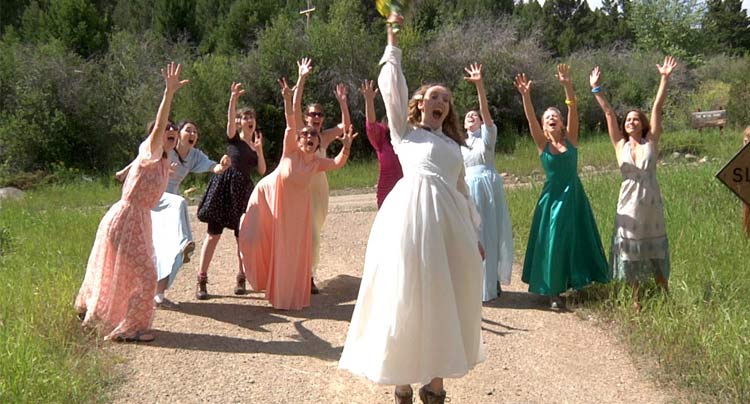 Tickets are now on sale for The Westchester Jewish Film Festival at The Jacob Burns Film Center which will run from April 8th - 30th and feature an extraordinary crop of moving, humorous and enlightening films from all over the world, plus discussions, special guests, receptions and live music. You'll find the full listing at Westchester Jewish Film Festival.
Here are recommendations for films you may like to see and programs to attend from Karen Goodman, a former Scarsdale resident who selected the movies and programs for the festival.
She found a group of films at this year's Toronto International Film Festival including several historical dramas: Phoenix, the opening night selection which is a stunning post-war drama about mistaken identity from Germany, and the unexpected break out hit from the Netherlands Secrets of War, along with Israeli films including the riveting courtroom drama Gett: The Trial of Viviane Amsalem with Ronit Elkabetz, and the courageous dark comedy The Farewell Party. Another one of her personal favorites is Felix & Meira, a tender drama about an unhappy Hasidic wife featuring young actress from last year's hit Fill The Void.
The festival includes some documentaries that highlight the broad history and legacy of Jews and the entertainment industry, some with live musical performances: Forbidden Films, the chilling chronicle of film making under the Nazi regime, The Go-Go Boys: The Inside Story of Cannon Films, which chronicles the rise and fall of moguls Menachem Golan and Yoram Globus, Theodore Bikel: In The Shoes of Sholem Alechem which will be presented with a live concert from The Aaron Alexander Klezmer Trio, and finally The Outrageous Sophie Tucker, a delightful look back at the iconic stage and screen star dubbed 'Last of the Red Hot Mamas' for which they have arranged to welcome the cabaret performer and renowned impressionist Christine Pedi to share Tucker's musical legacy and milieu.
Scarsdale residents may be interested in seeing 112 Weddings which will include a session with WRT's Rabbi Blake who is in the film. The new Ben's Deli on Central Avenue in Scarsdale will sponsor a Community Night reception with the film Deli Man.
Also on the program are Lloyd Handwerker with his unique documentary Famous Nathan about his grandfather's legendary Coney Island empire, and veteran actor Mark Blum who gives a spot-on performance in the quintessentially New York comedy Blumenthal. And finally, the iconic Israeli singer/songwriter David Broza will be speaking and performing on closing night after East Jerusalem/ West Jerusalem which highlights his music and peace initiatives in the Middle East.
All of the events and many films sell out quickly, so reserve your tickets today.
Greenacres Goes Global and Greener for St. Patrick's Day
- Details
- Written by: Joanne Wallenstein
- Hits: 3982
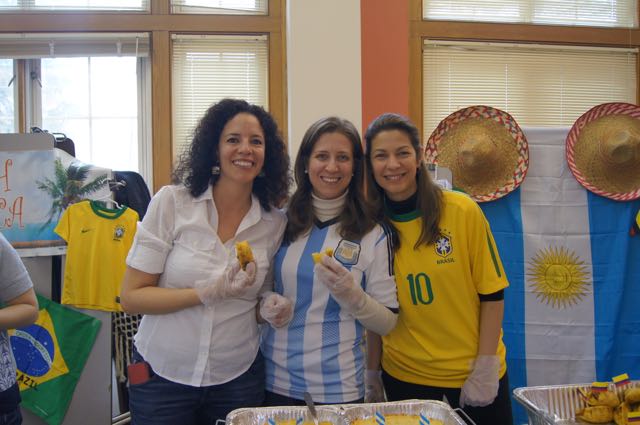
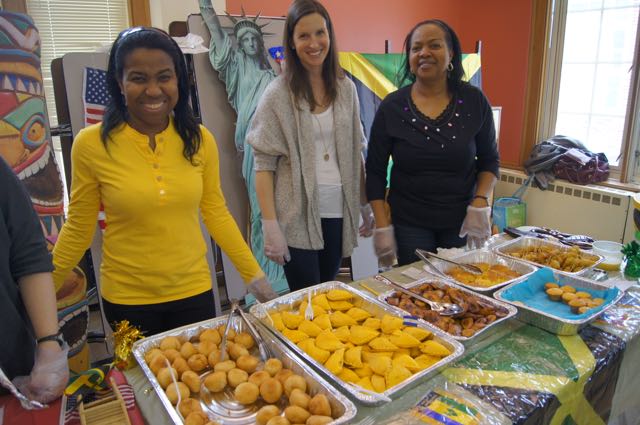
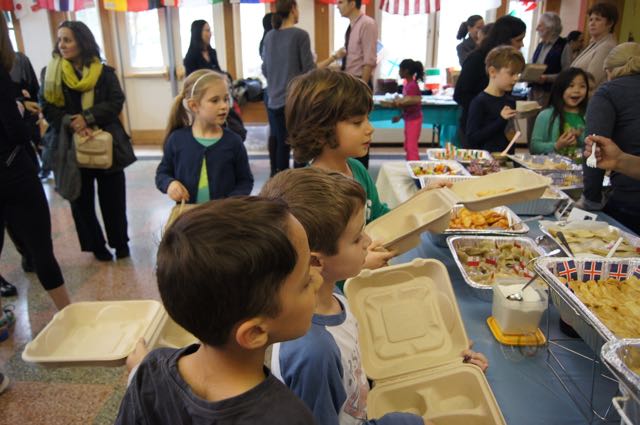
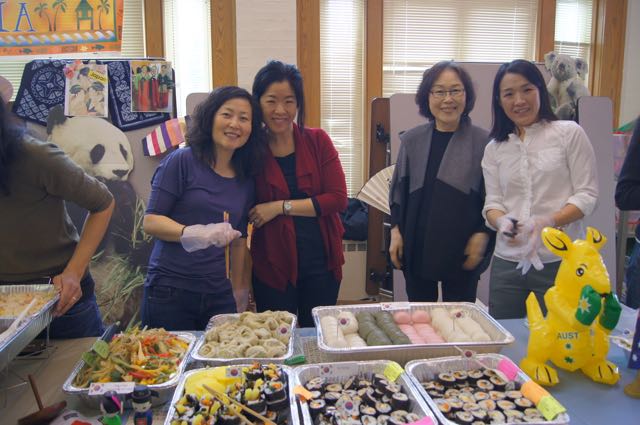 Perhaps this year St. Patrick's Day got the short end of the stick at Greenacres Elementary School, when it coincided with the PTA's annual spring multicultural luncheon. For some children the luncheon is their favorite event of the year, and judging by the mad rush in the lunchroom this year was no exception.
Families of students contributed over 130 dishes to the luncheon. Entrees and desserts originated from countries as diverse as Iceland, Nigeria, India, Peru, and New Zealand.
 The luncheon was perhaps unique in that it might have been the first school wide zero-waste event ever held in the district. PTA Environmental Committee Chair Michelle Sterling explained that, "a zero-waste event is one that uses sustainable practices to send the least possible amount of waste to a landfill. In order to have a zero waste event all items at the event either need to be reusable, compostable or recyclable - which is what we did!" All food was prepared and brought to the event in either reusable or recyclable aluminum trays. Students were given compostable clamshells and compostable birchwood forks for their food. Even the "plastic" cups used for juice and the gloves servers wore were fully compostable. Food scraps, clamshells, cups and utensils went into the compost bin and all non-reusable serving trays were recycled.
 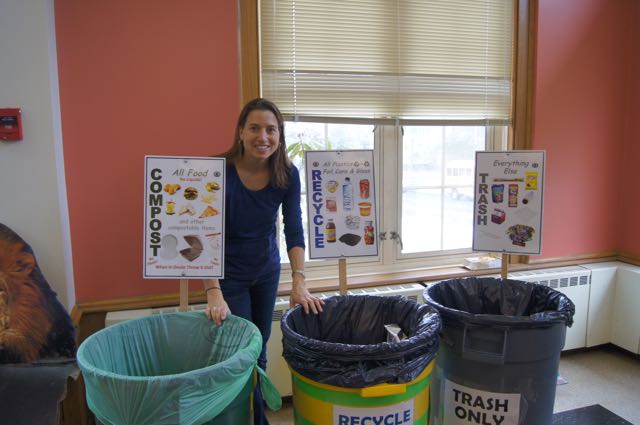 Ms. Sterling explained that, "normally at a school wide event such as this (serving about 500 people) we would have generated around 50 large bags of trash. Today we filled our compost and recycling bins but our trash bins remained empty!"
Composting is not new to Greenacres students, who have been doing it at every lunch since late 2014.
By Midori Im and Michelle Sterling


Ode to the Massage Parlors
- Details
- Written by: Joanne Wallenstein
- Hits: 5963
 Scarsdale satirist Deborah Skolnik wrote this poem in honor of the police closing six so-called 'massage parlors' on Central Avenue in Scarsdale last week.
THAT SPECIAL SCARSDALE TOUCH
Scarsdale's a stressful, type-A town,
but try not to let it get you down!
When you're rubbed the wrong way, don't get uptight:
Someone nearby can rub you just right.
To infuse a dull day with ooh and ahh,
guys head to a Central Ave unlicensed 'spa.'
The attractive staff greets them with wide-open arms,
and allegedly some other wide-open charms.
The gals don't do highlights, and no balayage.
What they do is, uh—hmm, they call it massage.
There isn't a mani or pedi in sight,
nor even a blow-dry...well, that one's half-right.
We're far too polite here to guess at their biz. Could
Five Corners' red light not be the sole one there is?
Has Scarsdale branched out multiculturally,
so you can go 'round the world right in 10583?
But now the cops forced all these great spas to close!
I suppose they simply could move if they chose.
Right here in the Village there's unoccupied space—
to let it stay empty is such a disgrace.
How about the old Child's Play? It makes total sense.
Just change Child's to Adults' for the new audience!
If you're sick of snide store clerks, enjoy the new tune:
The spa gals say "Goodbye!" and "Come again—soon!"
© 2015 Deborah Skolnik
 See more poems from Deborah Skolnik on her Facebook Page, Gentle Scarsdale Satire. Search for it on Facebook, request to be added and you'll be promptly approved. In less than 3 weeks the page has grown to more than 400 local residents, amused by its slyly humorous daily verses.
Love Has No Labels
- Details
- Written by: Joanne Wallenstein
- Hits: 5415
 A video entitled Love Has No Labels broke out as a viral sensation this past week, with over 50 million views worldwide in five days. The video and other elements were the work of the Ad Council. Priscilla Natkins (a Scarsdale resident for many years), who oversees the development of all of the campaigns at the Ad Council, provided some interesting background on this extraordinary effort.
The goal of the campaign is pretty straightforward – further acceptance of all communities regardless of race, religion, gender, sexual orientation or age. The ultimate goal is to encourage everyone to examine their own implicit bias. Leading non-profits in this space (including the Anti-Defamation League, Human Rights Campaign and Southern Poverty Law Center) serve as partners to this issue.
The ad agency, R/GA worked on a pro bono basis to develop the creative idea, centered around an event held in Santa Monica on Valentine's Day. From this event, a three minute video was developed, and after being posted on Upworthy's Facebook page, spread like wildfire.
Shorter versions of the video were released a few days ago, to coincide with the 50th Anniversary of the Selma Marches, an event that reminds everyone, that although great progress has been made in promoting equality and reducing acts of discrimination, there's still much to accomplish.
News coverage of the video has been equally impressive. Good Morning America, World News Tonight, CNN, the Washington Post, Cosmopolitan, People magazine, Upworthy,Today.com, Buzzfeed, and Funny or Die...to name just a few. More than a million Facebook users have shared to their own pages, causing both 'Ad Council' and 'Love Has No Labels' to become trending topics. Click here to see a link to the Good Morning America segment.
Priscilla noted "we are deeply proud of all of the work we do on behalf of so many important issues facing our country, but we are particularly grateful for the outpouring of support behind this critical issue. We are still reeling from the success! I am personally so honored to be a part of this".